
 13
Jan,2026
13
Jan,2026
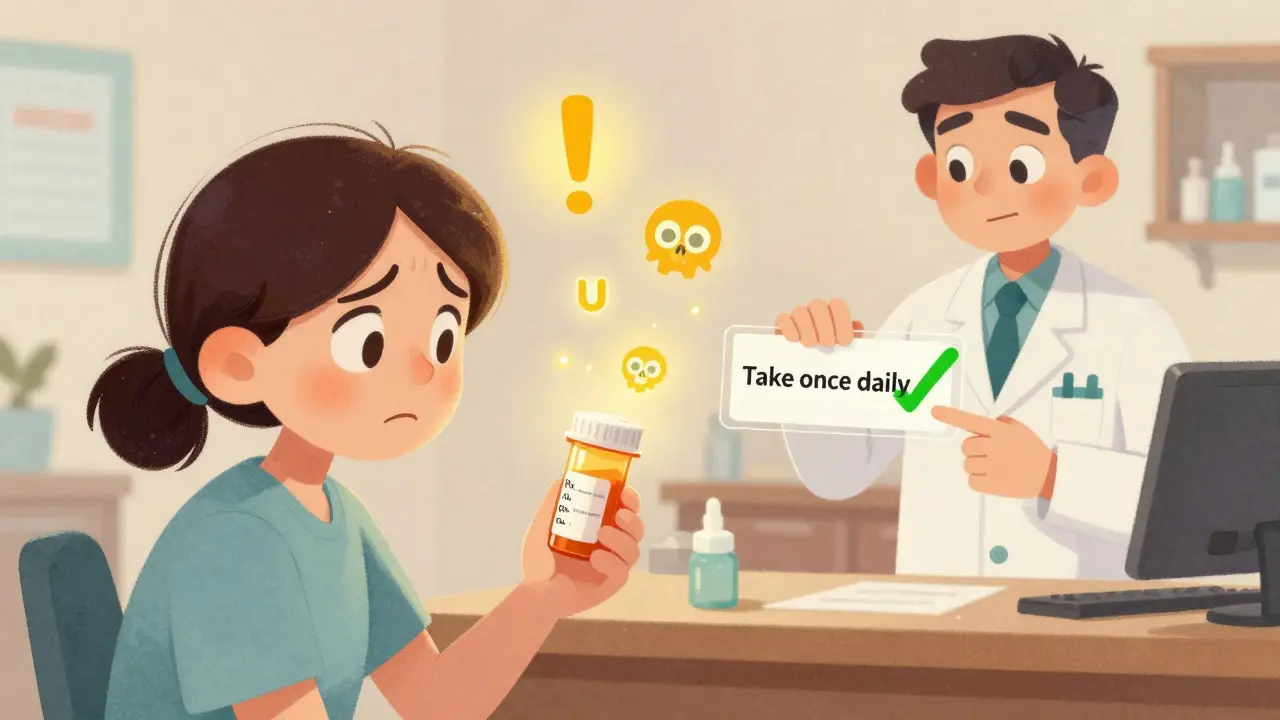
Ever looked at your prescription label and felt like you’re reading a secret code? You’re not alone. That tiny print with symbols like Rx, q.d., o.d., and SC isn’t just confusing-it can be dangerous. These abbreviations come from centuries-old Latin terms, but in today’s fast-paced healthcare system, they’re causing real harm. Every year, thousands of medication errors happen because someone misread a symbol on a prescription. The good news? You don’t need a medical degree to understand what’s on your label. This guide breaks down the most common abbreviations, explains why they’re risky, and shows you exactly what to look for to stay safe.
What Does Rx Really Mean?
You see it on every prescription: Rx. It looks like a fancy R with a line through it. But it’s not a logo. It’s shorthand for the Latin word recipe, which means take. Back in the 1500s, doctors wrote prescriptions in Latin so only trained professionals could read them. Today, it’s just tradition. But here’s the thing: Rx itself isn’t dangerous. The real problems start with what comes after it.
The Dangerous Ones: Abbreviations That Can Kill
Some abbreviations are so risky, they’ve been banned in hospitals across the U.S. and Canada. The Joint Commission and the Institute for Safe Medication Practices (ISMP) have been clear: these aren’t just inconvenient-they’re life-threatening.
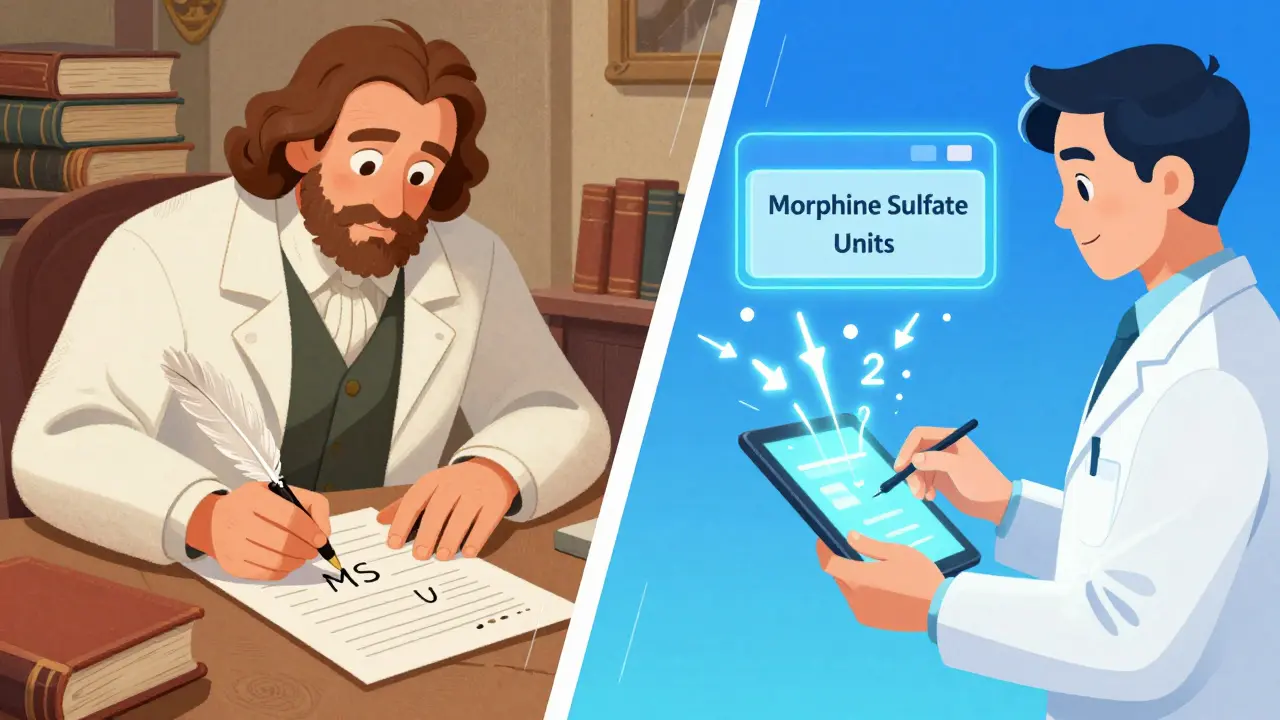
- U for units: This one caused at least 12 deaths in Pennsylvania between 2018 and 2022. Why? Because it looks like a 4 or a 0. A doctor wrote “10U” for insulin. The pharmacist read it as “100.” The patient got ten times the dose. That’s not a mistake-it’s a near-fatal event.
- IU for international units: Confused with IV (intravenous), leading to dangerous injections. One patient got a powerful drug meant for the bloodstream injected into a muscle instead.
- QD for daily: Sounds simple, right? But it’s often mistaken for QID (four times a day). A 2021 ISMP report found QD was involved in over 21% of all dosing frequency errors.
- MS for morphine sulfate: Could also mean magnesium sulfate. Mix them up, and you’re giving a patient a drug that lowers blood pressure instead of one that stops pain. That’s a recipe for cardiac arrest.
- SC for subcutaneous: Sometimes read as SL (sublingual). That’s how insulin meant for under the skin ended up under the tongue. One patient had a seizure because of it.
These aren’t rare cases. The American Hospital Association recorded over 14,000 incidents in 2023 alone. And the worst part? Most of these errors happen in community pharmacies-not hospitals.
Eye and Ear Abbreviations: A Silent Killer
Eye drops and ear drops are especially risky because of two-letter codes:
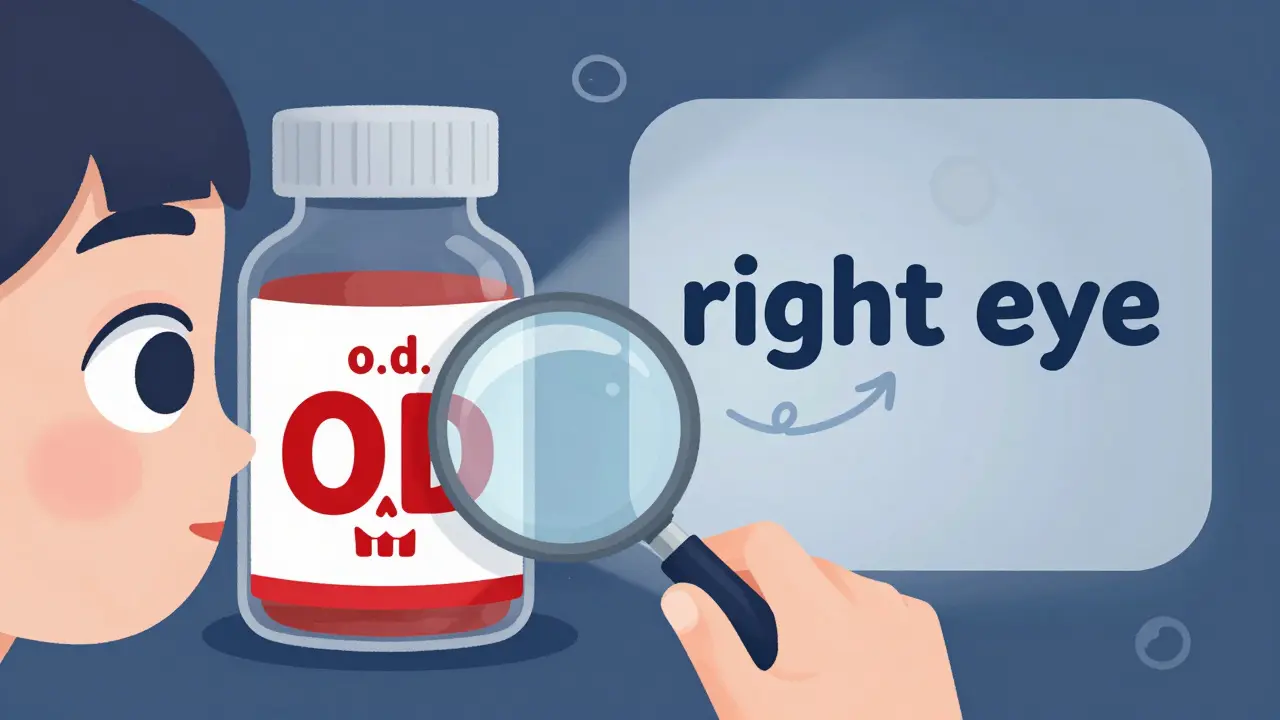
- o.d. = oculus dexter (right eye)
- o.s. = oculus sinister (left eye)
- a.d. = auris dexter (right ear)
- a.s. = auris sinister (left ear)
Here’s the problem: pharmacists and patients often mix up o.d. with OD-which stands for overdose. In 2022, the American Academy of Ophthalmology found that 12.3% of eye medication errors came from this confusion. One woman took her glaucoma drops in her right eye every day. The label said o.d. She thought it meant “overdose,” so she skipped it. Her vision worsened. She didn’t realize the label meant “right eye,” not “too much.”
Same goes for ears. a.d. and a.s. get confused with each other. A patient got ear drops for the left ear but used them in the right. The infection spread. It took weeks to fix.
What’s on Your Label vs. What the Pharmacist Sees
Here’s something most people don’t know: the label you take home is often different from what the pharmacist reads.
Pharmacies like CVS, Walgreens, and Walmart now convert all abbreviations into plain English on patient labels. So if your prescription says “t.i.d.,” your label says “three times a day.” If it says “p.o.,” you’ll see “by mouth.” That’s not just nice-it’s required under safety policies adopted by 98% of major U.S. pharmacy chains since 2023.
But here’s the catch: if your doctor writes “q.d.” on a paper script, and the pharmacy’s system doesn’t catch it, you might still get a label that says “q.d.” That’s why you need to double-check.
How to Protect Yourself
You don’t have to guess. You don’t have to hope. Here’s how to make sure your medication is safe:
- Ask: “Can you write that out in full?” If you see any abbreviation you don’t understand, say so. Pharmacists are trained to explain this stuff. Don’t feel shy.
- Check the dose. If you see “1.0 mg,” ask if it’s supposed to be “1 mg.” Trailing zeros (like 1.0) are banned because they cause errors. A 1.0 mg dose could be read as 10 mg.
- Compare the label to the bottle. Does the label say “daily” or “q.d.”? Does it say “right eye” or “o.d.”? If it’s still using abbreviations, ask why.
- Use your phone. Take a picture of the label and send it to your pharmacist if you’re unsure. Most community pharmacies offer free text-based consultations.
- Know the big three dangerous ones: U, MS, and QD. If you see any of these, stop and ask.
Why This Is Changing-Fast
The world is moving away from Latin abbreviations. Australia, Canada, Germany, and the UK have already banned them. The World Health Organization wants them gone worldwide by 2030. In the U.S., the U.S. Pharmacopeia made it mandatory as of May 1, 2024: all prescriptions must use plain English. Exceptions? Only for units like mg, mL, and mcg.
Electronic prescribing systems like Epic and Cerner now auto-convert abbreviations. If a doctor types “q.d.,” the system changes it to “daily” before it even reaches the pharmacy. That’s why hospital errors dropped by 43% since 2020.
But community pharmacies still struggle. Many doctors still use paper scripts or hybrid systems. That’s why 67.8% of pharmacists say they still see dangerous abbreviations every week.
What You Should Expect in 2026
By the end of this year, the FDA will ban 12 high-risk abbreviations from all drug labels. Medicare and Medicaid will start cutting hospital payments if they don’t follow the rules. AI tools like IBM Watson’s MedSafety AI are already converting prescriptions with 99.2% accuracy.
That means in two years, you’ll rarely see “q.i.d.” or “p.r.” on your label. Instead, you’ll see:
- “Take by mouth” instead of “p.o.”
- “Every day” instead of “q.d.”
- “Right ear” instead of “a.d.”
- “Morphine sulfate” instead of “MS”
This isn’t just about being modern. It’s about survival.
Final Tip: Trust Your Gut
If something on your prescription label feels off, it probably is. You don’t need to be a doctor to spot a red flag. If the label says “U” or “MS” or “QD,” ask. If the dose seems too high or too low, ask. If the instructions don’t make sense, ask again.
Medication errors are preventable. And the person who stops them is often the one holding the bottle.
What does Rx mean on a prescription?
Rx stands for the Latin word "recipe," which means "take." It’s not a symbol for a pharmacy or a brand-it’s an instruction from the doctor telling you to take the medicine. It’s been used for over 400 years, but it’s harmless on its own. The danger comes from the abbreviations that follow it.
Is q.d. the same as daily?
Yes, q.d. means daily, from the Latin "quaque die." But it’s dangerous because it looks like q.i.d. (four times a day). Many people misread it, leading to overdoses. That’s why most pharmacies now write "daily" on patient labels instead of q.d.
Why is U dangerous on a prescription?
U stands for units, but it can be mistaken for a 4 or a 0. If a doctor writes "10U," someone might read it as "100." That’s how insulin overdoses happen. Since 2004, the Joint Commission has banned U on prescriptions. You should always see "units" written out.
What’s the difference between o.d. and OD?
o.d. means "right eye" (from Latin oculus dexter). OD means "overdose." They look almost identical, and mixing them up has caused serious harm. One patient skipped her glaucoma drops because she thought o.d. meant "overdose." Now, most pharmacies write "right eye" on labels to avoid this.
Can I ask my pharmacist to rewrite my prescription in plain English?
Absolutely. You have the right to understand your medication. If your label has abbreviations like q.d., p.o., or SC, ask your pharmacist to explain them in plain language. Most pharmacies will even print a new label with full words if you request it. Don’t be afraid to ask twice.
Are abbreviations still allowed in 2026?
In electronic systems, most are automatically converted to plain English. But some doctors still use paper prescriptions with old abbreviations. By 2026, U.S. regulations will require all prescriptions to use full words, except for units like mg and mL. If you see an abbreviation on your label, it’s likely outdated or misprinted-and you should question it.
What should I do if I think I got the wrong medicine?
Stop taking it. Call your pharmacist immediately and read them the label. If you’re unsure about the name, dose, or instructions, don’t guess. Most pharmacies have a 24/7 hotline for medication questions. If you feel sick or dizzy after taking it, go to the nearest emergency room and bring the bottle with you.




Let me just say this: if you’re still seeing 'U' or 'MS' on a prescription in 2024, someone’s either criminally negligent or actively trying to kill someone. I work in healthcare administration in Toronto, and we banned those abbreviations in 2019. The fact that this is even a conversation in the U.S. is horrifying. It’s not ‘tradition’-it’s malpractice dressed up in Latin. If your pharmacist doesn’t auto-convert every single abbreviation to plain English, fire them. No excuses. People are dying because someone was too lazy to type 'daily' instead of 'q.d.'
bro i just had my grandma’s med label printed with 'o.d.' and i thought she was supposed to take it 'overdose' style 😅 i almost called 911. thank god i googled it before she swallowed it. like... why are we still doing this? my phone’s autocorrect knows more than my pharmacist. 🤦♂️
As a clinical pharmacist with over two decades of experience, I must emphasize that the systemic failure to eliminate Latin abbreviations is not merely an inconvenience-it is a profound breach of the duty of care. The Joint Commission’s warnings have been unequivocal since 2004. The persistence of 'U', 'QD', and 'MS' in community pharmacy settings reflects a dangerous complacency. I routinely intercept these errors, often at the point of dispensing. Patients must be empowered to demand full terminology. If a label contains an abbreviation, it is not yet safe. Request a revised label. Insist. Your life depends on it.
Stop acting like this is a new problem. You people are just too dumb to read basic medical terms. Latin abbreviations have been used for centuries. If you can’t handle 'q.d.' or 'o.d.', maybe you shouldn’t be taking meds at all. This is why America’s healthcare is a joke-people want everything spelled out like they’re five. Grow up. The system works fine. It’s you who’s broken.
yo this is wild but also kinda beautiful?? like imagine if we just stopped using ancient latin codes and started talking like actual humans?? 🌱 i just asked my pharmacist to rewrite my label in plain english and she gave me a sticker that says 'take 1 pill every morning' instead of 'q.d.' and i cried a little. we’re not dumb-we just want to live. thanks for making this so clear.
Ugh I HATE when I get a label with 'SC' on it. Last time I thought it meant 'super concentrated' so I doubled my dose. Ended up in the ER with a panic attack. Turns out it meant subcutaneous. I’m not a doctor. I’m not a chemist. I’m just a guy trying not to die. Why is this still a thing??
Thank you for this. I’m a nurse and I see this every single day. I had a patient last week who was terrified because her label said 'MS'-she thought it meant 'morphine sulfate' and she was on a blood thinner. Turns out it was magnesium sulfate. She was sobbing. We spent 20 minutes explaining it. We need to make this mandatory. No more Latin. No more ambiguity. If you can’t say 'right ear' in English, don’t write it. Period.
This article is overblown. People have been reading prescriptions for centuries. If you can’t understand 'q.d.' or 'o.d.', you’re not the victim-you’re the problem. The healthcare system isn’t failing; you’re just too lazy to learn basic terms. Why does everything have to be dumbed down for the lowest common denominator?
If you see 'U' on a label, don’t take it. Call the pharmacy. That’s it. No explanation needed. That’s not a suggestion-it’s a rule. Stop reading articles. Just stop taking meds with dangerous abbreviations. Period.
Thank you for sharing this vital information. I am deeply moved by the gravity of these errors-and I feel compelled to emphasize that the responsibility does not rest solely with the patient. Pharmacies, physicians, and regulatory bodies must be held accountable. The persistence of these dangerous abbreviations is not an oversight-it is a systemic failure. I urge all readers to document every instance of non-compliance, report it to their state board of pharmacy, and demand transparency. Your life is not a gamble.