
 10
Dec,2025
10
Dec,2025
BY : Robot San
15 Comments
Every year, hundreds of patients in hospitals across Australia and the U.S. are harmed because someone misheard a medication order. Not because the doctor made a mistake - but because the way the order was spoken didn’t follow basic safety rules. Verbal prescriptions aren’t going away. They’re still needed in emergencies, during surgery, or when the EHR is down. But if you’re not following clear, proven steps to communicate them, you’re putting lives at risk.
Why Verbal Prescriptions Are Still Necessary
You can’t always type an order into a computer. Surgeons in the operating room can’t stop to click through menus. Nurses in the ER need antibiotics given five minutes ago, not five minutes from now. In these moments, saying the order out loud is the fastest - and sometimes only - way to get the right drug to the right patient. But here’s the problem: verbal orders are messy. Studies show error rates between 30% and 50% when no safety steps are used. That’s not a small risk. That’s one in every two or three orders being wrong. And the consequences? Wrong dose. Wrong drug. Wrong patient. Sometimes, death. The good news? You can cut those errors in half - even without a computer. It’s not about technology. It’s about how you talk.The One Rule That Saves Lives: Read-Back Verification
The most powerful tool you have isn’t a tablet or a voice assistant. It’s your mouth - and your ears. Read-back verification means the person receiving the order repeats it back, word for word, before acting on it. Not just the drug name. Not just the dose. The whole thing: patient name, medication, strength, route, frequency, reason, and who ordered it. This isn’t optional. The Joint Commission made it mandatory in 2006. Medicare requires it. And every major hospital in Australia and the U.S. has it in their policy. Here’s how it works in real life:- Doctor: “Give 500 milligrams of vancomycin IV over 60 minutes for MRSA infection.”
- Nurse: “Confirming: 500 milligrams of vancomycin, intravenous, over 60 minutes, for MRSA infection, ordered by Dr. Lee.”
- Doctor: “Correct.”
How to Say It Right: Phonetics, Numbers, and No Abbreviations
It’s not enough to say the drug name. You have to say it in a way that can’t be misunderstood. Spell out drug names phonetically. Don’t say “Zyprexa.” Say “Z-Y-P-R-E-X-A.” Don’t say “Celebrex.” Say “C-E-L-E-B-R-E-X.” Sound-alike drugs are the #1 cause of verbal order errors. Celebrex and Celexa. Zyprexa and Zyrtec. Hydralazine and Hydroxyzine. These pairs have caused serious harm. Spelling them out removes the guesswork. State numbers two ways. Say “15 milligrams” and then “one-five milligrams.” Say “500 micrograms” and then “five-zero-zero micrograms.” This prevents mishearing “10” as “100” or “5” as “50.” Never use abbreviations. No “BID.” Say “twice daily.” No “QHS.” Say “at bedtime.” No “PO.” Say “by mouth.” No “IU.” Say “international units.” Abbreviations are a known trigger for errors. The Institute for Safe Medication Practices banned them in verbal orders back in 2020 - and hospitals that follow this rule see 40% fewer mistakes.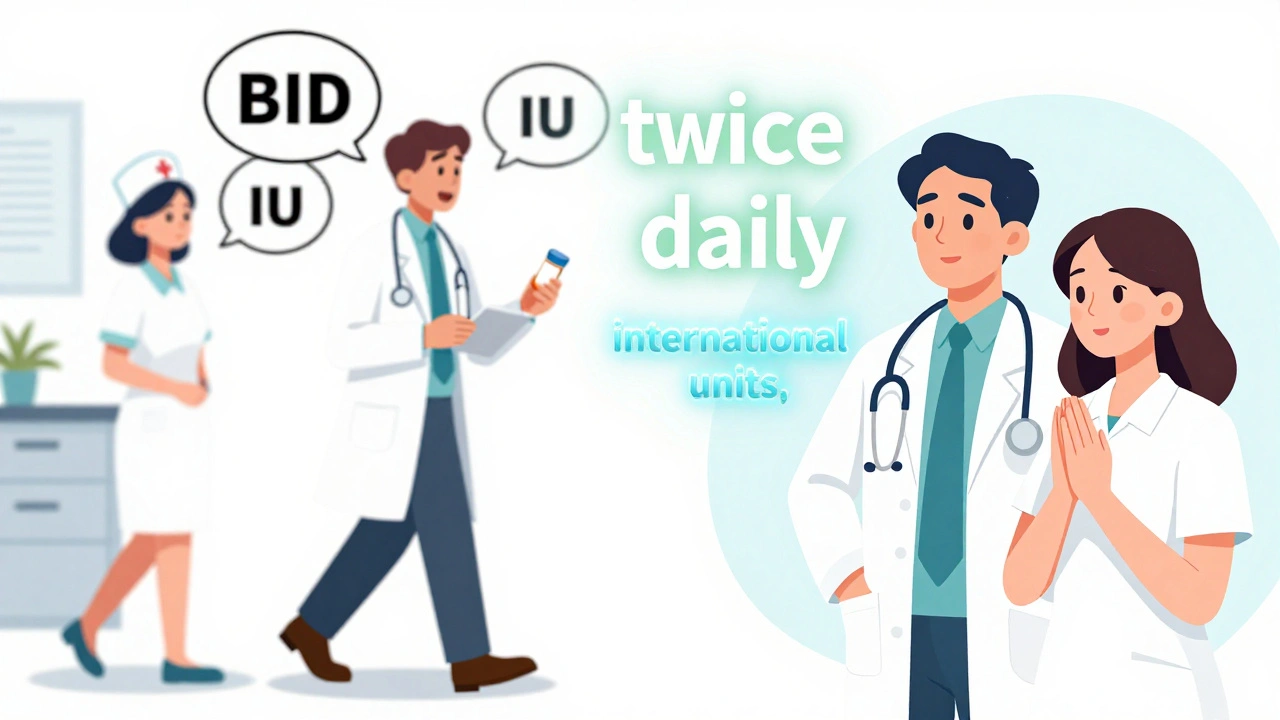
High-Alert Drugs: When Verbal Orders Are Forbidden
Some drugs are too dangerous to order verbally unless it’s a true emergency. The Pennsylvania Patient Safety Authority and ISMP Canada list these as high-alert medications where verbal orders should be avoided if possible:- Insulin
- Heparin
- Opioids like morphine or fentanyl
- Chemotherapy agents
- Concentrated electrolytes like potassium chloride
Documentation: The Only Real Record
The only thing that matters after a verbal order is what’s written down. The prescriber’s memory? Gone in 20 minutes. The nurse’s memory? Subject to fatigue, stress, and interruptions. Immediate transcription is non-negotiable. As soon as the order is given, the nurse or assistant must enter it into the electronic health record - with all details:- Full patient name and date of birth
- Medication name spelled out
- Dose with units (mg, mcg, mL, etc.)
- Route (IV, IM, PO, etc.)
- Frequency (twice daily, every 6 hours)
- Indication (why it’s being given)
- Name and title of prescriber
- Exact time and date the order was received
- Time and date the prescriber authenticated it
Who’s Responsible? Everyone.
This isn’t just the nurse’s job. Or the doctor’s job. It’s everyone’s job. Nurses: You have the right - and the duty - to ask for clarification. If something sounds off, say so. “I’m not sure. Can you spell that again?” Doctors: Don’t rush. Don’t talk over background noise. Don’t give orders while walking out the door. If you’re interrupted, pause. Say: “Let me finish this order first, then I’ll answer your question.” Administrators: Train your staff. Make read-back part of orientation. Role-play bad scenarios. Reward people who speak up. Culture matters more than policy. In a 2022 survey by the American Nurses Association, 87% of nurses said they support mandatory read-back. But only 58% said they see it done consistently. That gap? That’s where mistakes happen.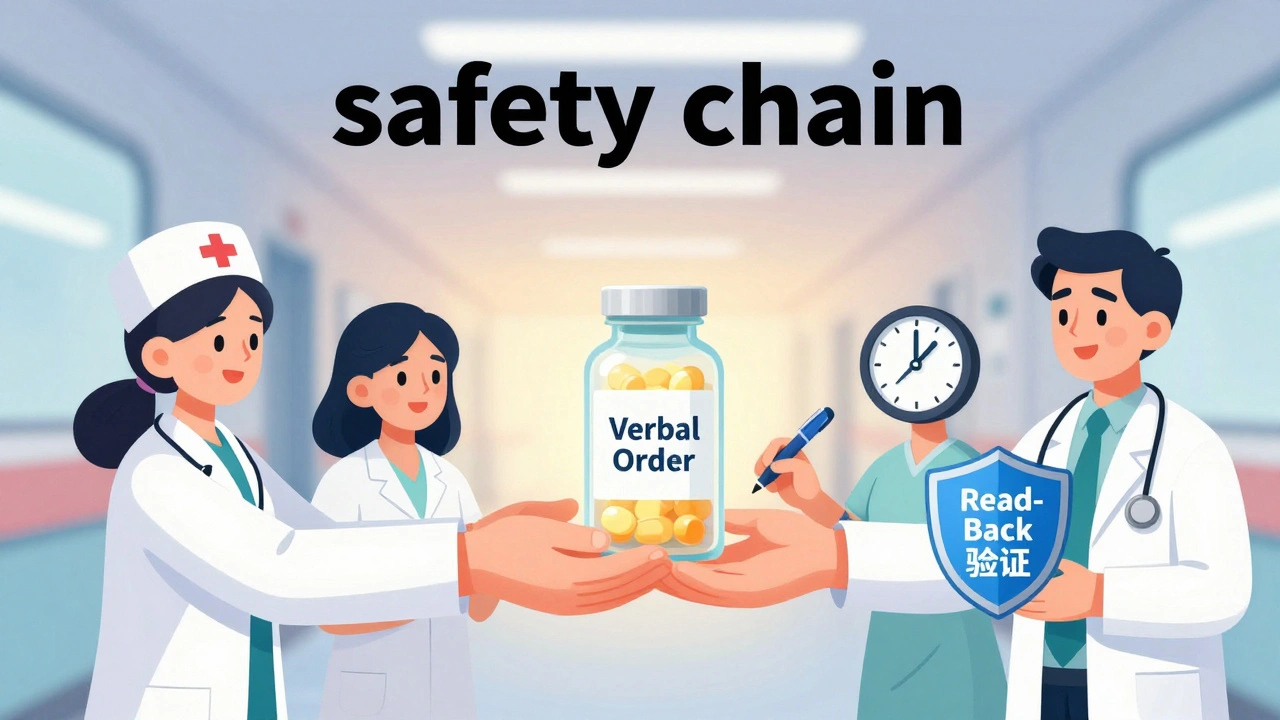
What’s Changing? And Where Are We Headed?
Computerized Physician Order Entry (CPOE) has cut verbal orders in hospitals from 22% of all orders in 2006 to about 10-15% today. In emergency departments, it’s still higher - 25-30% - because speed matters. But even with better tech, verbal orders won’t disappear. Dr. Robert Wachter from NEJM Catalyst says it plainly: “Some clinical moments will always need spoken communication.” The future isn’t eliminating verbal orders. It’s making them safer. The FDA is working on a 2024 initiative to standardize how high-risk drug names are pronounced. Some hospitals are testing voice recognition systems that auto-transcribe orders - but only after the nurse confirms them with a read-back. By 2025, KLAS Research predicts verbal orders will drop to 5-8% of all orders. But until then, every time you say “give this,” you’re holding a life in your hands. Don’t take it lightly.Real Talk: What Nurses and Doctors Say
On Reddit’s r/medicine, an ER nurse wrote: “Verbal orders saved a trauma patient’s life. Written order would’ve taken 8 minutes. We lost 8 minutes, we lost the patient.” Another nurse on AllNurses.com shared: “I once heard ‘hydralazine’ and almost gave it. But I asked, ‘Is that H-Y-D-R-A-L-A-Z-I-N-E?’ The doctor said yes. I almost gave a drug meant for high blood pressure to a patient with low heart rate. That’s why I spell everything now.” A doctor in Sydney told me: “I used to think read-back was slow. Then I saw a patient get 10 times the right dose of morphine because I said ‘ten mg’ and they heard ‘one zero.’ Now I say ‘ten milligrams, one-zero milligrams.’ It takes 5 extra seconds. But I’d rather lose 5 seconds than lose a patient.”Bottom Line: Clarity Is a Skill, Not a Suggestion
Verbal prescriptions aren’t evil. They’re necessary. But they’re dangerous if done carelessly. The fix is simple: say it clearly, hear it back, write it down, and confirm it fast. No shortcuts. No exceptions. No exceptions for busy days. No exceptions for trusted colleagues. No exceptions for “I know what they meant.” Your words matter. The way you say them saves lives.
Write a comment
LATEST POST




Diflucan (Fluconazole) vs Popular Antifungal Alternatives - Comparison Guide
6 Oct 2025 | 13:34 PM
Buy Cheap Generic Zoloft Online - Safe Australian Pharmacy Guide
7 Oct 2025 | 16:58 PM
Current GMP Standards: Detailed Requirements Explained for 2025
15 Dec 2025 | 02:23 AM
Best Reliable Online Resources for Generic Drug Information
4 Jan 2026 | 11:14 AM
OTC Gas and Bloating Remedies: Simethicone vs Enzyme Products Explained
12 Jan 2026 | 15:33 PM
Man I just heard a doc say 'ten mg' and I thought he meant 100. I almost gave it. Then I asked him to spell it. He said 'one-zero.' I almost quit nursing that day.
This is so real. I work in a rural ER and half the time the EHR is down. Read-back saved my butt last week when someone said 'Hydralazine' and I said 'like the blood pressure one?' He was like 'yeah' and I said 'wait spell it.' Turns out it was Hydroxyzine. Big difference. I’m never not spelling again.
Of course you’re telling us this now. You know how many times nurses have been blamed for errors that were caused by doctors mumbling through masks? This isn’t a safety tip-it’s a cover-up for lazy, arrogant physicians who think their word is gospel. And don’t get me started on how they blame the nurse when the patient dies. Wake up.
I’ve been a nurse for 22 years and I’ve seen everything. But the one thing that never fails? The read-back. I used to think it was slow. Then I saw a baby get 10x the dose of morphine because the doc said 'ten' and the nurse heard 'one zero.' That kid didn’t survive. Now I say every number twice. I say every drug spelled out. I don’t care if it takes 10 extra seconds. I’d rather be late than dead.
Love this. My hospital just rolled out mandatory read-back training and I was skeptical-but now I see how much it changes things. Even my grumpy old attending started doing it. He said, 'I used to think it was redundant. Now I think it’s the only thing keeping me employed.' Haha. But seriously, it works.
Yessss!! 🙌 I’ve been yelling this from the rooftops since 2020. Spell. It. Out. 🧠💉 And stop saying 'IU'-it’s 'international units'!! 🚨 Also, I just saw a doc write 'PO' and I screamed. I’m not sorry. 🤫
so like uhhhhh read back is a thing? wow. i thought everyone just did that. guess not. also why do u spell out everything like its 1999? i mean its not like we got a typo machine or something. also why are we still talking about this? its 2024. just use the damn app.
Let me guess-this is another American hospital propaganda piece. In Canada, we don’t need all this. We trust our professionals. We don’t treat nurses like robots repeating back nonsense. This is overregulation. It’s not about safety-it’s about liability. And now you’re making us waste time so lawyers can sleep better.
Hey, I’m a new grad nurse and I used to think read-back was just bureaucracy. Then I worked a shift where a doctor said '500 mcg of epinephrine' and I said 'five-zero-zero micrograms?' He said yes. I almost gave it. But I checked the vial-it was 1 mg/mL. I asked him again. He corrected himself: 'I meant 5 mcg.' That was 500x the dose. I’m never skipping it again. Thank you for this.
Oh, so now you want us to spell out every drug? In India, we’ve been doing this for decades without your fancy Joint Commission rules. We have 10x the patient load, 1/10th the staff, and we still don’t make mistakes. Why? Because we’re trained. Not because you invented a 2006 rule. This is cultural imperialism disguised as safety.
While I applaud the intent, the article fundamentally misunderstands the cognitive load of clinical environments. Read-back is a band-aid for systemic under-resourcing. The real solution isn’t verbal protocol-it’s CPOE integration, AI-assisted decision support, and reducing clinician burnout. This is like teaching firefighters to hold their breath while running into a burning building. It’s not wrong-it’s incomplete.
They’re hiding something. Why is this only being pushed in the US and Australia? Who profits from mandatory read-back? Big Pharma? EHR vendors? The Joint Commission? I’ve seen nurses get fired for not reading back-yet doctors who misstate orders get zero consequences. This isn’t safety. It’s control. And they’re using 'patient lives' to justify it. Classic.
I’ve been on both sides-nurse and charge nurse. I used to roll my eyes at read-back. Then I had a nurse call me out on a typo in a verbal order. She said, 'You said 10 mg, but the chart says 100.' I corrected it. She didn’t say a word. Just nodded. That’s the kind of culture we need. Not blame. Not fear. Just clarity. Thank you for reminding us how to do this right.
While I appreciate the intentionality of this protocol, I must respectfully express my profound concern regarding the potential for psychological dissonance induced by mandatory verbal confirmation rituals. The human cognitive apparatus, under conditions of acute stress, is demonstrably prone to semantic disambiguation failure-thus, the reliance on linguistic redundancy may inadvertently exacerbate decisional fatigue. Furthermore, the institutionalization of such procedures, while ostensibly benevolent, may constitute a form of performative compliance, wherein the ritual supersedes the substantive goal of patient safety. One must question whether the orthographic and phonetic formalism herein prescribed constitutes a modern liturgy of liability, rather than a genuine epistemic safeguard.
I read this and cried a little. Not because it’s sad-but because it’s so simple. We’ve turned medicine into a checklist game. But this? This is just two people talking. One says something. The other listens. And says it back. No tech. No apps. Just human beings being careful with each other’s lives. I wish we did this more often-not just with drugs, but with everything. We forget how powerful a quiet, clear voice can be.