
 8
Jan,2026
8
Jan,2026
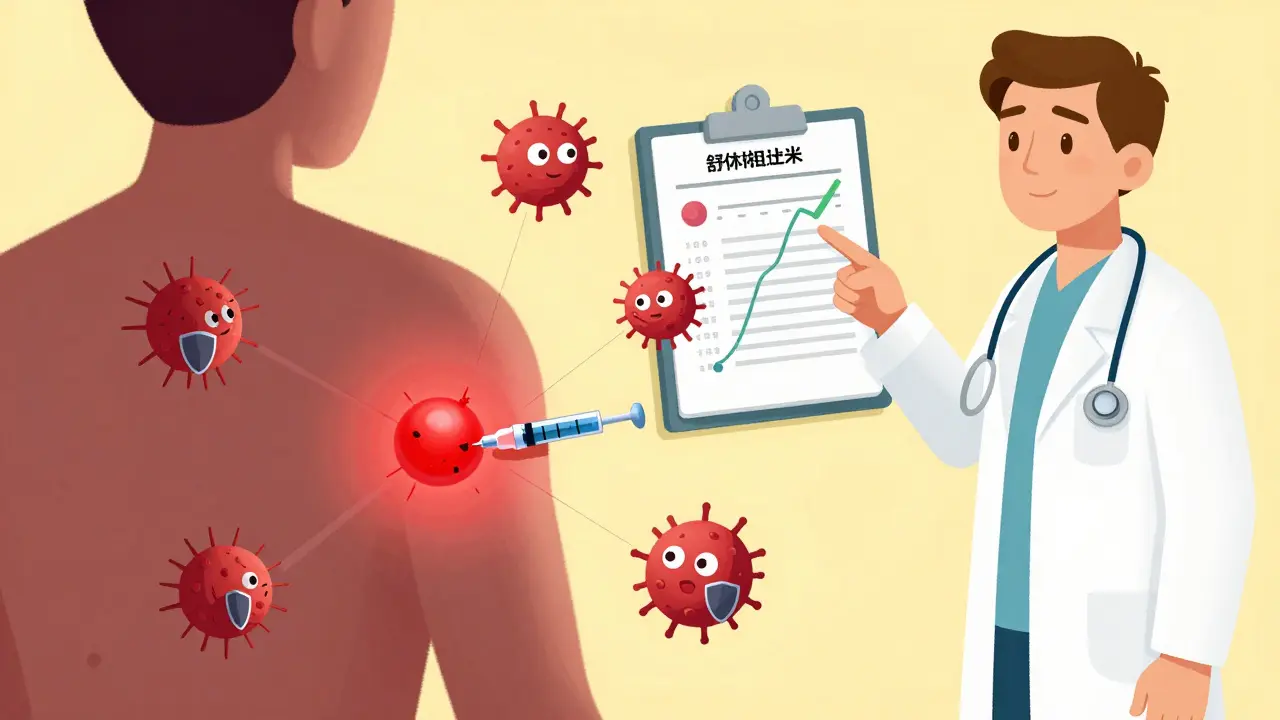
Most people with diabetes rely on insulin to survive. But for a small number, the very thing keeping them alive can trigger a dangerous reaction. Insulin allergies are rare - affecting about 2.1% of insulin users - but they can be life-threatening if ignored. You might think a red, itchy bump at your injection site is just irritation. It could be your immune system sounding the alarm.
What an Insulin Allergy Really Looks Like
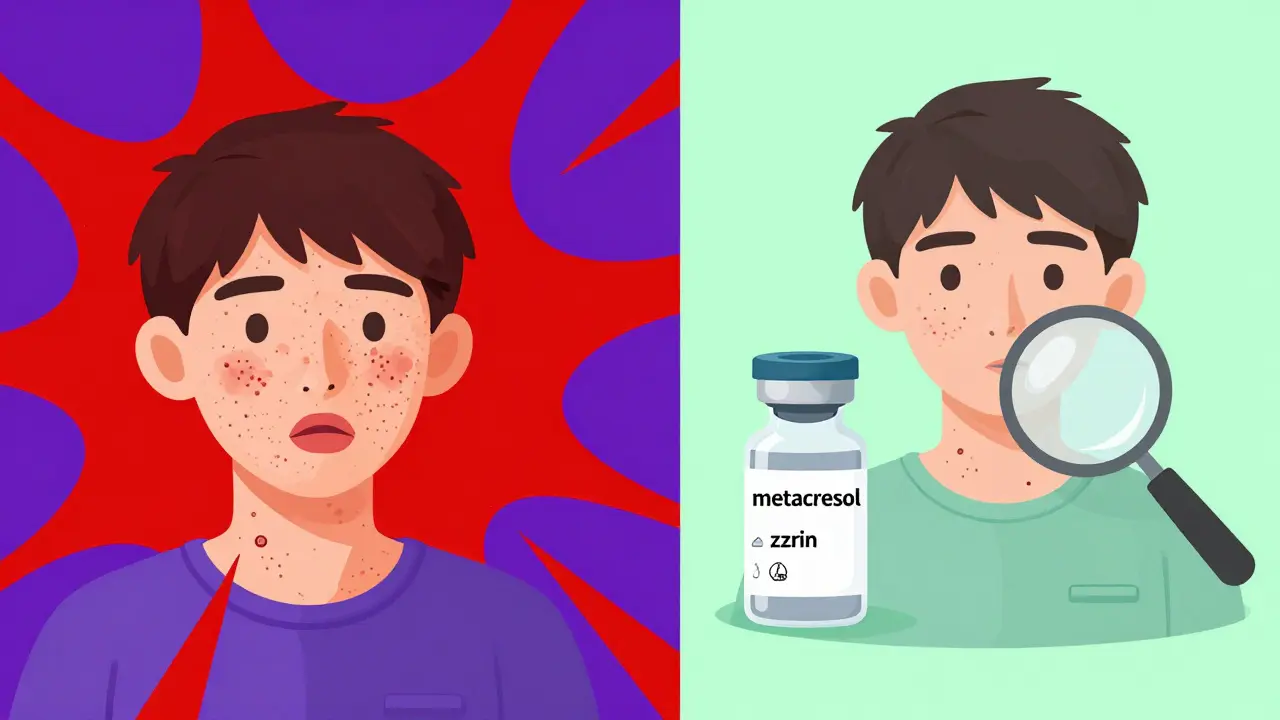
Not every red spot or itch is an allergy. Common insulin side effects like sweating, shaking, or anxiety are signs of low blood sugar - not an immune response. True insulin allergies are immune-mediated. That means your body sees insulin, or something mixed with it, as a threat and attacks. There are three main types of reactions:- Localized reactions: These happen right where you inject. Think swelling, redness, itching, or a tender lump under the skin. They usually show up 30 minutes to 6 hours after the shot and fade in 1-2 days. About 97% of insulin allergy cases fall into this category.
- Systemic reactions: These are rare but serious. Symptoms include hives, swelling of the lips or throat, trouble breathing, dizziness, or low blood pressure. This is anaphylaxis - a medical emergency.
- Delayed reactions: These can surprise you. Joint pain, muscle aches, or bruising that appears 2-24 hours after the shot, even if you’ve been using the same insulin for years. This isn’t IgE-driven like typical allergies; it’s T-cell mediated, meaning it’s a slower, different kind of immune response.
One key thing to remember: insulin allergies aren’t always about the insulin molecule. Sometimes, it’s the preservatives - like metacresol or zinc - mixed into the solution. For example, Humalog has more metacresol than other insulins, and that’s been linked to more reactions in some patients.
How to Tell It’s an Allergy - Not Just Irritation
It’s easy to blame the needle, the alcohol swab, or dry skin. But here’s how to tell if it’s something bigger:- Does the reaction keep happening in the same spot - even after you rotate injection sites?
- Does it get worse over time, not better?
- Do you get symptoms beyond the skin - like swelling in your mouth, trouble breathing, or feeling faint?
- Did the reaction start after switching insulin brands or types?
If you answered yes to any of these, don’t wait. Talk to your diabetes team. Stopping insulin because you’re scared of a reaction is dangerous. Without insulin, your blood sugar can spike dangerously high, leading to diabetic ketoacidosis - a life-threatening condition.
What to Do If You Have a Reaction
Your next steps depend on how bad the reaction is.For mild, localized reactions:
- Apply a topical calcineurin inhibitor like tacrolimus or pimecrolimus right after your shot, then again 4-6 hours later. This can calm down the immune response at the site.
- For delayed bruising or swelling, a mid-to-high potency steroid cream like flunisolide 0.05% applied twice daily for a few days helps.
- Take an over-the-counter antihistamine like cetirizine or loratadine. It won’t fix everything, but it reduces itching and redness.
For systemic or severe reactions:
- Call emergency services immediately (999 in the UK, 911 in the US). Don’t drive yourself.
- Symptoms like throat swelling, wheezing, or blue lips mean your airway is at risk.
- If you have an epinephrine auto-injector (like an EpiPen), use it right away - even if you’re unsure.
Never assume it’s “just a rash.” Systemic reactions can escalate fast. The NHS and the American Academy of Allergy, Asthma & Immunology both stress: when in doubt, call for help.
Switching Insulin Types - A Common Fix
Here’s good news: in about 70% of cases, switching to a different insulin brand or type stops the reaction. Not all insulins are made the same. Even “human” insulin formulations vary in additives, purity, and structure.For example:
- If you’re on a pork or beef insulin (rare now), switching to a modern human analog like Lantus or Humalog often helps.
- If you’re on Humalog and reacting to metacresol, try NovoRapid or Fiasp - they have different preservatives.
- Some patients do better with insulin detemir or degludec, which have fewer additives.
Your doctor can help you compare formulations. The goal isn’t just to avoid the reaction - it’s to keep your blood sugar stable. A switch isn’t a cure, but it’s often the fastest path back to safety.
When All Else Fails: Desensitization
If switching insulins doesn’t work, and you can’t live without insulin, there’s another option: desensitization.This is a controlled process where you get tiny, gradually increasing doses of the insulin you’re allergic to - under medical supervision. It’s not quick. It can take days to weeks. But it works.
A 2008 study published in PubMed followed four patients with severe insulin allergies. Three of them completed desensitization. Two had no more reactions. The third had a major improvement. The key? Close teamwork between your endocrinologist and an allergist.
Desensitization isn’t for everyone. It requires hospital monitoring. It carries risks - including triggering anaphylaxis during the process. But for people with type 1 diabetes, it’s often the only way to keep using insulin safely long-term.

Tracking Your Reactions - The Hidden Key
One thing most patients miss: keeping a detailed log. Write down:- What insulin you used (brand, lot number if possible)
- Time of injection
- Time reaction started
- Location of reaction
- Severity (mild itch vs. swelling that blocked your vision)
- What you did to treat it
This isn’t busywork. It’s your best tool. Patterns emerge. Maybe every time you use insulin from a new batch, you get a reaction. Maybe it only happens with your evening dose. Maybe it’s linked to stress or illness. Your allergist needs this data to figure out if it’s the insulin, the preservative, or something else entirely.
What You Should Never Do
- Don’t stop insulin. Even if you’re scared. Diabetic ketoacidosis kills faster than an allergic reaction.
- Don’t assume it’s just skin deep. Delayed reactions can be just as serious as immediate ones.
- Don’t try to self-diagnose. Many people mistake low blood sugar for an allergy. Only a proper skin test or blood test (IgE levels) can confirm it.
- Don’t ignore a reaction just because it’s been years. People have developed allergies after 10+ years of using the same insulin.
What’s Changing in Insulin Allergy Care
Newer insulins are being designed with cleaner formulations - fewer additives, more stable molecules. That’s reducing allergy rates over time. Continuous glucose monitors (CGMs) are making it safer to test desensitization protocols, because doctors can watch your blood sugar in real time.Researchers are also looking for biomarkers - specific proteins in the blood - that might predict who’s at risk before a reaction even happens. That’s still experimental, but it’s the future.
Right now, the best advice is simple: know your body. Track your reactions. Talk to your team. Don’t suffer in silence. Insulin allergies are rare, but they’re manageable. You don’t have to choose between safety and survival.
Can you outgrow an insulin allergy?
No, insulin allergies don’t go away on their own. Unlike some childhood food allergies, they’re typically lifelong. But they can be managed - through switching insulins, topical treatments, or desensitization. The goal isn’t to outgrow it, but to keep using insulin safely.
Can you be allergic to one type of insulin but not another?
Yes. Insulin allergies are often triggered by additives - like metacresol, zinc, or preservatives - not the insulin molecule itself. That’s why switching from Humalog to NovoRapid or Lantus can solve the problem. Even different batches of the same brand can vary slightly. Testing different formulations is a standard first step.
Are insulin allergies more common with animal insulin?
Yes - historically, animal-sourced insulin (from pigs or cows) caused allergies in up to 15% of users. Modern human insulin and analogs are far purer, reducing rates to under 3%. But even today, some people react to the newer versions, usually due to preservatives or manufacturing changes.
Can you use an epinephrine pen if you’re having an insulin reaction?
Yes - if you’re having signs of anaphylaxis (throat swelling, trouble breathing, dizziness), use your epinephrine auto-injector immediately. Then call emergency services. Epinephrine is the first-line treatment for severe allergic reactions, regardless of the trigger. Don’t wait to see if it gets worse.
Is there a blood test to confirm an insulin allergy?
Yes. A skin prick test or intradermal test is the gold standard. Blood tests can measure IgE antibodies specific to insulin or its additives. These tests are done by allergists, not general doctors. If you suspect an allergy, ask your diabetes team for a referral.
Can type 1 diabetics ever stop using insulin because of an allergy?
Almost never. Type 1 diabetics make no insulin on their own. Stopping it leads to diabetic ketoacidosis - a medical emergency. The only alternatives are experimental or not viable long-term. Desensitization or switching insulin types are the real solutions. Giving up insulin isn’t an option - but managing the allergy is.
How long do insulin allergy reactions last?
Localized reactions usually fade in 24-48 hours. Delayed reactions - like joint pain or bruising - can take 1-2 weeks to resolve. Systemic reactions need immediate treatment and can be fatal within minutes without intervention. The duration depends on the type and severity - but timing matters. If it’s still there after 48 hours, get it checked.



I used to think my itchy spots were just from bad injection technique. Turns out, I was reacting to metacresol in Humalog. Switched to Fiasp and boom - no more red lumps. Took me two years and three ER visits to figure it out. Don’t wait like I did.
Also, keep a log. I started using Google Sheets with timestamps and lot numbers. My allergist called it ‘the most organized patient she’d ever seen.’
Insulin isn’t the villain. The preservatives are. Learn their names. Know your enemy.
OMG I’ve been dealing with this for 7 years and no one ever told me delayed reactions were a thing 😭 I thought it was just stress or bad sleep. Last month I got this brutal joint pain after my evening shot - like arthritis but only on the right side where I inject. I cried in the shower. My endo said ‘maybe it’s the zinc’ and I was like… zinc?? Like in cereal??
Now I’m switching to degludec and praying. I’ve got three kids and I can’t afford to be bedridden for two weeks every time I inject. Please someone tell me this works.
Also, why does no one talk about this? It’s like we’re supposed to just suffer quietly while our blood sugar spikes and we look like we’re having a nervous breakdown. I’m so tired.
Wow. So people are allergic to insulin now? Next thing you know, we’ll find out people are allergic to oxygen.
Let me guess - you’re also allergic to breathing, eating, and existing. You’re not allergic to insulin. You’re allergic to responsibility. Stop blaming preservatives and start taking care of your body. If you can’t handle one shot a day, maybe you shouldn’t be diabetic.
Also, why are you injecting in the same spot? You’re not a robot. Rotate. Use alcohol. Don’t be a baby. This is basic hygiene, not a medical mystery.
And for the love of God, stop Googling symptoms. You’re not going to die from a rash. You’re going to die from your own ignorance.
Let’s break this down like a clinical trial: IgE-mediated vs. T-cell mediated hypersensitivity is a critical differentiator. The fact that 97% of cases are localized suggests a Type IV delayed response - not classic anaphylaxis. That means we’re looking at cytokine cascades, not mast cell degranulation.
Also, metacresol is a known haptens. It binds to proteins, creates neoantigens, and triggers adaptive immunity. Humalog’s formulation has 0.3% metacresol. NovoRapid? 0.15%. That’s a 50% reduction in hapten load.
And yes - CGMs are game-changers for desensitization. Real-time glucose telemetry allows micro-dosing protocols with <1% risk of DKA. FDA’s 2023 guidance on this is under review. Stay tuned.
TL;DR: It’s not the insulin. It’s the excipients. And yes, you need an allergist, not a Reddit therapist.
I HATE THIS SO MUCH. I’ve been using Lantus for 8 years and suddenly my arm looks like I got bit by a snake. I cried in the parking lot after my shot. I thought I was dying. My husband had to drive me to urgent care. They said ‘it’s probably fine’ and gave me Benadryl. I felt like a drama queen.
But now I know it’s real. And I’m so mad no one warned me. Why is this not on every diabetes pamphlet? Why does it feel like we’re the only ones with this problem?
I’m switching to Basaglar tomorrow. Pray for me. I need this to work. I’m not ready to die because my body hates a chemical.
My doctor told me to stop worrying. Said it was ‘just irritation.’ I didn’t believe him. I kept a journal. Took pictures. Went to an allergist. Turns out I’m allergic to the preservative in my insulin. Switched brands. No more swelling.
Don’t trust your doctor if they don’t listen. I had to fight for 18 months to get tested. Now I’m fine. But I wish I’d known sooner.
Just log it. Track everything. It’s not extra work. It’s survival.
My cousin in India had this and no one knew what it was. She went to five doctors before someone said ‘maybe it’s the insulin.’ She switched to a cheaper brand and boom - no more itching. I told her to write down every shot, every reaction. She did. Now she helps other patients. You’re not alone.
Also, don’t let money stop you. In India, we use biosimilars. They work. Ask your clinic. Don’t suffer because you think you can’t afford better.
Let me guess - you’re one of those people who blames the insulin because you don’t want to admit you’re not rotating sites properly.
Or maybe you’re just addicted to being a victim. Look, I’ve been on insulin for 20 years. I’ve had 12,000+ injections. I’ve never had an allergy. I rotate. I clean. I don’t cry over a red dot.
Maybe your problem isn’t the insulin. Maybe it’s your attitude.
And yes, I know what IgE is. No, I don’t need to explain it to you. Go read the FDA guidelines. Stop asking for hand-holding.
Hey - I just want to say this: you are not broken. You are not weak. You are not crazy for feeling this way.
I used to think I was the only one. I felt guilty for needing help. I thought if I just pushed through, I’d be ‘stronger.’ But my body was screaming. And I ignored it until I couldn’t walk for three days.
Switching to degludec changed my life. Not because it’s magic - because it’s cleaner. Because someone finally listened.
Keep logging. Keep speaking up. Keep asking for help. You deserve to live without fear every time you inject. This isn’t just medicine - it’s your right.
And if you’re reading this and you’re scared? I’m here. I’ve been there. You’re not alone. We’ve got you.
Love, someone who’s been in your shoes.
My brother had a systemic reaction after switching from Lantus to Levemir. Hives, swelling, BP dropped to 80/50. He had to be airlifted. Turned out it was the phenol in Levemir. Switched back to Lantus - fine.
Point is: even ‘similar’ insulins aren’t the same. The excipients vary. Lot numbers matter. I keep a spreadsheet too. My brother’s allergist says he’s one of the most documented cases they’ve seen.
If you’re reacting, it’s real. Don’t let anyone tell you otherwise. Trust your body. And get tested.
To everyone feeling scared or alone: you are not alone. There are thousands of us. We’re the ones who keep logs, who take photos, who call our endocrinologists at midnight.
Insulin allergies are rare - but they’re real. And they’re manageable. You don’t have to suffer. You don’t have to accept ‘it’s just irritation.’
Ask for a referral. Demand a skin test. Bring your log. Be the patient who asks the hard questions.
You are not a burden. You are not overreacting. You are surviving - and that takes courage.
I’m proud of you. Keep going.
You’re all missing the point. The real issue is that insulin is a protein. Proteins are immunogenic. Period. Whether it’s the molecule or the preservative, your immune system is going to react if it sees something foreign.
But here’s the thing: you’re all acting like this is new. It’s been documented since the 1920s. Animal insulin caused 15% reactions. Human insulin dropped it to 3%. Now it’s 2.1%. Progress.
Desensitization? Been done since the 70s. It’s not magic. It’s immunology.
Stop treating this like a conspiracy. It’s science. Learn it. Own it. Don’t cry about it.