
 2
Feb,2026
2
Feb,2026
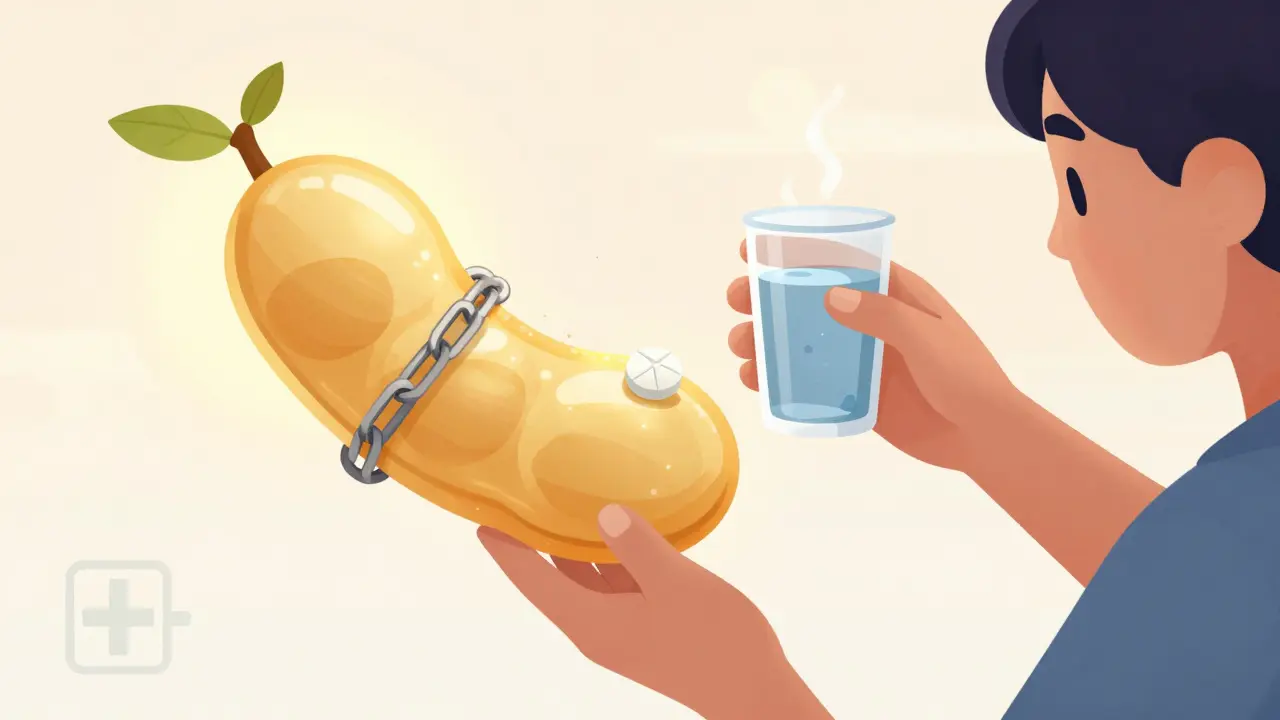
If you're taking levothyroxine for hypothyroidism and you love tofu, soy milk, or edamame, you’re not alone-but you might be making a simple mistake that’s messing with your medication. It’s not that soy is bad for you. It’s that soy can block your thyroid medicine from being absorbed properly. And if that happens, your TSH levels can creep up, you might feel tired again, and your doctor might keep increasing your dose-without ever figuring out why.
Why Soy Interferes with Thyroid Medicine
Soy contains compounds called isoflavones-mainly genistein and daidzein. These aren’t toxins. They’re natural plant chemicals. But when they meet levothyroxine in your gut, they stick to it like glue. This binding prevents your body from absorbing the hormone your thyroid can’t make anymore. Studies show this can cut absorption by 9% to 30%, depending on how much soy you eat and when you eat it. This isn’t new. Back in the 1960s, doctors noticed babies on soy formula needed way higher doses of levothyroxine than those on regular formula. Fast forward to today, and the same thing happens in adults. A 2006 case report told the story of a woman who took 200 micrograms of levothyroxine daily-double the usual dose-because she drank soy protein shakes right after her pill. Her TSH stayed high until she stopped mixing them. Here’s the twist: soy doesn’t damage your thyroid. It doesn’t make hypothyroidism worse. It just hides your medicine from your body. That’s why some people take soy every day and never notice a problem-they’re timing it right.How Much Soy Is Too Much?
Not all soy is created equal. A cup of soy milk? That’s a problem if you drink it with your pill. A small serving of tofu in your stir-fry? Less risky. A soy protein shake with 30 grams of soy isolate? That’s the worst-case scenario. Research shows:- Whole soy foods (tofu, tempeh, edamame) reduce absorption by up to 30% when eaten at the same time as levothyroxine.
- Soy milk causes a 9-15% drop in absorption.
- Soy isoflavone supplements (pills or powders) are less disruptive than whole foods, but still risky if taken together.
- Other things like calcium, iron, and coffee interfere more than soy. But soy is still in the top three.
Timing Is Everything
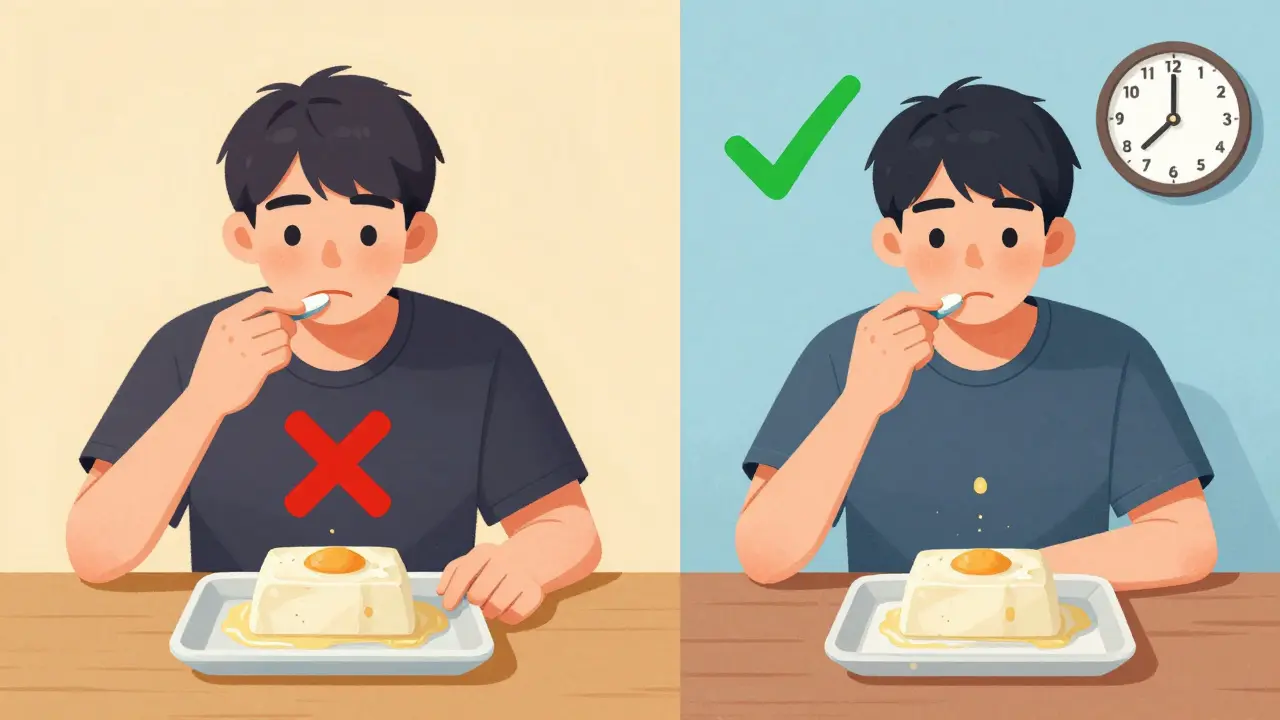
This is the key. You don’t have to quit soy. You just need to separate it from your pill. The latest guidelines from Mayo Clinic (2023) say:- Take levothyroxine on an empty stomach with a full glass of water.
- Wait at least 60 minutes before eating or drinking anything else.
- Wait at least 2 hours after your pill before eating soy products.
- For children and infants, wait 3-4 hours.
What About Vegetarians and Vegans?
If you’re plant-based, soy is probably a big part of your protein. That’s fine. But you need to be smarter about timing. A 2022 survey found that 74% of vegetarians and vegans with hypothyroidism have been told by their doctor to avoid taking soy with their medication. Many of them were surprised-some thought soy was “natural,” so it must be safe. Here’s what works for real people:- Take your pill first thing in the morning, wait 3 hours, then have your soy smoothie or tofu scramble.
- Swap soy milk for almond or oat milk at breakfast, and save soy for lunch or dinner.
- Use soy sauce or miso-they have way less soy protein and don’t interfere.
- If you take soy protein powder, don’t mix it with your pill. Take it with lunch or after dinner.
What Doesn’t Work
Don’t fall for these myths:- “I’ve been taking soy with my pill for years and feel fine.” That’s luck. Your body might be absorbing enough right now, but stress, illness, or a change in diet could trigger a drop in absorption. Don’t risk it.
- “My doctor says it’s fine.” Not all doctors know this. A 2022 survey showed only 68% of endocrinologists routinely advise patients on soy timing. If yours didn’t mention it, ask.
- “I’ll just take a higher dose.” That’s treating the symptom, not the cause. You’re masking the problem, not fixing it. Your dose could keep creeping up until you’re on way more than you need.
What Else Interferes?
Soy isn’t the only troublemaker. Here’s the ranking of common interferers, from worst to least:- Calcium supplements (especially carbonate) - can cut absorption by 25-36%
- Iron supplements - similar to calcium
- Soy products - 9-30% reduction
- High-fiber foods (like psyllium) - up to 20% reduction
- Coffee - about 20% reduction
How to Stay on Track
Create a routine. Consistency beats perfection.- Set a phone alarm: “Take pill” at 7 a.m.
- Another alarm: “Can eat soy” at 10 a.m.
- Keep a small note on your fridge: “No soy within 2 hours of pill.”
- If you travel, pack your pill in a separate container. Don’t let it sit next to your soy yogurt.
- Check labels. Soy hides in broths, protein bars, and even some breads.
Final Takeaway
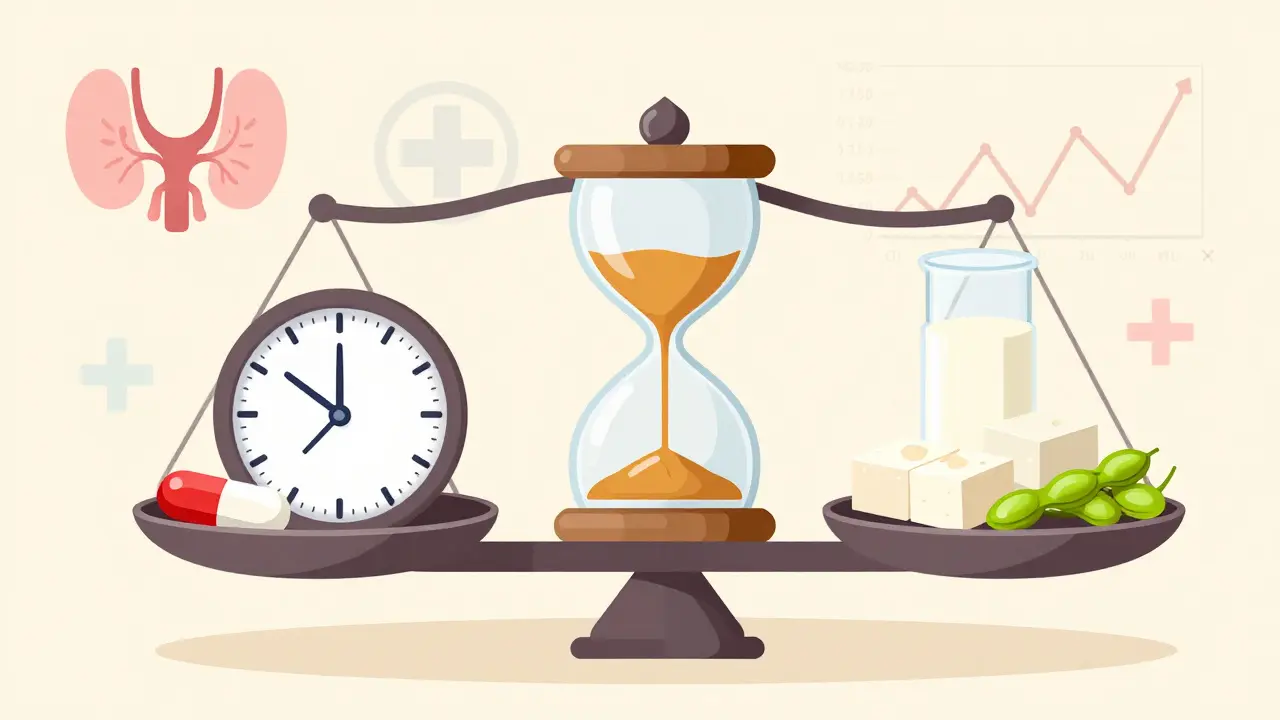
You don’t have to give up soy. You just need to time it right. Levothyroxine is a life-changing medication. Soy is a healthy food. They can coexist-just not in the same hour. The science is clear: separation works. Waiting two hours is enough for most adults. For kids, go longer. For soy protein powders, err on the side of caution. And if your TSH is creeping up for no reason, check your soy habits first. It’s not about fear. It’s about control. You’re managing your health. And small changes in timing make all the difference.Can I drink soy milk with my thyroid medication?
No, you should not drink soy milk at the same time as your thyroid medication. Soy can reduce how much levothyroxine your body absorbs. Wait at least 2 hours after taking your pill before drinking soy milk or eating any soy product.
Does soy make hypothyroidism worse?
No, soy does not cause or worsen hypothyroidism itself. It doesn’t damage your thyroid gland. But if you’re taking levothyroxine, soy can block your body from absorbing the medication properly, which can make your symptoms return-even if your thyroid is functioning fine.
How long should I wait after taking levothyroxine before eating soy?
Wait at least 2 hours. For children, infants, or if you’re eating large amounts of soy (like a protein shake), wait 3-4 hours. Studies show that 2 hours is enough to prevent most absorption interference in adults.
Are all soy products equally bad for thyroid medication?
No. Whole soy foods like tofu, edamame, and soy milk have more protein and isoflavones, so they interfere more. Soy sauce, miso, and tempeh have much less soy protein and are generally safe even close to your pill time. Soy protein powders and supplements are the strongest interferers-always separate them by 3 hours.
Can I take my thyroid pill at night instead of in the morning?
Yes, many people do. Taking levothyroxine at bedtime, at least 2-3 hours after your last meal, works just as well as morning dosing. This can make it easier to avoid soy if you eat it for breakfast. Just make sure you’re consistent-take it the same time every day.
What if I accidentally eat soy right after my pill?
One mistake won’t ruin your treatment. But if it happens often, your TSH levels may rise over time. Don’t panic-just get your thyroid levels checked in 6-8 weeks. In the future, set a reminder to avoid soy for at least 2 hours after your pill.
Do I need to avoid soy forever?
No. You don’t need to avoid soy forever. You just need to time it right. Most people can enjoy soy safely by waiting 2-3 hours after taking their medication. It’s not about giving up your favorite foods-it’s about making them work with your treatment.

So let me get this straight-you’re telling me I gotta wait TWO HOURS after my pill to eat my damn tofu bowl? That’s like telling a starving man to wait until after the buffet to eat. This is ridiculous. I’ve been eating soy with my meds for 12 years and I’m fine. My TSH is perfect. You people are overreacting like it’s a damn plague.
From a clinical endocrinology standpoint, the isoflavone-mediated inhibition of intestinal thyroxine absorption is well-documented via competitive binding to transthyretin and reduced passive diffusion across enterocytes. The 2023 meta-analysis in the European Thyroid Journal confirms a statistically significant but clinically marginal TSH elevation (0.35 mIU/L) only in subclinical hypothyroid cohorts. Timing mitigation remains the gold standard-2-hour separation achieves >95% bioavailability restoration.
Love this breakdown 🙌 Totally get it-soy isn’t the enemy, just a sneaky roommate who steals your meds. I switched to oat milk in the a.m. and save my edamame for dinner. Small change, huge difference. My energy’s back and my doc didn’t even need to adjust my dose. You’re not alone, friend 💪
Oh wow. So now we’re treating healthy adults like fragile lab rats because of some soy isoflavones? Let me guess-the pharmaceutical industry paid these ‘experts’ to scare people off plant-based diets. I’ve been vegan for 15 years, take my levothyroxine with my soy smoothie, and I run marathons. Your ‘guidelines’ are fear-mongering dressed up as science. If your TSH is ‘creeping up,’ maybe your dose is wrong-not your tofu. Don’t let corporate medicine turn your breakfast into a minefield.
Thank you for this clear, compassionate, and scientifically accurate guide. This information is vital for individuals managing thyroid health, and your emphasis on timing rather than elimination is both practical and empowering. I encourage all patients to discuss these nuances with their healthcare providers to optimize treatment outcomes with dignity and confidence.
took my pill at 7, ate soy at 10, tsh dropped from 5.1 to 2.0 in 6 weeks. no joke. i used to think i was fine until i started tracking. now i set a reminder. its not hard. just dont be lazy.
It’s wild how something so simple-timing-can fix what meds alone can’t. We treat thyroid issues like they’re broken machines, but the body’s just… waiting for the right rhythm. Soy isn’t the villain. Rushing is. Maybe the real problem isn’t what we eat, but how fast we eat everything. Slow down. Wait. Breathe. The medicine will find its way.
My cousin in Delhi has hypothyroidism and eats soy daily. She takes pill at 6am, eats soy at 9am. Her TSH is always normal. So 3 hours is safe. No need to panic. Just wait a bit. Easy.
Oh please. This is just another woke nutrition cult trying to make people feel guilty for eating food. Soy is a superfood. Levothyroxine is a synthetic hormone made in a lab. Who’s the real problem here? The plant or the pill? I’d rather have a 10% drop in absorption than give up my daily tempeh bacon. Your ‘guidelines’ are a scam to sell you more meds. I’m not changing my life for a 0.35 mIU/L bump.
bro i just take my pill at night before bed. no soy after 7pm. no stress. no alarms. life’s good. 🤙
Okay I just had to say this-I’m a vegan mom of two, and I used to give my kids soy formula with their thyroid meds. I didn’t know any better until my oldest’s TSH went through the roof. We switched to almond milk in the morning, waited 3 hours before soy, and now her levels are perfect. I cried when I saw the results. This isn’t just about me-it’s about my kids. Thank you for writing this. I wish I’d known sooner.
The empirical data presented herein, while methodologically sound, suffers from a notable conflation of correlation with causation in the context of dietary interference. The assumption that temporal separation alone resolves bioavailability issues neglects interindividual pharmacokinetic variability, including gastric pH, motility, and microbiome composition. A more rigorous approach would involve therapeutic drug monitoring via serum free T4 assays rather than relying on TSH as a surrogate marker.
Hey, if you’re reading this and you’re new to this whole thyroid thing-you got this. It’s okay to feel overwhelmed. I was there. I thought I had to give up tofu forever. Turns out, I just needed to wait a couple hours. You’re not broken. You’re not failing. You’re just learning. Take it slow. One meal at a time. You’re doing better than you think.
How dare you suggest soy is harmless? This is the same propaganda pushed by Big Soy to undermine public health. Soy contains phytoestrogens that disrupt endocrine function across the board-thyroid, reproductive, even cognitive. You’re being manipulated into thinking it’s ‘just timing.’ It’s not. It’s poison. And if your doctor isn’t warning you, they’re complicit. Stop eating it. Period. No excuses.