
 8
Dec,2025
8
Dec,2025
Immunosuppressant Pregnancy Safety Checker
Trying to get pregnant while taking immunosuppressants isn’t something most people plan for. But for those managing autoimmune diseases like lupus, rheumatoid arthritis, or who’ve had organ transplants, it’s a real and urgent concern. The good news? Many people can have healthy pregnancies. The catch? It takes planning, timing, and a clear understanding of which drugs are safe-and which aren’t.
Not All Immunosuppressants Are Created Equal
If you’re on immunosuppressants and thinking about starting a family, the first thing to know is that these medications vary wildly in how they affect fertility and pregnancy. Some are relatively safe. Others can cause permanent damage.Azathioprine is one of the safest options. Over 1,200 pregnancies in women taking this drug showed no increase in birth defects or miscarriages. It’s often the go-to choice for doctors when patients plan to conceive. Even men on azathioprine don’t need to worry about sperm damage-no evidence shows it affects fertility.
On the other end of the spectrum is cyclophosphamide. This drug, often used for severe autoimmune conditions, can permanently destroy ovarian tissue. Studies show that 60-70% of women who receive cumulative doses over 7g/m² lose their ability to conceive naturally. For men, it causes irreversible azoospermia (no sperm) in about 40% of cases. If you’re on this drug and want kids someday, fertility preservation-like egg or sperm freezing-should be discussed before starting treatment.
Methotrexate is another big red flag. It’s highly toxic to developing embryos. Even small amounts can cause severe birth defects. You must stop taking it at least three months before trying to conceive. And yes, men too-sperm can carry traces of the drug, and it’s not worth the risk.
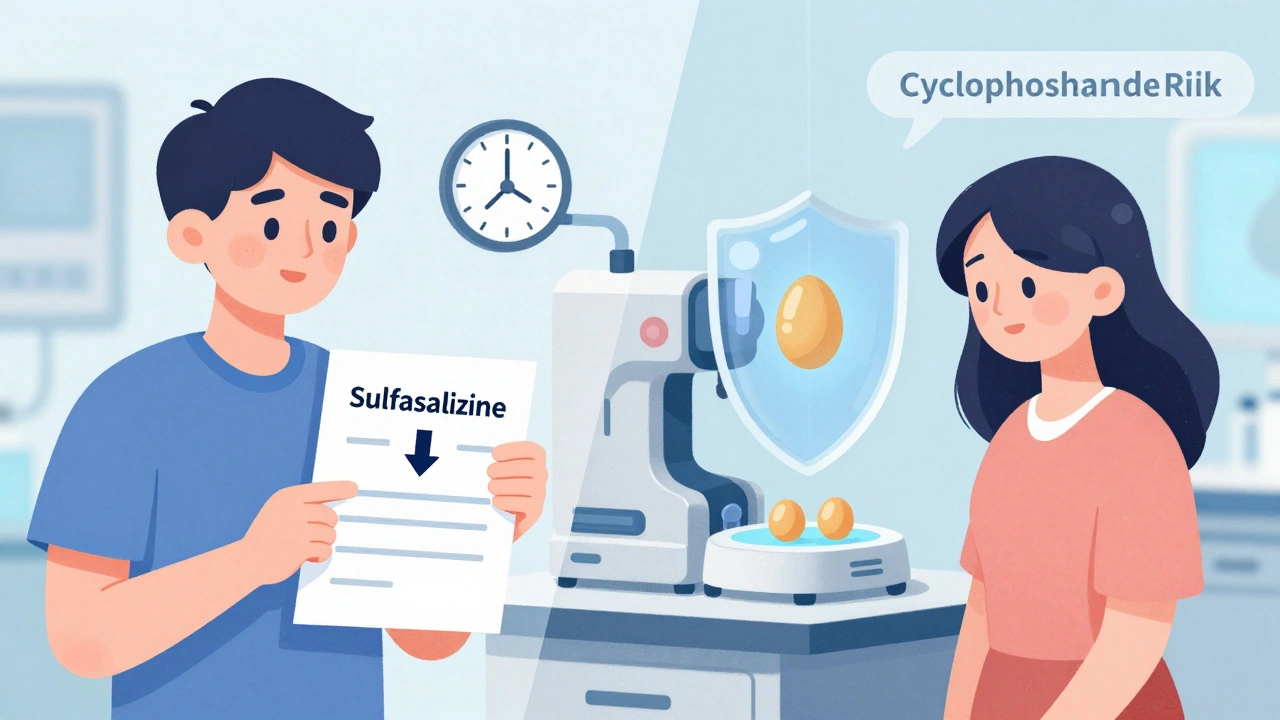
Sulfasalazine is tricky. It cuts sperm counts by 50-60%, making conception harder. But here’s the relief: this effect is fully reversible. Once you stop the drug, sperm counts bounce back in about three months. No freezing needed-just time.
Steroids and Pregnancy: A Delicate Balance
Corticosteroids like prednisone are often used long-term for autoimmune diseases. Many assume they’re harmless in pregnancy. They’re not harmless-but they’re manageable.Prednisone can interfere with ovulation and sperm production. It also raises the risk of premature rupture of membranes by 15-20%. That means your water could break too early. Still, unlike methotrexate or cyclophosphamide, you don’t need to stop prednisone cold turkey. Most doctors recommend continuing it at the lowest effective dose during pregnancy. Stopping it suddenly can trigger a disease flare, which is far more dangerous to the pregnancy than the drug itself.
Newer Drugs: Hope With Caveats
In the last decade, newer immunosuppressants like tacrolimus, sirolimus, and belatacept have become more common. Their safety data is still limited, but here’s what we know so far.Tacrolimus increases the risk of gestational diabetes by 30-40%. That means you’ll need more frequent blood sugar checks during pregnancy. But it doesn’t cause birth defects. Many transplant centers now prefer it over older drugs because the risks are predictable and manageable.
Sirolimus is a different story. Early reports show a 43% miscarriage rate in women who took it during early pregnancy-nearly three times the normal rate. There’s also one documented case of serious birth defects. The FDA and European regulators still list it as contraindicated in pregnancy. If you’re on sirolimus, switching to a safer alternative before conception is non-negotiable.
Belatacept is one of the few newer drugs with promising early data. Only three pregnancies have been reported so far, but all resulted in healthy babies with no abnormalities. That’s encouraging, but it’s not enough to call it safe yet. Doctors may consider it only if no other options exist-and only after thorough counseling.
Male Fertility: Often Overlooked
Most counseling focuses on women. But men on immunosuppressants need guidance too. Many of these drugs were approved before anyone tested their effects on sperm.Cyclophosphamide is the worst offender for men. As mentioned, it can cause permanent sterility. Even a single course can wipe out sperm production for years-or forever.
Sulfasalazine lowers sperm count, but again, it’s reversible. A semen analysis after stopping the drug, around three months later, can confirm recovery.
The FDA recommends testing sperm count at three key points: before starting the drug, after one full spermatogenic cycle (about 74 days), and again 13 weeks after stopping. That’s not routine practice everywhere-but it should be. If you’re a man on immunosuppressants and want kids, ask for a baseline semen analysis. It’s simple, non-invasive, and gives you real data to work with.
Preconception Counseling: Your Most Important Step
You can’t just stop a medication and hope for the best. This isn’t like quitting caffeine. Immunosuppressants control life-threatening conditions. Stopping them without a plan can trigger organ rejection or a flare-up of lupus or Crohn’s disease-which can be far more dangerous than the drugs.Experts recommend starting preconception counseling at least 3-6 months before trying to conceive. That’s not a suggestion. It’s a requirement.
During this time, your care team-rheumatologist, transplant specialist, OB-GYN, and possibly a fertility specialist-will:
- Review your current meds and switch to safer alternatives if needed
- Check your disease stability (you need to be in remission for at least 6 months)
- Test kidney and liver function (high creatinine levels before pregnancy raise preeclampsia risk)
- For women: assess ovarian reserve with AMH and FSH tests
- For men: perform a semen analysis
- Discuss fertility preservation options if you’re on high-risk drugs like cyclophosphamide
One study found that 85% of transplant centers now have formal protocols for this. But not all clinics do. If yours doesn’t, ask for a referral to a center that does. Your future child’s health depends on it.

What About Breastfeeding?
Many people worry about passing drugs to babies through breast milk. The answer varies by drug.Azathioprine is considered safe. Only tiny amounts pass into milk, and no adverse effects have been reported in nursing infants.
Chlorambucil is a hard no. It’s linked to serious birth defects and should never be used while breastfeeding.
Prednisone is generally okay. To minimize exposure, wait 3-4 hours after taking your dose before nursing. Most moms can breastfeed without issue.
For newer drugs like tacrolimus or belatacept, data is limited. Some doctors allow breastfeeding with monitoring. Others advise against it. This is a conversation you need to have with your doctor-don’t assume.
What Happens After Birth?
Babies born to mothers on immunosuppressants aren’t just at risk for birth defects. Their immune systems can be affected too.One study found that newborns of kidney transplant mothers had significantly lower B-cell and T-cell counts than babies of healthy mothers. That means they’re more vulnerable to infections in the first year of life. Their vaccines may need to be delayed or adjusted. Pediatricians need to know about drug exposure so they can monitor closely.
Long-term studies on growth, development, and cancer risk are still lacking. We don’t yet know if kids exposed in utero to tacrolimus or belatacept have higher rates of learning delays or autoimmune problems later in life. That’s why registries tracking these outcomes are so important-and why your participation matters if you’re part of a study.
The Bottom Line
Yes, you can get pregnant while on immunosuppressants. Yes, you can have a healthy baby. But it doesn’t happen by accident. It happens because you planned it.Don’t wait until you miss a period to ask questions. If you’re on any of these drugs and thinking about kids-whether you’re male or female, whether you’re trying now or in five years-talk to your doctor today. Bring this article. Ask for a referral to a fertility specialist who works with autoimmune or transplant patients. Ask for your drug’s safety profile in pregnancy. Ask for a semen test if you’re male.
Medications that were once thought to make pregnancy impossible are now manageable. But only if you act early, stay informed, and work with a team that knows the latest evidence. The science has caught up. Now it’s your turn to use it.





So basically if you’re on azathioprine you’re golden but if you’re on cyclophosphamide you’re screwed unless you froze your eggs years ago? Thanks for the clarity. I’m just glad I’m not the one having to make these calls.
Preconception counseling is not optional it is essential for patient safety and successful outcomes
Why are we even talking about this like its a choice? If you're on these drugs you're already playing with fire and now you want to make a baby? Wake up people
There’s hope here really there is. So many of us are told we can’t have kids and then we find out we can if we just plan ahead. You’re not broken you’re just navigating a different path and that’s okay
The data on tacrolimus and gestational diabetes is concerning but not surprising given its mechanism of action. However I find it curious that the literature on belatacept remains so sparse given its increasing use in transplant populations. The sample size of three pregnancies is statistically insignificant yet it is being cited as a basis for clinical consideration. This raises questions about the adequacy of postmarket surveillance for reproductive safety in immunosuppressive agents. A formal registry would be a necessary step forward rather than relying on anecdotal case reports
so if you're a guy on sulfasalazine just stop it for 3 months and you're good to go? no freezing needed? that's actually kinda relieving lol
Why is it always the woman who has to jump through hoops? Men get to just... exist while their sperm is getting wrecked by cyclophosphamide and nobody says a word. It's so tired
I had lupus and took azathioprine through my whole pregnancy. My son is 7 now and runs like a cheetah. This article? It’s the one I wish I’d found before I got pregnant. You’re not alone. You can do this
It is imperative that medical professionals prioritize preconception risk stratification for patients on immunosuppressive regimens. The ethical obligation to inform extends beyond mere disclosure to proactive coordination of multidisciplinary care
men need semen tests before starting these drugs why is this not standard everywhere it should be mandatory
I cried reading this. I’m on prednisone and I thought I’d never be a mom. I just started talking to my rheum and OB and I feel like maybe… maybe there’s a way
so let me get this straight… if you’re rich enough to freeze your eggs you’re fine but if you’re not? too bad? classic
bro this is wild but i just found out my cousin’s husband was on sulfasalazine and they got pregnant 4 months after he stopped. no big deal. also 🤞