
 1
Feb,2026
1
Feb,2026
What Works for IBS? Not All Diets Are Created Equal
If you’ve been dealing with bloating, cramps, or unpredictable bowel movements for years, you’re not alone. Around 1 in 7 people worldwide have irritable bowel syndrome (IBS), and for many, food is the biggest trigger. But not every diet advice you hear actually helps. Some make things worse. The truth? There are three main dietary approaches backed by science: the low-FODMAP diet, the low-residue diet, and general elimination diets. Only one of them is designed specifically for IBS-and it was developed right here in Melbourne.
The Low-FODMAP Diet: The Gold Standard for IBS
The low-FODMAP diet isn’t just another gluten-free or dairy-free trend. It’s a clinically proven, three-phase system created by researchers at Monash University to target specific carbohydrates that ferment in the gut and cause IBS symptoms. FODMAP stands for Fermentable Oligo-, Di-, Mono-saccharides And Polyols. These are sugars found in common foods like onions, garlic, apples, milk, honey, and artificial sweeteners like sorbitol.
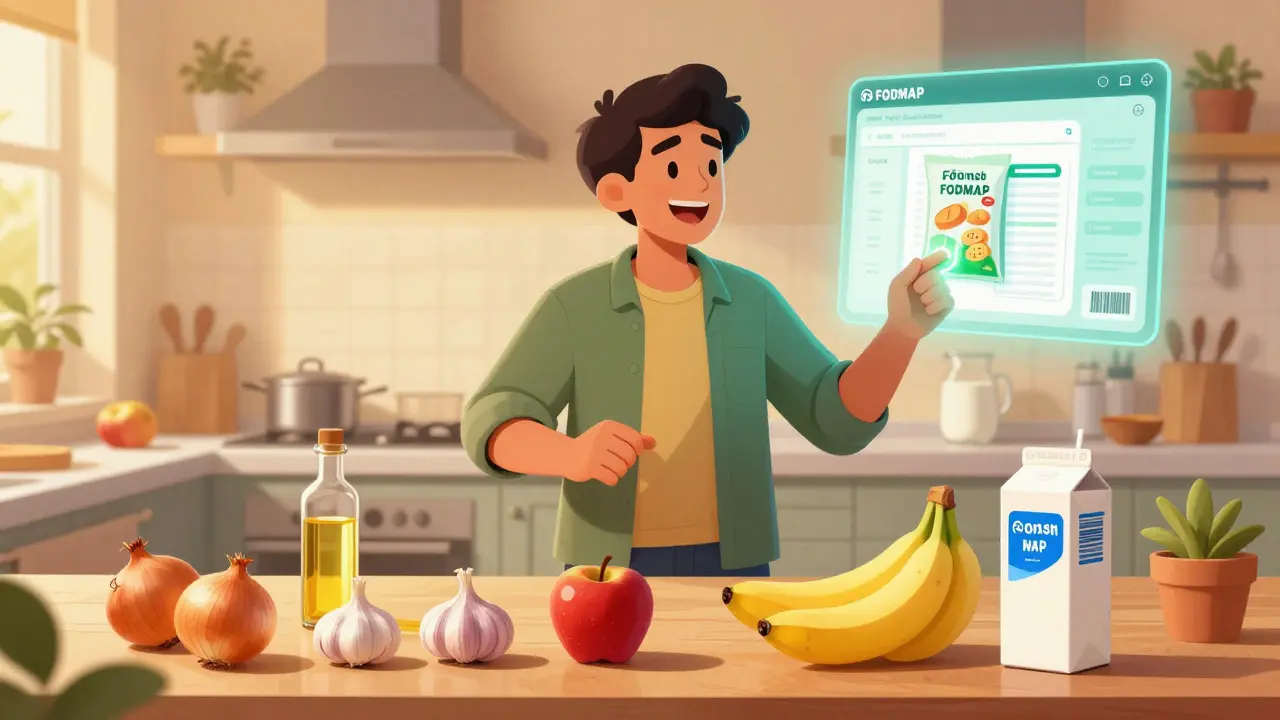
Phase 1 is strict: you cut out all high-FODMAP foods for 2 to 6 weeks. No garlic, no wheat bread, no apples, no beans, no cauliflower. Sounds extreme? It is-but it works. Studies show 75 to 80% of people see major improvement in bloating, pain, and diarrhea during this phase. You’re not starving; you’re just swapping. Instead of onion, use garlic-infused oil (the FODMAPs stay in the solid bits). Swap apples for bananas. Use lactose-free milk. The Monash FODMAP app, updated in 2023, has a barcode scanner that tells you if a packaged food is safe-even if it says “natural flavors” or “inulin” on the label.
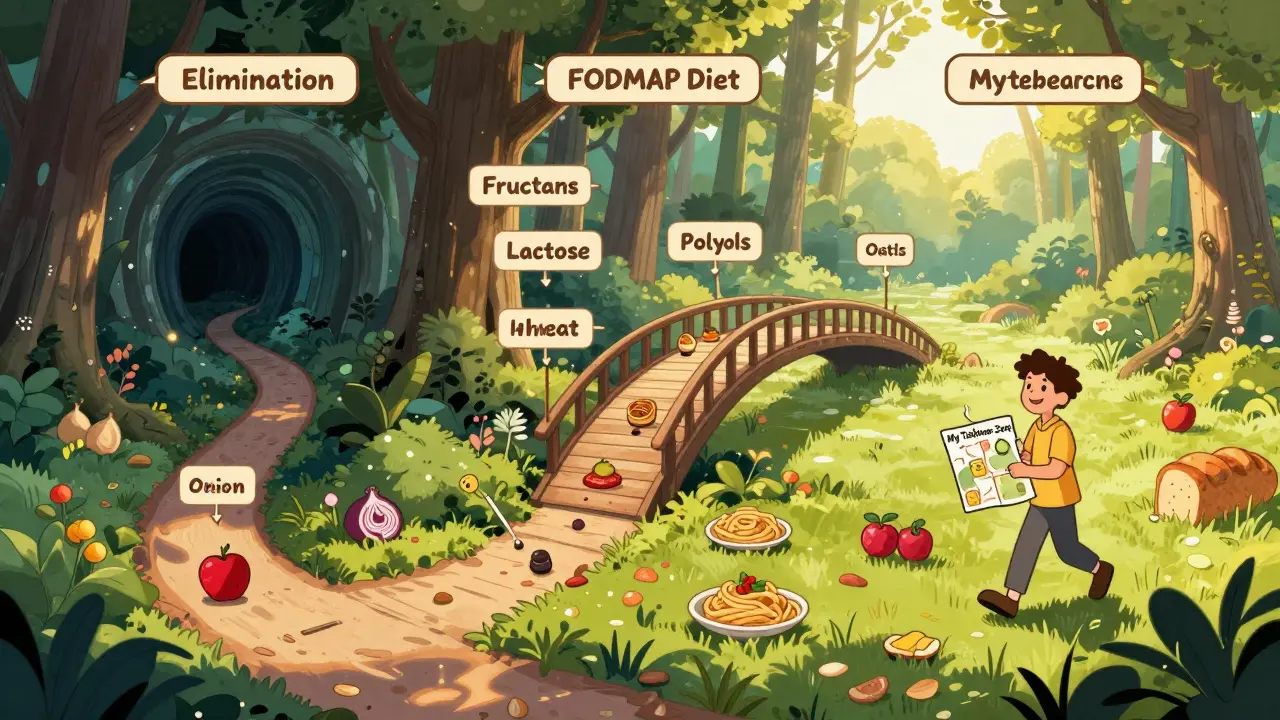
Phase 2 is where the real power lies. You slowly bring back one FODMAP group at a time. Start with fructans (found in wheat and onions). Eat 3 grams-about half a cup of cooked pasta-and track symptoms for 3 days. Then move to lactose, then excess fructose, then polyols (like chewing gum). Most people find they’re only sensitive to one or two groups. You don’t need to avoid all FODMAPs forever.
Phase 3 is personalization. You build a diet that includes 50 to 80% of the foods you cut out, based on what you can tolerate. Most people end up eating moderate amounts of FODMAPs without symptoms. This isn’t a lifelong restriction. It’s a map to freedom.
Low-Residue Diet: Why It’s Often the Wrong Choice
The low-residue diet sounds simple: eat soft, low-fiber foods to reduce bowel movement volume. You cut out raw fruits, vegetables, nuts, seeds, whole grains, and dairy. It’s often recommended for people with Crohn’s disease or before a colonoscopy. But for IBS? It’s a blunt tool.
Here’s the problem: 60 to 70% of IBS patients don’t need this level of fiber restriction. Cutting fiber too much can actually make constipation worse-especially if you have IBS-C. And it’s nutritionally risky. Studies show people on long-term low-residue diets drop their calcium intake by 25% and folate by 35%. That increases osteoporosis and anemia risk over time.
It also doesn’t help with bloating or gas. Those come from FODMAPs, not fiber. A 2022 Monash study found that while low-residue diets helped reduce diarrhea frequency slightly, they only improved bloating in 45% of users-compared to 75% on low-FODMAP. If you’re eating white toast, boiled chicken, and mashed potatoes for months, you’re not fixing the root cause. You’re just masking it.
General Elimination Diets: The Wild West of IBS Eating
Many people try cutting out gluten, dairy, caffeine, or sugar on their own. Sometimes they feel better. But why? Without a system, you’re guessing.
General elimination diets remove common trigger foods for 2 to 4 weeks, then add them back one by one. Sounds logical. But here’s the catch: without knowing which FODMAP subgroup is the problem, you might eliminate dairy (lactose) but miss fructans in bread or excess fructose in apples. A University of Virginia study found only 30% of people correctly identify their true trigger without professional guidance.
Plus, eliminating gluten without testing for celiac disease can hide a serious condition. Cutting out dairy might help if you’re lactose intolerant, but if you’re not, you’re just losing calcium and vitamin D. These diets lack the precision of FODMAP testing. They’re better than nothing if you can’t access a dietitian-but they’re not a replacement.
Who Should Try What?
Let’s cut through the noise. Here’s who benefits from each approach:
- Low-FODMAP diet: Best for people with bloating, gas, abdominal pain, or mixed IBS (diarrhea and constipation). Works best for IBS-D (diarrhea-predominant). If you’ve tried other diets and nothing worked, this is your next step.
- Low-residue diet: Only for short-term use during a flare-up of severe diarrhea. Not for long-term management. Avoid if you have constipation or are at risk for nutrient deficiencies.
- General elimination diet: Useful if you can’t access a dietitian or FODMAP resources. Can help identify obvious triggers like dairy or caffeine. But don’t expect lasting results without structured reintroduction.
Real People, Real Results
On Reddit’s r/FODMAP community, 78% of over 1,200 users reported major symptom relief after completing all three phases. One user wrote: “After 15 years of daily diarrhea, FODMAP eliminated it in 3 weeks.” Another said: “I thought I was gluten intolerant. Turns out, it was just onions and garlic.”
But it’s not easy. Sixty-five percent of people struggle with the reintroduction phase. Some get sick again when they test a food-so they quit. That’s why so many give up. The key? Don’t skip phase 2. If you never test, you never learn. You stay stuck on a diet that’s too restrictive.
Others face social challenges. Eating out during phase 1? Hard. Many restaurants use garlic, honey, or high-FODMAP sauces. Carrying Monash’s FODMAP-friendly restaurant cards helps. So does calling ahead. One Melbourne woman said she now books tables at lunchtime when kitchens are less busy-and always asks for sauces on the side.
What You Need to Succeed
You don’t need to be a nutrition expert. But you do need tools.
- The Monash FODMAP app: $9.99/month or $49.99/year. It’s the only app with lab-tested FODMAP levels for over 1,200 foods. Includes portion guides-because even low-FODMAP foods can trigger symptoms if you eat too much (like 1 teaspoon of garlic).
- A food and symptom journal: Track what you eat, portion sizes, and symptoms within 24 hours. Use a simple notebook or a free app like MySymptoms.
- A digital kitchen scale: Accurate to 1 gram. FODMAPs add up fast. A small cup of lentils might be safe, but a large one isn’t.
- A registered dietitian: Especially one certified in FODMAP. Studies show people with professional support are 40% more likely to complete the diet successfully. In Australia, Monash has a directory of certified dietitians. In the U.S., ask your gastroenterologist for a referral.
The Risks and the Reality
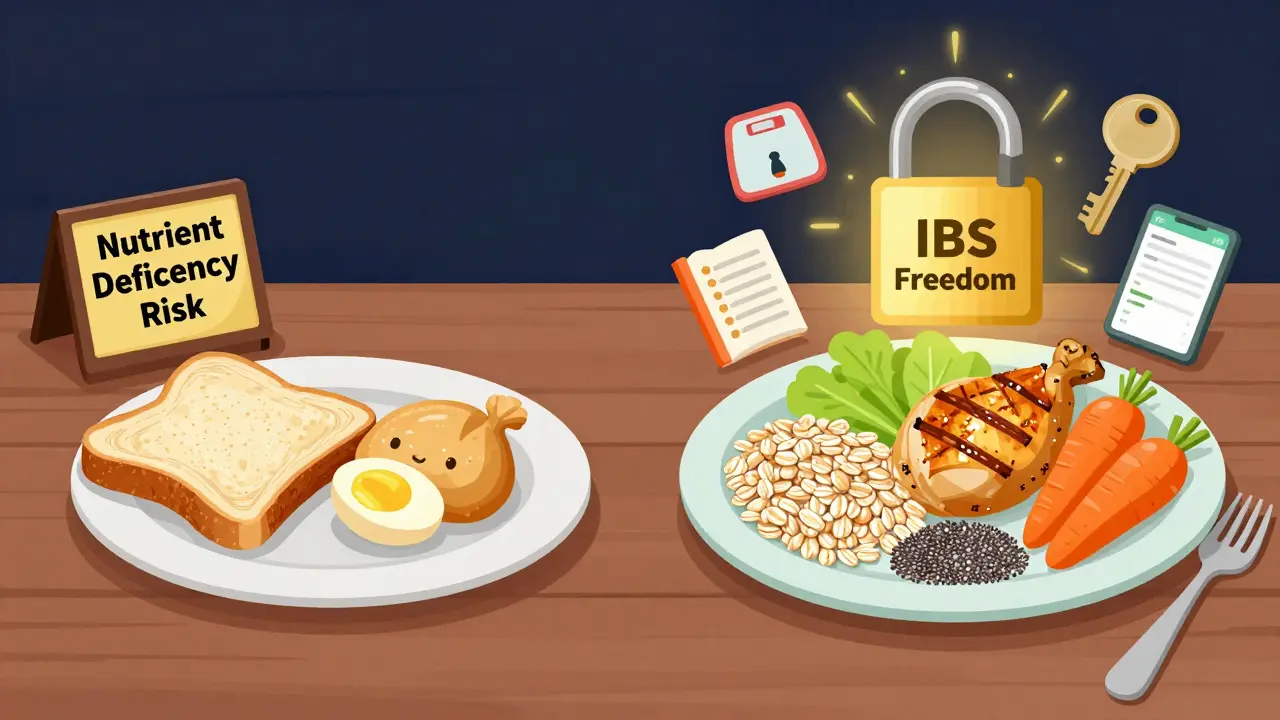
Yes, the low-FODMAP diet has downsides. During phase 1, gut bacteria like Bifidobacterium drop by 40% in just four weeks. That’s why reintroduction is critical-you need to feed your microbiome again. Long-term restriction without supervision can lower calcium intake by 30%, increasing fracture risk. It’s also not for people with eating disorders. In fact, 15% of IBS patients are advised against it for that reason.
And it’s not magic. About 25% of people don’t respond at all. That could be because stress, sleep, or other factors are driving their symptoms. Or they tried it wrong-skipped reintroduction, didn’t track portions, or didn’t give it enough time.
But for the rest? It’s life-changing. One woman in Sydney told me: “I went from missing work every week to running a 10K. All because I learned I could eat pasta again-just not with garlic butter.”
What’s Next for IBS Diets?
Science is moving fast. Monash is testing AI-powered meal planners in their app to predict safe meals based on your tolerance. Researchers are looking at gut microbiome patterns to predict who will respond to FODMAP diets before they even start. By 2026, doctors expect FODMAP tracking to be built into electronic health records.
But the core hasn’t changed: IBS isn’t caused by one food. It’s caused by how your gut reacts to certain carbs. And you don’t have to avoid them forever. You just need to know which ones are yours.
Can I do the low-FODMAP diet without a dietitian?
Yes, but it’s harder. Studies show people without professional help are only 45% likely to complete the reintroduction phase correctly. You’ll need the Monash FODMAP app, a food journal, and discipline. If you’re unsure, start with a single consultation. Even one session can prevent costly mistakes.
How long does the low-FODMAP diet take?
The full process takes 3 to 6 months. Phase 1 (elimination) lasts 2 to 6 weeks. Phase 2 (reintroduction) takes 8 to 12 weeks. Phase 3 (personalization) is ongoing. Most people feel better within 2 weeks of starting, but the real goal is long-term freedom-not permanent restriction.
Is the low-FODMAP diet the same as gluten-free or dairy-free?
No. Gluten-free removes wheat, barley, and rye-but wheat contains fructans, a FODMAP. Dairy-free removes lactose-but lactose is just one of five FODMAP groups. You can eat gluten-free bread and still have symptoms if it contains onions or honey. The low-FODMAP diet targets specific sugars, not just gluten or dairy.
Will the low-FODMAP diet help with constipation?
It can, but less reliably than for diarrhea. About 40 to 50% of people with IBS-C see improvement. The key is avoiding low-FODMAP foods that are also low in fiber, like white rice and processed snacks. Focus on low-FODMAP fiber sources like oats, chia seeds (1 tablespoon), and carrots. Hydration and movement matter just as much.
Can I eat out on a low-FODMAP diet?
Yes, but plan ahead. Look for restaurants with grilled meats, plain rice, steamed vegetables (carrots, zucchini), and olive oil-based sauces. Avoid garlic, onion, garlic powder, honey, and high-FODMAP condiments. Call ahead and ask for sauces on the side. Monash’s FODMAP-friendly restaurant cards can help explain your needs simply.
What if I don’t feel better after 6 weeks?
Don’t assume the diet failed. Check your execution: Did you avoid all high-FODMAP foods? Did you track portions? Did you check for hidden FODMAPs in sauces, dressings, or supplements? Some people need longer than 6 weeks. Others have other triggers like stress, SIBO, or medication side effects. Talk to your doctor or dietitian. You might need further testing.
Final Thought: It’s Not About Perfection
You don’t need to be flawless. You need to be consistent. One slip-up won’t ruin everything. The goal isn’t to live on plain chicken and rice forever. It’s to find your own balance-so you can enjoy life without fear of your gut betraying you. The low-FODMAP diet isn’t a prison. It’s a key. And once you turn it, you’ll see what’s been hidden all along: food that doesn’t hurt you.
i tried the low-fodmap thing last year after my doc said 'maybe try not eating everything' lol. i thought it was bullsh*t but honestly? after 3 weeks i stopped feeling like a balloon filled with soda. the app is a game changer. i now eat pasta with olive oil and parmesan and cry happy tears. also garlic oil? genius.
if you're not eating real american food you're not eating at all. why are we letting australian scientists tell us what to eat? we got burgers and fries and they don't give you bloating. if your gut can't handle america, maybe your gut needs a visa.
so you're telling me the solution to 15 years of suffering is... buying an app? 😂 i'm sure your 49.99/year subscription will fix your trauma. meanwhile, real people eat onions and live. you're not broken, you're just weak. 🤦♀️
as a canadian who once tried to eat 'fodmap-friendly' ramen and ended up crying in a subway station... i get it. the diet sounds like a cult. but honestly? after my flare-up last winter, i did phase 1 for 4 weeks and i could finally sit through a movie without planning 3 bathroom breaks. it's not perfect, but it's not magic either. just science with a fancy acronym.
the fact that you can buy a barcode scanner app to tell you if your cereal is safe is both hilarious and terrifying. we’ve gone from ‘eat your veggies’ to ‘avoid anything that sounds like a chemical compound’. but hey, if it works, i’m not judging. just please don’t tell me what’s in my coffee creamer.
in south africa, we eat pap and chakalaka and onions and no one has IBS. this is a western problem caused by overthinking food. you eat what your ancestors ate. you don't pay for apps to tell you onions are bad. your ancestors didn't have barcode scanners. they had guts. and so do you.
the monash study is funded by a university that patented the diet. of course they say it works. the real question is why no one’s testing if stress, sleep, or the fact that you’re scrolling reddit at 2am is the actual trigger. this feels like corporate medicine selling anxiety as a subscription
just wanted to add that phase 2 is the hardest but also the most empowering. i thought i was allergic to dairy. turned out i could handle 2 tablespoons of Greek yogurt. then i tried garlic and exploded. now i know. it’s not about restriction. it’s about knowledge. and yes, the app is worth every cent. i used to live in fear. now i cook for friends.
PLEASE, if you’re doing this, keep a journal. write down EVERYTHING. even the mint tea. even the ‘just one bite’ of cake. i did this for 9 months and learned that my trigger was honey in my kombucha. i never would’ve known. also, don’t skip the dietitian. i did it alone and almost gave up. one session changed everything.
my doctor said ‘try it’. i did. i’m alive. that’s all you need to know.
so let me get this straight - you’re telling me the solution to my digestive issues is to stop eating onions, garlic, apples, and wheat... and then pay $50 a year to know if my yogurt has inulin? i’m sorry, but if you can’t handle real food, maybe you should stop eating. this isn’t a diet. it’s a lifestyle of fear.
i used to think i was lactose intolerant. turned out i was just eating too much almond milk (high in polyols). now i drink oat milk, use garlic oil, and eat a banana every morning. i’m not ‘cured’ but i’m not crying in public bathrooms anymore. this diet didn’t fix me. it just gave me back my life. and yes, the app is worth it. i’ve used it 372 times.