
 26
Dec,2025
26
Dec,2025
Light hurts your eyes-not just a little, but enough to make you squint, close them, or even leave the room. If you’ve ever flinched at a fluorescent bulb, felt pain under sunlight, or avoided going outside because your eyes felt like they were burning, you’re not alone. About 35% of people experience this, and most don’t realize it’s a symptom, not a condition. This isn’t just about being sensitive to brightness. It’s your nervous system sending alarm signals. And if you’re ignoring it, you could be missing something serious.
What’s Really Going On When Light Hurts?
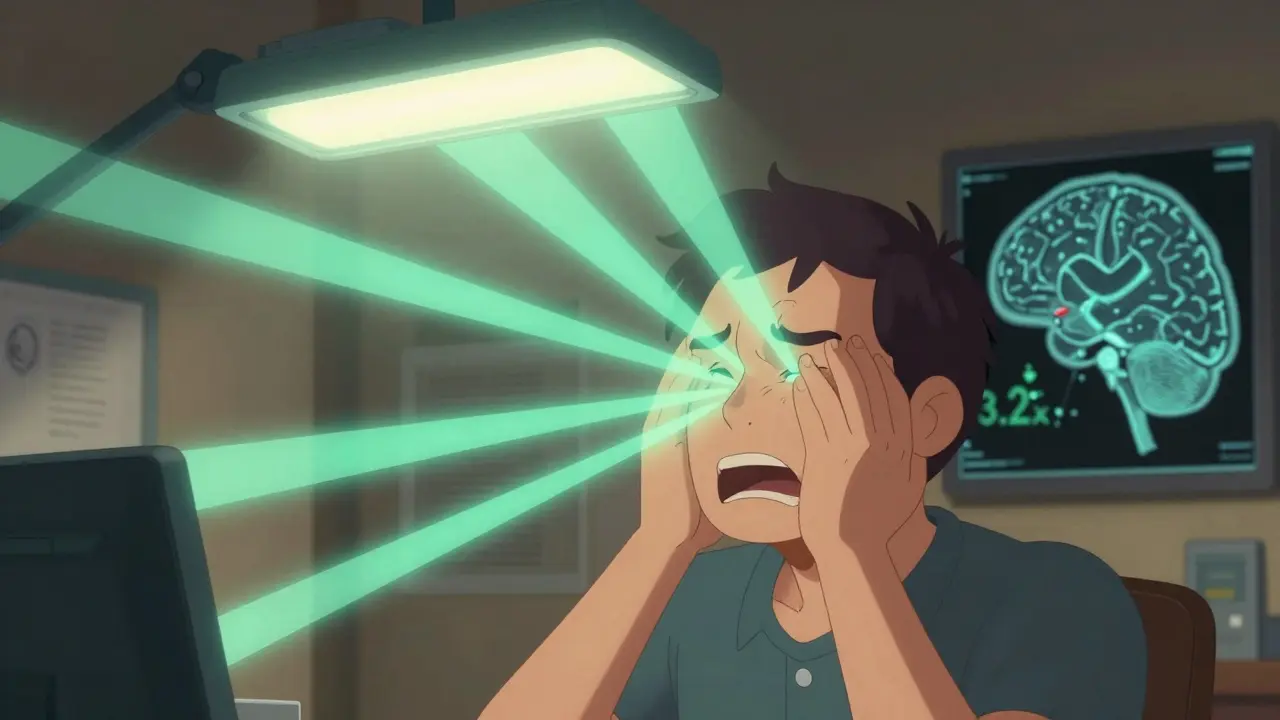
Photophobia isn’t a fear of light-it’s a neurological reaction. Your eyes aren’t broken. Your brain is overreacting. When light hits the retina, signals travel through the trigeminal nerve to areas of the brain that process pain. In people with photophobia, that signal gets amplified. A regular office light at 500 lux can feel like staring into a spotlight. Studies using fMRI show these individuals have 3.2 times more brain activity in the thalamus than people without sensitivity. It’s not about how bright the room is. It’s about the wavelength. The worst offenders are blue-green light between 500-550 nanometers. That’s the range emitted by LEDs, fluorescent bulbs, and screens. Normal eyes adjust fine. Photophobic eyes don’t. Their pupils barely constrict-even at just 0.5-2.0 lux, where most people wouldn’t blink twice.Three Main Causes (And What They Mean for You)
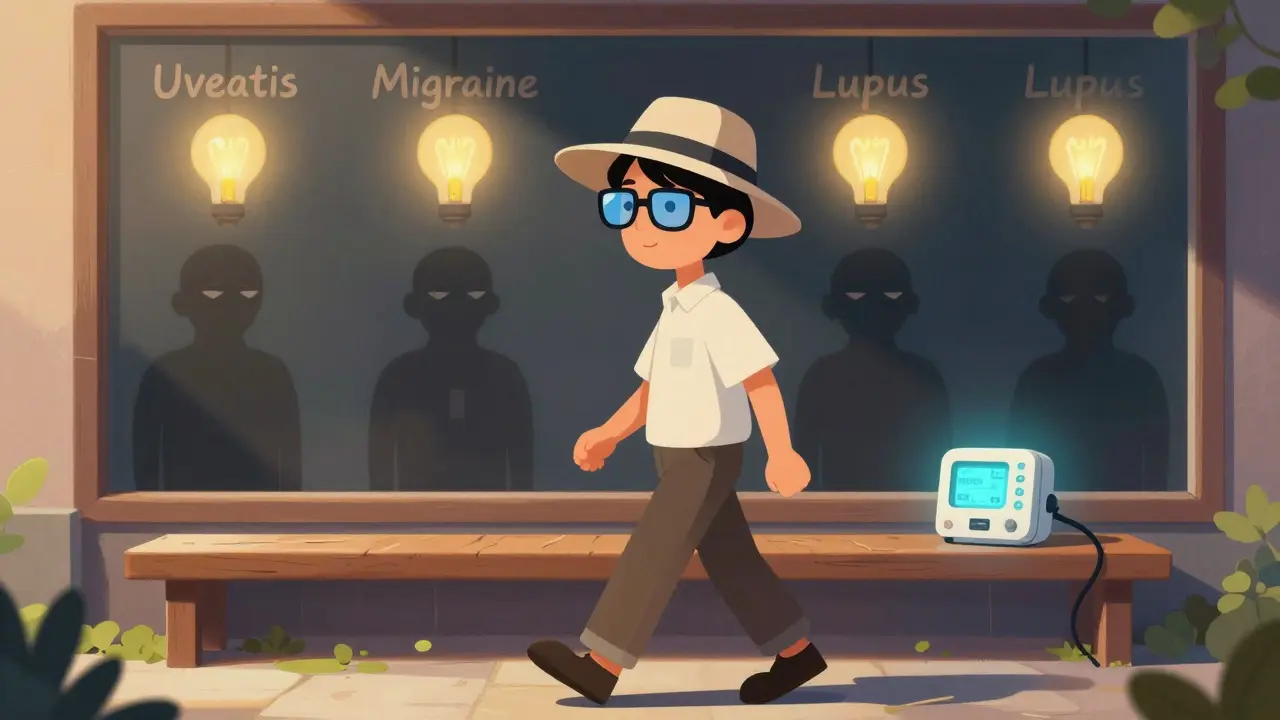
Photophobia doesn’t come out of nowhere. It’s tied to one of three categories:- Eye conditions (45% of cases): Uveitis, corneal abrasions, albinism, or even dry eye can trigger it. If you’ve had redness, blurred vision, or eye pain along with light sensitivity, this is likely the cause. Uveitis is especially sneaky-92% of patients report light sensitivity before any other symptoms.
- Neurological issues (40% of cases): Migraines are the biggest culprit here. Between 76% and 80% of migraine sufferers have photophobia during attacks. But it’s not just migraines. Concussions, meningitis, and even brain tumors can cause it. The type of light sensitivity can actually help doctors tell them apart: migraine-related photophobia comes from cone-driven pathways, while meningitis triggers rod-driven responses.
- Medications (15% of cases): Some drugs make your eyes more reactive. Antibiotics like tetracycline, diuretics, and even some antidepressants can do this. If you started a new medication and then noticed light became unbearable, talk to your doctor.
How Bad Is It? The Three Levels of Photophobia
Not everyone with photophobia is the same. Severity falls into three clear tiers:- Mild (48%): You’re fine indoors, but direct sunlight hurts. You wear sunglasses outside, take cover under awnings, and avoid midday walks.
- Moderate (37%): Even indoor lighting is a problem. Fluorescent lights in offices, grocery stores, or schools trigger discomfort. You start wearing tinted glasses indoors.
- Severe (15%): Pain happens at 50 lux or higher-that’s the brightness of a dimly lit living room. You might avoid public spaces entirely. Some can’t work. Studies show these individuals have 52% lower workplace productivity and often report 20/40 vision or worse in bright conditions.
The FL-41 Lens Solution (And Why Most People Get It Wrong)
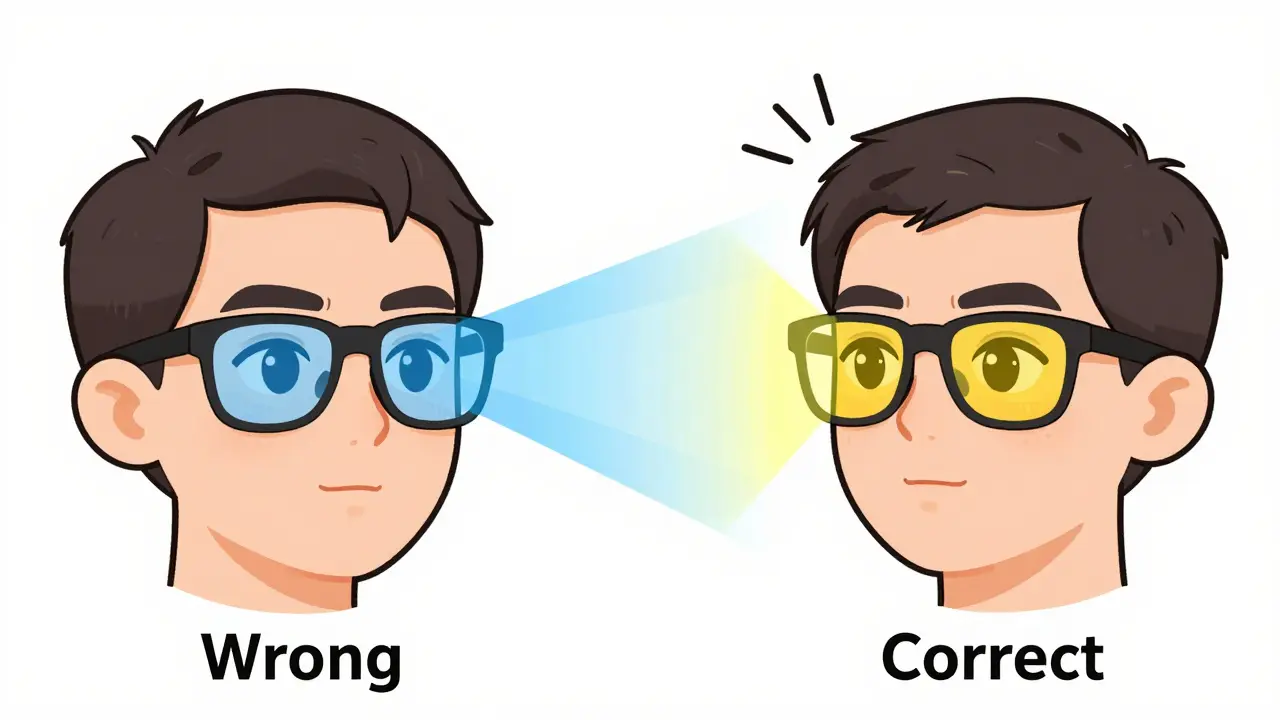
There’s one tool that’s changed lives: FL-41 tinted lenses. These aren’t regular sunglasses. They’re specially filtered to block 70% of the blue-green wavelengths that trigger photophobia. In clinical trials, users saw a 43% reduction in symptoms. On Reddit, users report migraine frequency dropping from 18 to 5 per month within three weeks. But here’s the catch: 73% of people who try tinted glasses fail because they pick the wrong ones. Blue-light blocking glasses marketed for screens? They filter the wrong part of the spectrum. They block 450nm light, but photophobia needs 500-550nm blocked. Using the wrong lens can make things worse. FL-41 lenses are sold under brands like TheraSpecs and are priced around $149. They’re not cheap, but they’re the only non-drug solution with solid clinical backing. Most users need 2-3 weeks to adapt. The first few days feel weird-colors look muted, especially greens and blues. But that fades. Your brain recalibrates.When to See a Doctor (And What Tests to Ask For)
If you’ve had light sensitivity for more than a few days, especially if it’s new or worsening, you need a proper diagnosis. Don’t let a doctor dismiss it as “just migraines.” Ask for:- A full eye exam with dilation to check for uveitis, glaucoma, or corneal damage.
- A neurological evaluation if migraines are involved or if you have headaches, nausea, or dizziness.
- Autoimmune screening if you’re female, over 30, and have joint pain or rashes. Lupus causes 46% of non-eye-related photophobia cases.
What Doesn’t Work (And Why)
Many people waste time and money on solutions that don’t address the root problem:- Blue-light screen filters: They only help 38% of cases. Ambient lighting is the real trigger in 62% of workplace cases.
- Darkening your whole house: Going pitch black makes your eyes more sensitive over time. You need controlled, low-light environments, not total darkness.
- Over-the-counter eye drops: Unless prescribed for dry eye or inflammation, they won’t touch photophobia.
- Just taking painkillers: Tylenol or ibuprofen might dull the headache, but they won’t stop the light sensitivity. You’re treating the symptom, not the cause.
Managing Daily Life: Practical Steps
You don’t have to quit your job or hide at home. Here’s how to take control:- Switch to warm-white LED bulbs (2700K-3000K) at home. Avoid cool white or daylight bulbs.
- Install dimmable lights. Keep indoor lighting between 100-200 lux. Use task lighting instead of overheads.
- Wear FL-41 lenses indoors and out. They’re discreet now-many look like regular glasses.
- Use a hat with a wide brim outdoors. Combine it with sunglasses for maximum protection.
- Keep a symptom journal. Note what lighting triggered it, how long it lasted, and if you had a headache. This helps your doctor spot patterns.
What’s Coming Next
The future is promising. The National Eye Institute is testing a new eye drop that targets TRPM8 receptors-the same ones that sense cold. Early trials show a 60% reduction in sensitivity. If approved in 2025, this could be a game-changer. Workplaces are catching on too. Twenty-eight percent of Fortune 500 companies now follow new OSHA lighting standards (effective January 2024) that require adjustable lighting between 300-500 lux. Employees with photophobia are getting accommodations like desk lamps, window shades, and screen filters.Final Thought: This Is Your Body Warning You
Photophobia is not normal. It’s not something you just “get used to.” It’s your body’s way of saying: something is wrong. Whether it’s a treatable eye condition, a migraine disorder, or an autoimmune issue, ignoring it can delay diagnosis by weeks-or even months. The good news? With the right diagnosis and tools like FL-41 lenses, 78% of people see major improvement within six months. You don’t have to live in the dark. You just need to know what to look for-and who to ask for help.Is photophobia the same as being sensitive to bright light?
No. Everyone reacts to bright light-squinting, blinking, looking away. Photophobia is when light causes actual pain, nausea, or the urge to flee. It’s not just discomfort-it’s a neurological response tied to underlying conditions like migraines, eye inflammation, or neurological disorders.
Can blue-light blocking glasses help with photophobia?
Usually not. Most blue-light glasses block around 450nm, but photophobia is triggered by 500-550nm wavelengths-blue-green light. Using the wrong glasses can make symptoms worse. Only FL-41 tinted lenses are proven to filter the right wavelengths and reduce symptoms by 43% in clinical studies.
Is photophobia a sign of something serious?
Yes, sometimes. While often linked to migraines, it can be an early warning sign of uveitis, meningitis, lupus, or even brain tumors. In 12% of emergency cases, photophobia appears 48-72 hours before other symptoms. If it’s new, worsening, or paired with headache, fever, or vision changes, see a doctor immediately.
How long does it take to get used to FL-41 lenses?
Most people adapt in 2-3 weeks. Initially, colors may look dull or washed out, especially greens and blues. This is normal-your brain is adjusting to filtered light. Studies show 68% of users report this color distortion, but it fades as your visual system recalibrates. Don’t give up too soon.
Can photophobia cause permanent vision damage?
Not directly. But if it’s caused by an untreated condition like uveitis or glaucoma, those can lead to permanent vision loss. Photophobia itself doesn’t damage your eyes-it’s the underlying disease that does. That’s why getting diagnosed is critical.
Do I need to avoid all sunlight if I have photophobia?
No. Avoiding sunlight entirely can lead to vitamin D deficiency-people with chronic photophobia have a 27% higher risk. Instead, use FL-41 sunglasses, wear a wide-brimmed hat, and go outside during early morning or late afternoon when light is softer. You can still get outside safely.


Light hurts? Yeah, I used to think I was just weird. Then I got diagnosed with migraines. FL-41 lenses saved my job. No more hiding in the break room.
I swear, the first time I put on FL-41s, I cried 😭 Not from pain-from relief. Like someone finally turned off a scream I didn’t know I was hearing. My friends thought I was dramatic. Now they’re asking where I got them.
Y’all need to stop buying those Amazon blue-light glasses. They’re a scam. FL-41 is the only thing that works. I’ve tried 5 different brands. Only TheraSpecs didn’t make my head explode.
I work in a hospital. We’ve had 3 nurses quit because the fluorescent lights gave them daily migraines. We just installed dimmable LEDs and ordered FL-41 glasses for everyone who asked. Morale’s up. Absenteeism down. Why isn’t this standard everywhere?
As someone who grew up in India with no access to specialist care, I spent 7 years thinking I was just "too sensitive." If you’re reading this and feel alone-please know you’re not. There are people who get it. And help exists.
Ah, yes. The neoliberal commodification of neurological suffering: "Buy this $149 pair of glasses and your pain will be... aestheticized." How quaint. We’ve turned bodily alarm systems into consumer products while ignoring systemic lighting design failures in workplaces and schools.
i got my fl-41s last month and omg i can actually go to the grocery store now without wanting to cry. also the color thing? yeah it felt like i was seeing the world in sepia at first but now i kinda like it? its calming??
You said 78% improve in 6 months. That’s great. But what about the 22%? Where’s the research on the ones who don’t? You’re selling hope like it’s a subscription box.
I just want to say... thank you. I’ve been suffering for 11 years. I thought I was crazy. I’ve seen 7 doctors who told me to "just wear sunglasses." This article? It’s the first time someone explained what’s actually happening inside my head. I’m going to ask my neurologist about the PAD-2000 tomorrow.
The data presented here is methodologically sound and clinically relevant. The distinction between photophobia as a symptom versus a condition is particularly well-articulated. I recommend this as a reference for primary care providers.
If you're using blue-light glasses and still in pain-you're not broken. The tech is just wrong. FL-41 isn't a luxury, it's a medical tool. And if your employer won't accommodate you? File a disability request. You're not asking for special treatment-you're asking for basic accessibility.