
 1
Dec,2025
1
Dec,2025
Drug Side Effect Search Tool
Search for reported side effects of prescription drugs using the FDA's OpenFDA API. This tool shows real-world data from the FDA Adverse Event Reporting System (FAERS) database. Note: Data may be incomplete and does not prove causation. Always consult with a healthcare professional for medical advice.
Enter a drug name above to see reported side effects
How this works
Example query:
This tool shows the most recent reports for the drug you search. The data has a 3-6 month delay and may not include all side effects.
Every year, millions of people take prescription drugs. Most benefit. Some don’t. And a small number experience serious side effects. But how do we know which drugs are risky? Who tracks those reports? And how can you find them without waiting weeks for a paper report?
The answer lies in the OpenFDA API - a free, public tool built by the U.S. Food and Drug Administration that gives you direct access to the FAERS database - the FDA’s official collection of adverse event reports. This isn’t theory. It’s real data from real patients. Over 14 million reports as of 2023. And you can query it like a search engine.
What Is FAERS and How Does OpenFDA Make It Usable?
FAERS stands for the FDA Adverse Event Reporting System. It’s a database where doctors, pharmacists, patients, and drug companies report side effects from medications, vaccines, and medical devices. These reports come in as free-text forms, often messy and hard to sort. Before OpenFDA, getting this data meant downloading massive XML files, writing custom parsers, and spending hours just to find one drug’s side effect profile.
OpenFDA changed that. Launched in 2014, it turned FAERS data into a clean, searchable API. Now, instead of wrestling with files, you type a simple query like openfda.generic_name:"ibuprofen" and get back structured JSON with patient age, reported reaction, drug dosage, and outcome - all in seconds.
It’s not magic. The FDA built it using Elasticsearch, Python pipelines, and Node.js. The data is updated quarterly, with a lag of up to three months. But it’s the only free, official source for this kind of information. Commercial tools like Oracle Argus or ARTEMIS do similar work - but they cost over $150,000 a year. OpenFDA? Free. For everyone.
How to Get Started with the OpenFDA API
You don’t need to be a programmer to use OpenFDA, but you do need to know how to build a query. Here’s how to start:
- Go to open.fda.gov/apis/authentication/ and sign up for a free API key. You’ll get an email with a 32-character key.
- Use that key in every request. Without it, you’re limited to 1,000 requests per day. With it, you get 120,000 per day - enough for serious research.
- Use the drug adverse event endpoint:
https://api.fda.gov/drug/event.json
Here’s a real example query:
https://api.fda.gov/drug/event.json?search=patient.drug.generic_name:"metformin"&limit=10
This returns the 10 most recent reports where metformin was taken and a side effect was reported. You can change limit to 100, 500, or even 1000 per call. Use skip to paginate through results.
The response includes fields like:
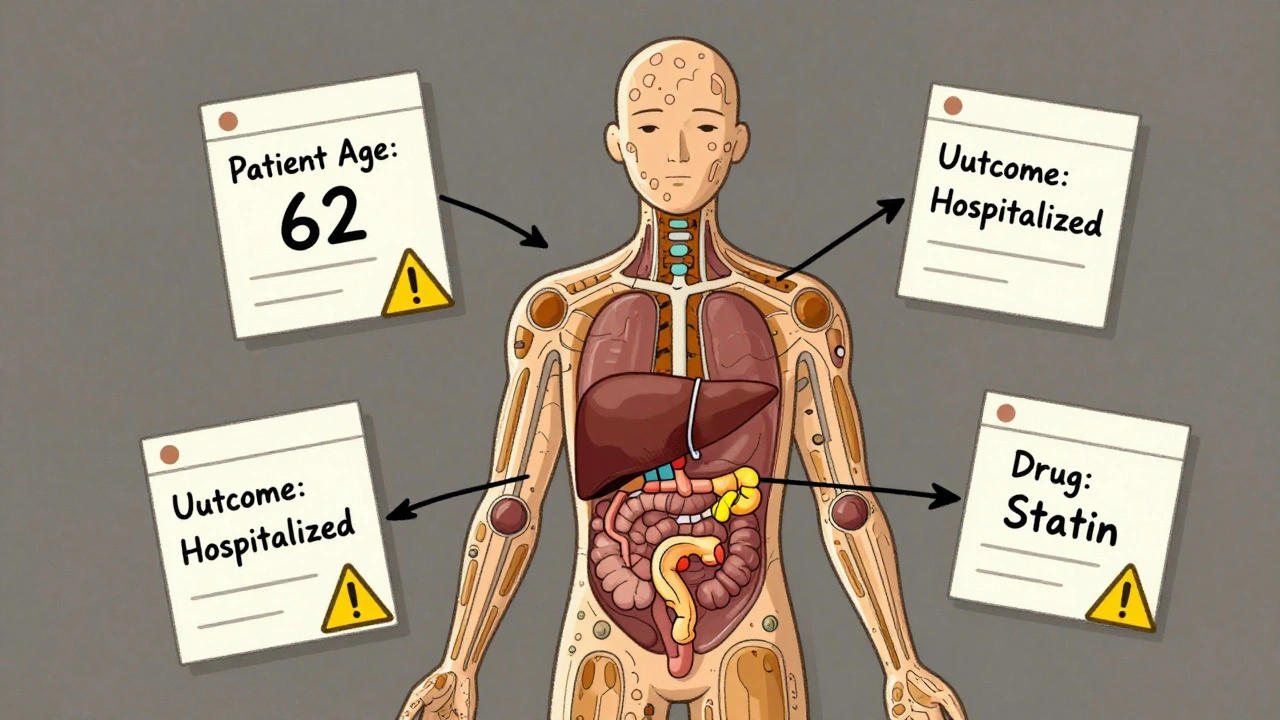
patient.drug.generic_name- the drug namepatient.reaction.reactionmeddrapt- the side effect, coded in MedDRA terminology (like "hypoglycemia" or "hepatotoxicity")patient.patientsex- genderpatient.patientage- ageoutcome- whether the patient recovered, was hospitalized, or died
That’s it. No XML. No Excel. Just clean, structured data.
What You Can and Can’t Do With OpenFDA
OpenFDA is powerful - but it’s not a crystal ball. Here’s what you can do:
- Find which drugs are commonly linked to specific side effects (like metformin and vitamin B12 deficiency)
- Compare side effect rates between similar drugs (e.g., lisinopril vs. losartan)
- Spot unusual patterns - like a sudden spike in reports after a new warning is issued
- Build tools for patients or clinicians to explore safety data
And here’s what you can’t do:
- Identify individual patients - all data is de-identified. No names, no addresses, no medical record numbers.
- Prove a drug causes a side effect - reports are voluntary and often incomplete. A report doesn’t mean causation.
- Get real-time data - the latest reports are at least 3 months old due to processing delays.
- Use it to make medical decisions - the FDA explicitly says: "Do not rely on openFDA to make decisions regarding medical care. Always speak to your health provider."
Think of OpenFDA as a spotlight. It shows you where problems might be hiding. It doesn’t tell you the full story.
Real Examples: What the Data Shows
Let’s look at real patterns found using OpenFDA:
Metformin and Vitamin B12 Deficiency
Over 3,000 reports in the last five years link metformin (a common diabetes drug) to low B12 levels. The FDA added a warning in 2020. OpenFDA helped researchers confirm this signal years before it became official.
Statins and Muscle Pain
Reports of muscle pain, weakness, or cramps linked to statins like atorvastatin and rosuvastatin make up over 12% of all drug adverse events. But only 1 in 10 of those reports mention a doctor’s diagnosis. That gap matters.
Antidepressants and Weight Gain
Over 15,000 reports tie SSRIs like sertraline and fluoxetine to significant weight gain. But only 8% of those reports include a weight measurement. Without numbers, it’s hard to judge severity.
These aren’t guesses. They’re counts from real patient reports. And they’re why researchers at universities and nonprofits use OpenFDA for studies - over 350 were published in 2022 alone.
How Developers Use OpenFDA
OpenFDA isn’t just for scientists. Developers build tools around it:
- MedWatcher - a consumer app that lets you search drug safety data by name or side effect.
- DrugSafety.io - a dashboard that tracks spikes in adverse events for newly approved drugs.
- Academic dashboards - used in medical schools to teach pharmacovigilance.
Most use Python or R. The R package openFDA makes it easy:
library(openFDA)
set_api_key("your-key-here")
results <- drug_events(generic_name = "sertraline", limit = 100)
JavaScript developers use fetch() with the API endpoint. Node.js apps connect directly. The key is understanding Elasticsearch syntax - it’s not SQL. You search with field:value, use quotes for phrases, and AND/OR for combinations.
Common mistakes? Forgetting the API key. Not handling rate limits. Trying to search for brand names instead of generic names. Always use generic_name - it’s more reliable than brand names like "Zoloft".
Limitations and Risks
OpenFDA is free. That’s great. But it comes with trade-offs:
- Reporting bias - serious side effects are more likely to be reported than mild ones. Patients who feel fine rarely report.
- Underreporting - experts estimate only 1% to 10% of actual side effects make it into FAERS.
- Missing context - no lab results, no dosage history, no comorbidities. Just a report: "Patient took drug X, felt Y."
- Delayed data - you’re always looking at data from 3-6 months ago.
Also, the API doesn’t tell you if a side effect is common or rare. A drug with 500 reports of nausea might be taken by 10 million people - meaning nausea is rare. A drug with 10 reports of liver failure might be taken by 1,000 people - meaning it’s serious. You need to calculate rates yourself.
And remember: OpenFDA doesn’t replace clinical judgment. It complements it.
What’s Next for OpenFDA?
The FDA is expanding OpenFDA. New endpoints now include medical device reports and tobacco product problems. The device data is still newer and less complete than drug data, but it’s growing fast.
They’re also working on reducing the data lag. Right now, reports take months to process. In 2023, they started testing faster pipelines. If successful, future updates could cut delays to 30-45 days.
The platform is open-source. You can see the code on GitHub. Developers can contribute fixes or new features. That’s rare for a government system - and it’s why OpenFDA is still alive and improving.
Who Should Use OpenFDA?
Not everyone needs it. But these people benefit most:
- Researchers - studying drug safety trends, publishing papers, or building predictive models.
- Developers - building apps that help patients understand drug risks.
- Healthcare professionals - looking for real-world data to inform patient conversations.
- Patients and caregivers - curious about side effects and want to see what others have reported.
If you’re just checking if a drug is safe, talk to your doctor. But if you want to dig deeper - if you want to see the patterns behind the headlines - OpenFDA is your best tool.
Where to Go From Here
Start small. Pick one drug you know. Search for its side effects. Look at the outcomes. See how many reports mention hospitalization or death. Compare it to another drug in the same class.
Use the OpenFDA Explorer on their website - it’s a visual tool to test queries without writing code.
Read the official documentation. It’s clear, well-organized, and updated regularly.
Join the GitHub community. There are open issues, feature requests, and examples from other users.
OpenFDA isn’t just data. It’s transparency. It’s accountability. And for the first time, it puts the power to see drug safety trends into the hands of the public - not just big companies or government agencies.
Use it wisely. Question what you see. And always, always talk to your doctor before making any health decision based on what you find.
Is OpenFDA the same as FAERS?
OpenFDA is not FAERS - it’s the API that gives you access to FAERS data. FAERS is the raw database of side effect reports collected by the FDA. OpenFDA is the tool that turns that messy database into clean, searchable JSON. Think of FAERS as the library, and OpenFDA as the librarian who helps you find the book you need.
Do I need an API key to use OpenFDA?
You don’t need one to make a few queries, but you’ll be limited to 1,000 requests per day. If you plan to use it regularly - even for research - get a free API key. It gives you 120,000 requests per day and faster response times. Registration takes less than 5 minutes at open.fda.gov/apis/authentication/.
Can I use OpenFDA to find out if my medication is dangerous?
You can see what side effects other people have reported, but you can’t use OpenFDA to decide if your medication is safe for you. Reports are voluntary, incomplete, and don’t prove cause-and-effect. Always talk to your doctor or pharmacist before changing your medication. OpenFDA is for exploration - not medical advice.
Why are there delays in OpenFDA data?
The FDA receives reports from doctors, patients, and drug companies. Each report must be reviewed, coded using standardized medical terminology (MedDRA), de-identified, and loaded into the system. This process takes time - usually 3 to 6 months. The FDA is working to reduce this delay, but privacy and accuracy come first.
Can I find side effects for over-the-counter drugs on OpenFDA?
Yes. OpenFDA includes reports for both prescription and over-the-counter (OTC) drugs. Just search by the generic name - like "acetaminophen" or "loratadine". The system doesn’t distinguish between prescription and OTC in the results. But you can filter by drug name to find what you need.
Is OpenFDA data reliable for academic research?
Yes - but with caution. Over 350 peer-reviewed studies in 2022 used OpenFDA data. Researchers use it to identify safety signals, track trends, and compare drug profiles. But because reports are voluntary and lack clinical context, OpenFDA data is best used for hypothesis generation, not final conclusions. Always combine it with clinical trials, lab studies, or other data sources.
What programming languages work best with OpenFDA?
Python and R are the most popular because they have built-in libraries for handling JSON and making HTTP requests. The R package openFDA and Python’s requests library make it easy. JavaScript (Node.js) and curl also work well. The key isn’t the language - it’s understanding how to structure Elasticsearch queries. Once you master that, any language can connect to the API.

Okay so let me get this straight - the FDA lets anyone with a laptop and a Wi-Fi connection dig into millions of patient reports and start drawing conclusions about drugs? No oversight? No vetting? And you’re telling me this isn’t just a goldmine for anti-vaxxers, pharma conspiracy bots, and people who think metformin is a government mind-control drug? I mean, I get it - transparency sounds nice on paper, but when people see 3,000 reports of B12 deficiency with metformin and panic because they read it on Reddit, who’s gonna clean up the mess? The FDA doesn’t even have enough staff to process these reports in under six months, but somehow we’re supposed to trust that a 22-year-old in Ohio who Googled ‘statins cause muscle pain’ and found this API is now a medical expert? This isn’t open data - it’s open chaos.
And don’t even get me started on the ‘developers building apps’ part. Yeah, sure, let’s put a drug safety dashboard in the hands of people who can’t tell the difference between correlation and causation. Next thing you know, someone’s telling their grandma to stop her blood pressure med because some anonymous user on a forum said ‘12% of reports mention muscle pain’ - and then she ends up in the ER. Great job, America. We turned public health into a TikTok trend.
I’m not saying we shouldn’t have access to data - I’m saying we shouldn’t pretend this is safe or responsible. The FDA is basically handing out loaded guns and calling it ‘empowerment.’
Also - why is the API key free? Who’s paying for this? Are they just using our tax dollars to fund a giant social experiment? Because I’m starting to think this isn’t transparency - it’s negligence dressed up as innovation.
This is the most dangerously oversimplified garbage I’ve seen all year. You treat OpenFDA like it’s a Google search for drug safety, but it’s a dumpster fire of unverified, uncorrelated, non-standardized noise. 14 million reports? So what? 99% of them are useless because they say ‘patient felt weird’ or ‘took drug X, got headache.’ No lab values. No dosing history. No comorbidities. No follow-up. And you’re telling people to use this to compare lisinopril and losartan? Are you kidding me? That’s like comparing two cars based on random Yelp reviews that don’t mention engine specs or mileage.
And the ‘350 studies’ you brag about? Most of them are observational crap published in predatory journals. You think a researcher actually believes this data proves causation? No - they use it to generate hypotheses, then go do real science with controlled trials. But you? You’ll take one report of ‘weight gain with sertraline’ and tell your cousin to quit her antidepressant. That’s not empowerment - that’s medical malpractice by proxy.
Also, ‘OpenFDA is free’? Yeah, and so is a free bullet. Doesn’t mean you should shoot yourself in the foot and call it ‘personal freedom.’
Real talk - OpenFDA is one of the most underappreciated public health tools we’ve got. The FAERS data is messy, no doubt, but having it structured and queryable? Huge win. I’ve used it in my work as a pharmacovigilance analyst - not to make clinical decisions, but to spot signals early. Like when we noticed a spike in reports of rhabdomyolysis with a new statin combo - we flagged it internally, and the FDA issued a warning three months later. OpenFDA got us there faster than any commercial system.
The key is context. You don’t look at raw numbers - you calculate reporting odds ratios, compare to baseline rates, cross-reference with clinical literature. It’s not a magic wand, but it’s a powerful lens. And yeah, the 3-month lag sucks, but it’s still better than waiting for a journal article to come out two years later.
Also - the API key thing? Totally worth it. 120k requests/day means you can do longitudinal analysis, track trends over quarters, even build alerts. I’ve got a cron job that pings it weekly for my top 10 drugs of interest. It’s low-effort, high-reward if you know how to use it.
And to the folks panicking about ‘misuse’ - yeah, people will misuse anything. But that’s not a reason to lock the data away. It’s a reason to educate. And honestly? The fact that patients are using this to ask smarter questions at their doctor’s office? That’s the win.
OpenFDA is a gift to public health and deserves more recognition. The fact that a government agency provides this level of transparency for free is extraordinary. Developers, researchers, and patients alike benefit from access to real-world data. This is how innovation should work - open, collaborative, and rooted in evidence. Thank you to the FDA team for making this possible. Keep improving it. We are watching and appreciating.
Wait - you’re seriously telling me that people are using this to ‘explore’ drug safety… without any medical training? And you’re not warning them that this data is literally useless for individual risk assessment? The FDA says ‘do not rely on this for medical decisions’ - and yet here you are, writing a whole guide on how to use it like it’s a medical textbook? You’re not helping - you’re enabling. You’re giving people the illusion of knowledge. A report saying ‘patient took drug X and died’ does NOT mean drug X killed them. It means someone wrote that down. Maybe they were drunk. Maybe they didn’t take the drug. Maybe they had three other meds. Maybe it was a heart attack at 78. But now someone’s going to scroll through that and say ‘see? I told you!’ And then they’ll quit their meds. And someone’s going to die. And you’re going to sit there with your ‘open data’ trophy and say ‘well, it’s transparent!’ - while ignoring the human cost. This isn’t empowerment. It’s recklessness dressed up as activism.
You think metformin causes B12 deficiency? Newsflash - it’s been known since the 90s. The FDA didn’t add the warning because of OpenFDA - they added it because of decades of clinical studies. OpenFDA just confirmed what we already knew. You’re giving credit to a tool that’s just a mirror. And the ‘15k reports of weight gain with SSRIs’? Yeah, because everyone who gains weight on antidepressants is more likely to report it - while the 100k who don’t? Silent. This isn’t data science - it’s confirmation bias with a JSON endpoint. Stop pretending this is groundbreaking. It’s just a searchable version of what’s been in medical journals since the 80s.
Hey everyone - just wanted to say how impressed I am with the transparency and accessibility OpenFDA provides. As someone who teaches pharmacology to undergrads, I use it every semester to show students how real-world data works - and how to interpret it responsibly. We do exercises where they search for side effects, then compare them to clinical trial data. It’s eye-opening.
Yes, the data has limitations - but so does every tool. The key is teaching people how to use it ethically and critically. That’s why I always say: OpenFDA doesn’t answer questions - it helps you ask better ones.
And to the folks worried about misuse? Let’s focus on education, not restriction. The answer isn’t to lock the data away - it’s to help people understand it. I’ve seen students go from confused to curious to confident because of this tool. That’s worth protecting.
Also - shoutout to the devs who built the R and Python libraries. You made it easy for non-coders to get started. That’s leadership.
I’ve been using OpenFDA for my personal research on thyroid meds after my diagnosis. I searched for levothyroxine side effects and found reports of hair loss, fatigue, and anxiety - which matched what I was experiencing. I didn’t stop my meds. I took the data to my endocrinologist. We adjusted my dose. Now I feel better. This isn’t about replacing doctors. It’s about giving patients the facts to have better conversations. Simple. Powerful. Thank you.
Honestly? I used to think OpenFDA was overhyped. Then I tried it. I searched for my dad’s old blood pressure med - turns out there were 400+ reports of dizziness in people over 70. We switched him to something else. No ER visits since. I didn’t need a PhD. I just needed to type a query. Yeah, the data’s messy. Yeah, it’s delayed. But it’s real. And for regular people who just want to understand what’s in their medicine? That’s worth more than you think. Don’t knock it until you’ve used it.