
 11
Feb,2026
11
Feb,2026
Every time you pick up a new prescription, you get a small paper insert - the medication guide. Most people glance at it, maybe read the side effects, and toss it in a drawer. But if you or someone you care about is taking a medicine with overdose risks, that guide holds life-saving details. You just need to know where to look.
Why Medication Guides Matter
Medication guides aren’t just paperwork. They’re legally required by the FDA for drugs with serious risks, including overdose. These guides break down what happens if too much is taken, what to watch for, and what can reverse it. Skipping them means missing critical info that could prevent a hospital visit - or worse.
Think of it this way: if you’re taking a painkiller like oxycodone or a sleep aid like zolpidem, you’re not just managing symptoms. You’re handling a substance that can slow or stop your breathing if taken in excess. The guide tells you exactly how much is too much, what symptoms to fear, and what to do next. Not knowing this isn’t ignorance - it’s risk.
Where to Find Overdose Warnings in the Guide
Don’t read the whole thing front to back. Go straight to three key sections:
- Boxed Warning - This is the FDA’s strongest alert. It’s in a thick black border at the top of the prescribing info (usually printed on the first page of the guide). If your drug has one, it means overdose is a real danger. Look for phrases like “risk of respiratory depression” or “fatal overdose reported.”
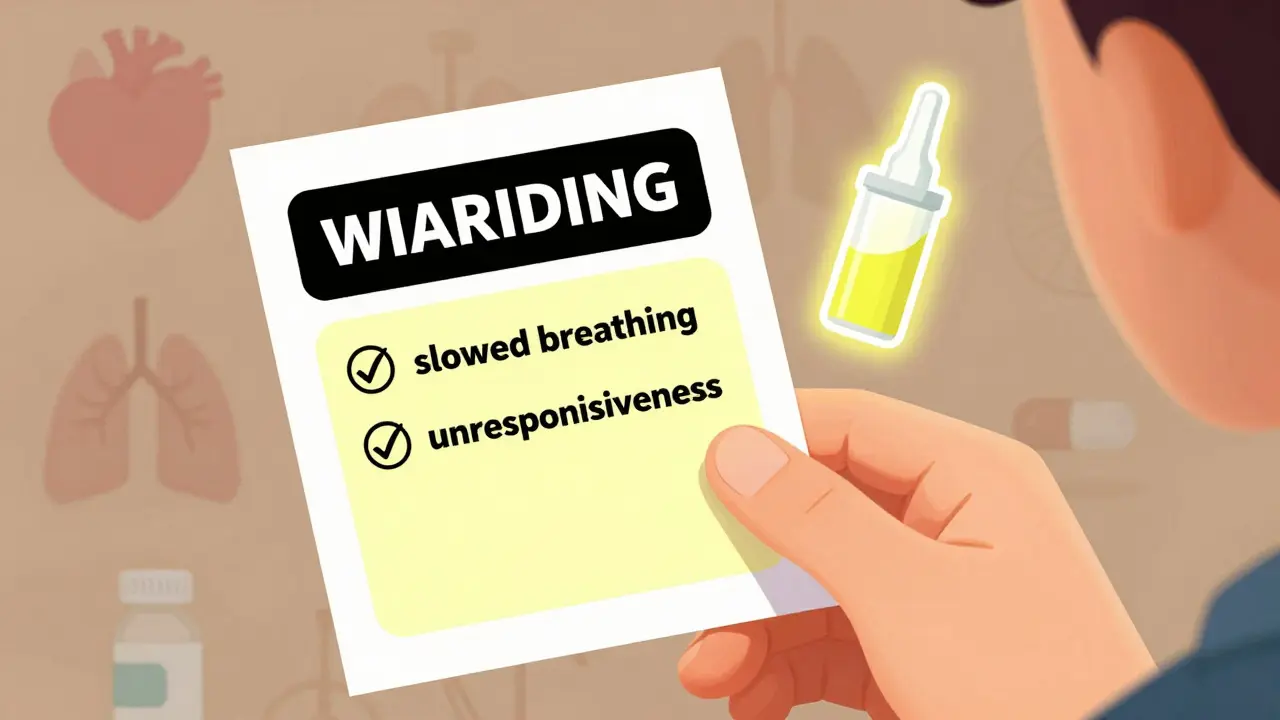
- Overdosage Section - This is usually near the end. It doesn’t say “if you take too much, here’s what happens.” It gives exact numbers: “Overdose may occur at doses greater than 40 mg.” It also lists symptoms: “drowsiness, confusion, slowed breathing, unresponsiveness.”
- Warnings and Precautions - This section often explains what makes overdose more likely. For example: “Avoid alcohol,” “Do not combine with benzodiazepines,” or “Higher risk in elderly patients.”
These aren’t vague warnings. They’re precise. If your guide says, “Overdose may cause coma or death,” that’s not scare tactics - it’s the truth. And if it says “Naloxone may reverse opioid overdose,” that’s your lifeline.
What Antidotes Look Like in the Guide
An antidote isn’t always a magic pill. Sometimes it’s a treatment step. But when a medication guide mentions one, it’s clear:
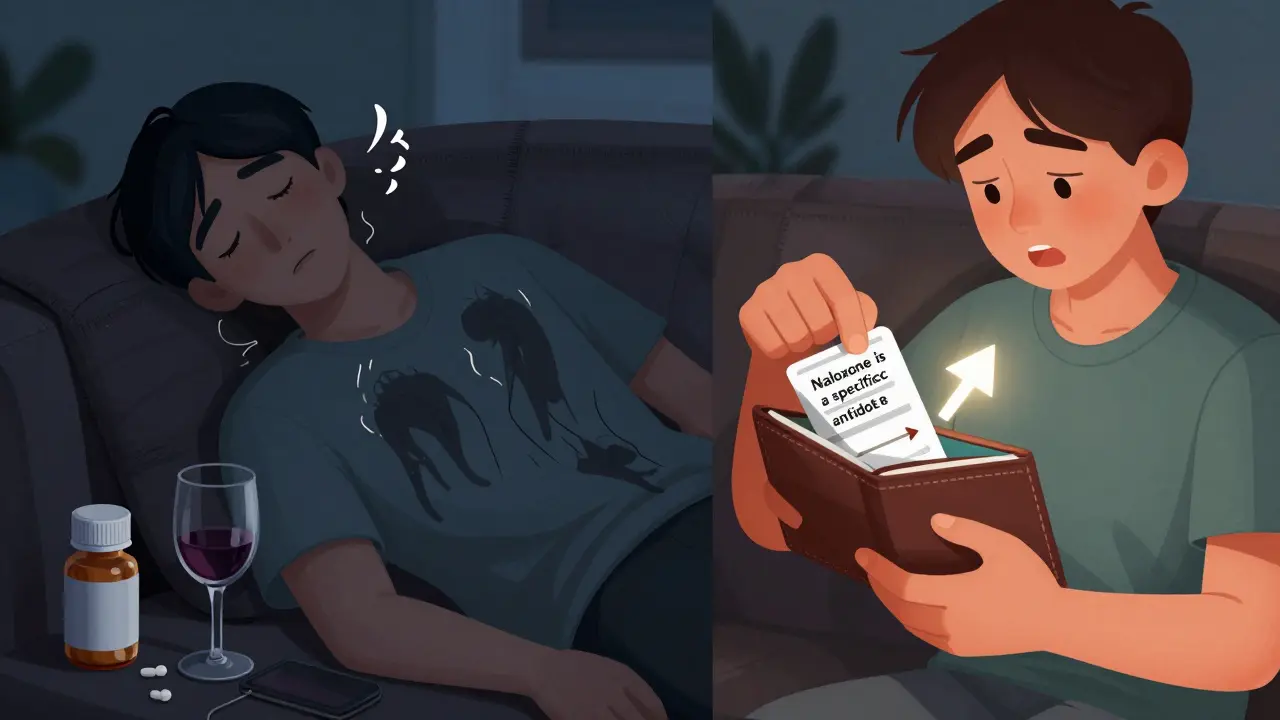
- Naloxone - Listed for opioids like oxycodone, fentanyl, hydrocodone. The guide will say: “Naloxone is a specific antidote for opioid overdose.” It may even note: “Available as nasal spray or injection.”
- Flumazenil - For benzodiazepines like lorazepam or alprazolam. The guide might say: “Flumazenil may reverse CNS depression.”
- Activated charcoal - Mentioned for some antidepressants or sedatives. It’s not a cure, but it can block absorption if given within an hour.
Some guides don’t name an antidote. That doesn’t mean there isn’t one - it means the antidote isn’t approved or widely used. In those cases, the guide will still list symptoms and stress: “Seek emergency care immediately.”
What the Numbers Mean
Medication guides often give overdose thresholds. Don’t ignore them.
For example:
- “Single doses greater than 100 mg of tramadol may cause seizures.”
- “Fatal overdose reported at 200 mg of bupropion.”
- “Ingestion of 500 mg of diphenhydramine may lead to coma.”
These aren’t guidelines. They’re red lines. The dose listed is often the minimum amount that caused serious harm - not the maximum safe dose. So if you’re told “take 50 mg,” and the guide says “overdose at 100 mg,” don’t assume 90 mg is fine. Your body reacts differently than the next person.
Red Flags in the Guide
Some phrases should make you pause:
- “Do not exceed recommended dose” - That’s code for “you can die if you take more.”
- “Risk increased with alcohol or other CNS depressants” - This means mixing it with wine, sleeping pills, or even some cold medicines could push you over the edge.
- “May cause respiratory depression” - That’s when breathing slows or stops. It’s silent. You won’t feel it coming.
- “Use with caution in patients with liver disease” - Your body can’t clear the drug. Even normal doses become dangerous.
If you see any of these, talk to your pharmacist. Ask: “What’s the real risk if I accidentally take too much?”
What to Do If You Suspect an Overdose
The guide will tell you symptoms. But what do you do next?
- Check for breathing. Is it shallow? Slow? Stopped? If yes, call emergency services now.
- Look for naloxone. If the guide says it’s an antidote, and you have it on hand (nasal spray or injection), use it. It’s safe. Even if you’re not sure, use it. It won’t hurt someone who didn’t overdose.
- Stay with the person. Don’t leave them alone. Put them on their side. If they stop breathing, start CPR if you’re trained.
- Bring the medication guide. Paramedics need to know what was taken. The guide has the exact name, dose, and antidote info.
Don’t wait for someone to “wake up.” Overdose doesn’t always look like someone passed out. Sometimes it’s just a person who won’t respond to their name. That’s enough.
Real-Life Example
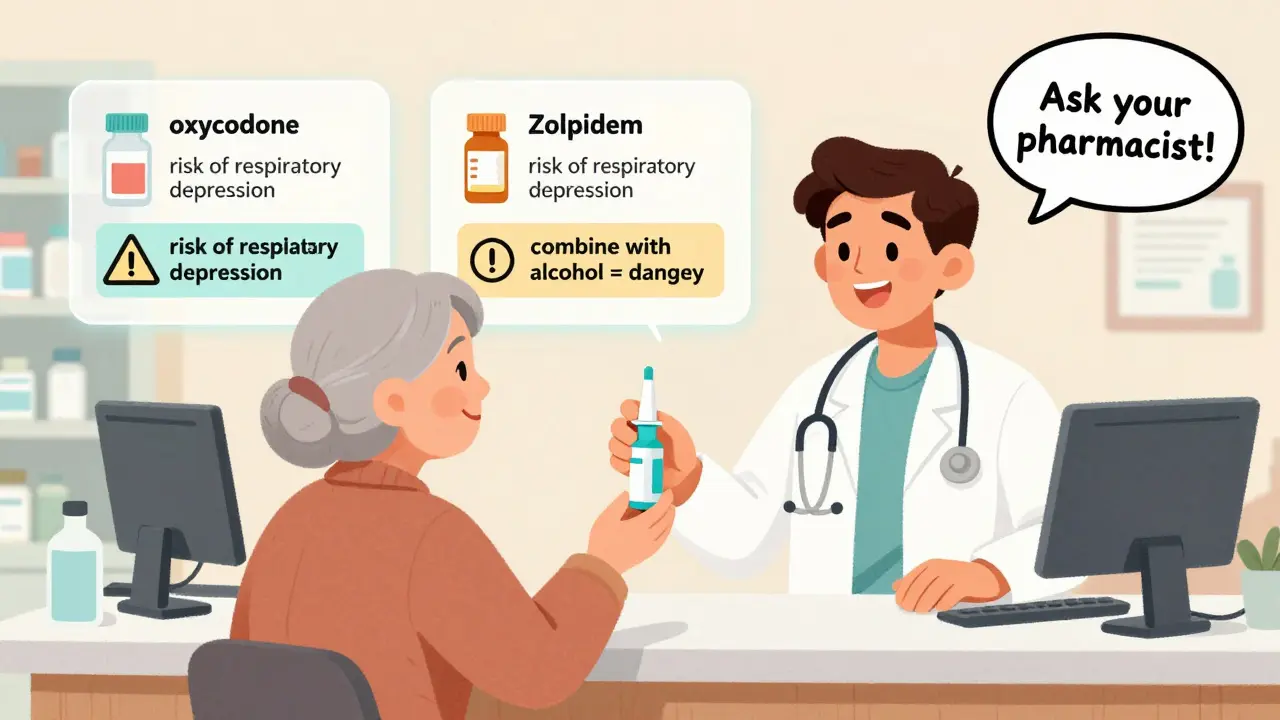
Take a 68-year-old woman in Melbourne prescribed oxycodone for arthritis. Her guide says: “Overdose may occur at doses greater than 80 mg.” She takes 30 mg twice a day - safe. But she also takes a sleeping pill (zolpidem) and drinks wine at night. Her guide for zolpidem says: “May cause respiratory depression when combined with alcohol.”
One night, she doesn’t wake up. Her daughter finds her. The medication guide for oxycodone says: “Naloxone is an antidote.” The daughter has a naloxone nasal spray from the pharmacy - she was told to keep it after a recent hospital visit. She gives one spray. The woman wakes up in 2 minutes. She’s taken to the hospital. No long-term damage.
She didn’t take too much of one drug. She took too much of a combination. That’s why reading both guides mattered.
How to Use This Info Every Day
Here’s what to do:
- Keep the guide with the pill bottle - not in a drawer.
- Highlight the overdose section and antidote info with a yellow marker.
- Teach one person in your household where to find it - your partner, adult child, or roommate.
- Ask your pharmacist: “Is there a naloxone kit I should have for this medicine?”
- Check your guide every time you refill. Manufacturers update them.
Most people don’t know naloxone is available without a prescription in Australia. It’s sold at pharmacies under brands like Narcan. Ask for it. Keep one at home if you take opioids, benzodiazepines, or sleep aids.
Final Thought
Medication guides aren’t meant to scare you. They’re meant to empower you. You don’t need to be a doctor to understand them. You just need to know where to look. Overdose isn’t always loud. Sometimes it’s quiet. And the guide? It’s the only voice that tells you how to stop it before it’s too late.
Do all prescription medications have overdose warnings in their guides?
No. Only medications with serious overdose risks are required by the FDA to include a medication guide. These include opioids, benzodiazepines, certain antidepressants, sleep aids, and some painkillers. If your prescription doesn’t come with a guide, it doesn’t mean it’s safe - just that the risk isn’t considered high enough to require one. Always ask your pharmacist if your drug has known overdose risks.
Can I rely on the drug label instead of the guide?
No. The drug label (the bottle) only has the name, dose, and refill info. The medication guide is separate, longer, and legally required to include overdose details, antidotes, and serious warnings. The label won’t tell you that 200 mg of bupropion can cause seizures - the guide will.
Is naloxone safe to use if I’m not sure it’s an overdose?
Yes. Naloxone only works on opioids. If someone didn’t take opioids, naloxone won’t hurt them - it just won’t do anything. It’s not addictive, doesn’t cause a high, and has minimal side effects. If someone is unresponsive and breathing shallowly, give naloxone. It’s a no-risk move.
What if the guide says there’s no antidote?
That means there’s no approved drug to reverse the overdose. But that doesn’t mean you can’t save a life. Call emergency services immediately. Keep the person breathing. Many overdoses - especially from antidepressants or sedatives - can be managed with oxygen, IV fluids, and monitoring in a hospital. Time matters more than an antidote.
Can I get a digital copy of the medication guide?
Yes. Most major pharmacies in Australia, including Chemist Warehouse and Clicks, offer digital copies through their apps or websites. You can also search the FDA’s database or the TGA (Therapeutic Goods Administration) website using the drug’s brand or generic name. Save it to your phone. Keep a printed copy at home.
Reading this felt like someone handed me a flashlight in a room I didn’t know was dark. I’ve been taking tramadol for years and never looked past the side effects list. Now I know that 100 mg is a red zone-not a target. I printed the guide, highlighted the overdose section, and taped it to my medicine cabinet. Small effort. Huge peace of mind.
Also-this isn’t fear-mongering. It’s responsibility. And honestly? More people should treat their meds like they’re handling live wires, not candy.
This is an exceptionally well-structured and clinically accurate guide. The distinction between regulatory requirements (FDA-mandated medication guides) and standard drug labeling is critical, and you’ve articulated it with precision. I would only add that pharmacists are legally obligated to counsel patients on these risks in many U.S. states under the Medication Therapy Management (MTM) framework. If you’re not receiving this counseling, request it. It’s your right.
Additionally, naloxone access laws vary by state-some allow direct pharmacy dispensing without a prescription, while others require a standing order. Always verify local protocols.
OMG I LOVE THIS. I’ve been yelling at my cousin for months because she takes Ambien and drinks wine like it’s juice. She said, ‘It’s just sleep medicine, how bad can it be?’ I showed her the guide. She cried. Then she called her pharmacist. Now she has a naloxone kit in her purse. Like. For real.
Also-did you know some pharmacies give out naloxone for free if you ask? Like, no questions. Just say ‘I need a kit for my meds’ and they hand it over. I’m telling you, this info is power. Don’t sleep on it.
man i never thought about this before but you’re right-i’ve got a bottle of zolpidem and the insert is buried under socks. i’m gonna go dig it out right now.
also-my grandma’s on oxycodone and she mixes it with her nightly tea. i didn’t even know that was a thing until now. i’m printing this out and taping it to her fridge. she’ll grumble but she’ll read it. she always does when i make it look like a ‘medical thing’.
also also-naloxone is like a fire extinguisher. you hope you never need it, but if you don’t have one and something catches fire? you’re screwed. get one. now.
Let me guess-this was paid for by Big Pharma. They want you scared so you’ll buy naloxone kits they sell for $120 when the real cost is $10. They’re not telling you that naloxone is just a temporary fix. The real problem? The FDA lets dangerous drugs stay on the market because they’re profitable. They don’t care if you die. They care if you keep buying.
And why do you think they make you ‘highlight’ the guide? So you feel like you’re doing something… while they keep raking in billions. Wake up.
Also-did you know the government stockpiles naloxone? But they won’t give it to you unless you jump through 17 hoops. That’s not safety. That’s control.
Oh wow. You actually think reading a 12-page insert will prevent overdose? That’s like telling someone to read the ‘Do Not Touch’ label on a live wire and assume they’re safe. The real issue is that these drugs are prescribed like candy. Your ‘guide’ is a Band-Aid on a hemorrhage.
And don’t get me started on naloxone. It’s not magic. It’s a temporary reversal that leaves you in withdrawal and screaming for more opioids. You’re not saving lives-you’re enabling the cycle. The real antidote? Stop prescribing these drugs. Period.
Also, your ‘real-life example’? Classic anecdotal fallacy. One story doesn’t prove anything. Data does. And the data says these guides are useless.
When you live in a world where the system tells you to read a pamphlet to survive what the system created you begin to understand that the real danger is not the drug but the silence that surrounds it
People think knowledge is power but knowledge without access is just another form of control
I have seen mothers in Lagos with no electricity reading guides on their phones trying to understand why their child stopped breathing after taking paracetamol because the label said 'take one tablet' but the guide said 'overdose at 150 mg per kg'
And still they say education is the answer
But education without equity is just another kind of violence
And we are all just reading the guide while the system burns
What is the antidote to a system that profits from your silence
bro i just got my first naloxone kit today and i’m crying 😭
my dad’s on oxycodone after his hip surgery and i didn’t even know it was a thing until i saw this post
just got the nasal spray from CVS for $0 with my insurance
weird thing? the pharmacist asked if i wanted a second one for my cousin who’s on Xanax
weird? no. beautiful. 🙌
also-taped the guide to the fridge next to the milk. now everyone sees it. even my dog.
THIS. THIS RIGHT HERE. I’ve been telling my sister for YEARS to read her meds guide and she just laughs. I sent her this link. She texted back: ‘I’m gonna do it right now.’
She’s on duloxetine and had no idea it could cause serotonin syndrome if mixed with cold meds. She’s gonna call her doc tomorrow.
You’re not just sharing info-you’re saving lives. And honestly? That’s the kind of post that makes me believe people still care.
Thank you. 🫶
Let’s be real. The FDA doesn’t care about you. They only require these guides because they got sued. If you think reading this insert prevents death, you’re naive. Most people don’t even know where the ‘Overdosage’ section is. And the ones who do? They still take the extra pill because ‘it’s just one more.’
And naloxone? It’s not a solution. It’s a bandage. The real problem? The drug industry. The doctors. The insurance companies. This post is just distraction.
Also-why do you think your guide says ‘seek emergency care’? Because they know you’re not getting help fast enough.
Okay but what if the guide is wrong? What if the numbers are outdated? What if the manufacturer changed the formula and didn’t update the insert? I’ve seen this before. My cousin took ‘as directed’ and ended up in ICU because the guide said 50mg was safe but the new version was 3x more potent.
And don’t even get me started on digital copies. They’re not always synced. I checked my TGA link-my drug’s guide was listed as ‘pending update’ for 8 months.
So… what are we supposed to do? Trust a PDF? This feels like playing Russian roulette with a pamphlet.
Just wanted to say this is the kind of post that makes me believe in people again. I’m a nurse and I’ve seen too many patients come in because they didn’t know the difference between ‘side effect’ and ‘overdose symptom.’
I keep a stack of printed guides in my office. I hand them out like candy. No judgment. Just ‘here-this might save your life.’
And yeah, naloxone is free at most pharmacies. Just ask. No shame. No questions. You’re not weak for needing it. You’re smart for having it.
Keep doing this. We need more of you.