
 1
Dec,2025
1
Dec,2025
When your child gets vaccinated, it’s normal to watch for fever. It’s one of the most common reactions-and one of the most worrying for parents. You want to help them feel better, but you also don’t want to accidentally weaken the vaccine’s protection. So when should you give fever reducers like acetaminophen or ibuprofen? The answer isn’t what most people think.
Don’t Give Fever Reducers Before the Vaccine
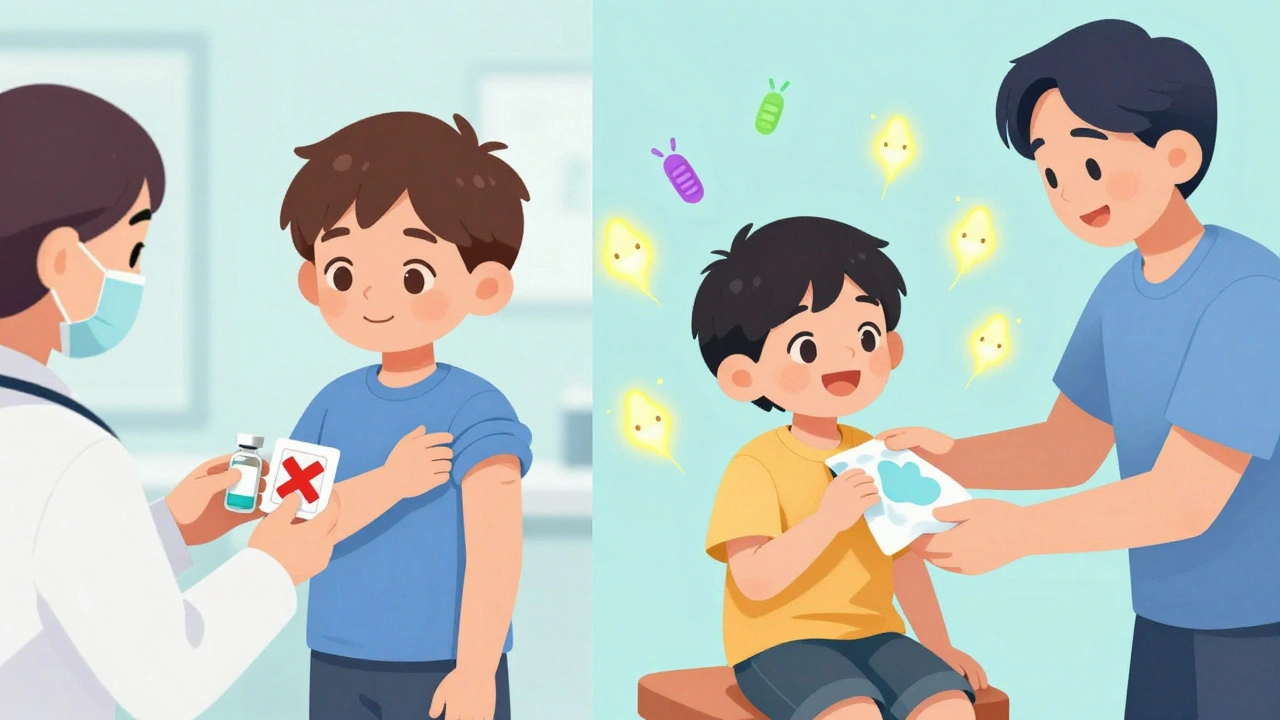
A few years ago, many doctors told parents to give acetaminophen right before the vaccine to prevent fever. That changed after research in 2009 and later studies showed something surprising: giving fever reducers before vaccination can lower the body’s immune response. Children who got medicine before their shots had fewer antibodies to key vaccine components like pneumococcus, hepatitis B, and pertussis. It didn’t mean the vaccine failed completely-but it did mean their protection might not be as strong.
Major health groups like the CDC, the American Academy of Pediatrics, and the Children’s Hospital of Philadelphia now agree: don’t give fever reducers before vaccination. The goal isn’t to prevent fever-it’s to let the immune system respond naturally. Fever is a sign the body is doing its job.
Wait at Least 4 Hours After the Vaccine
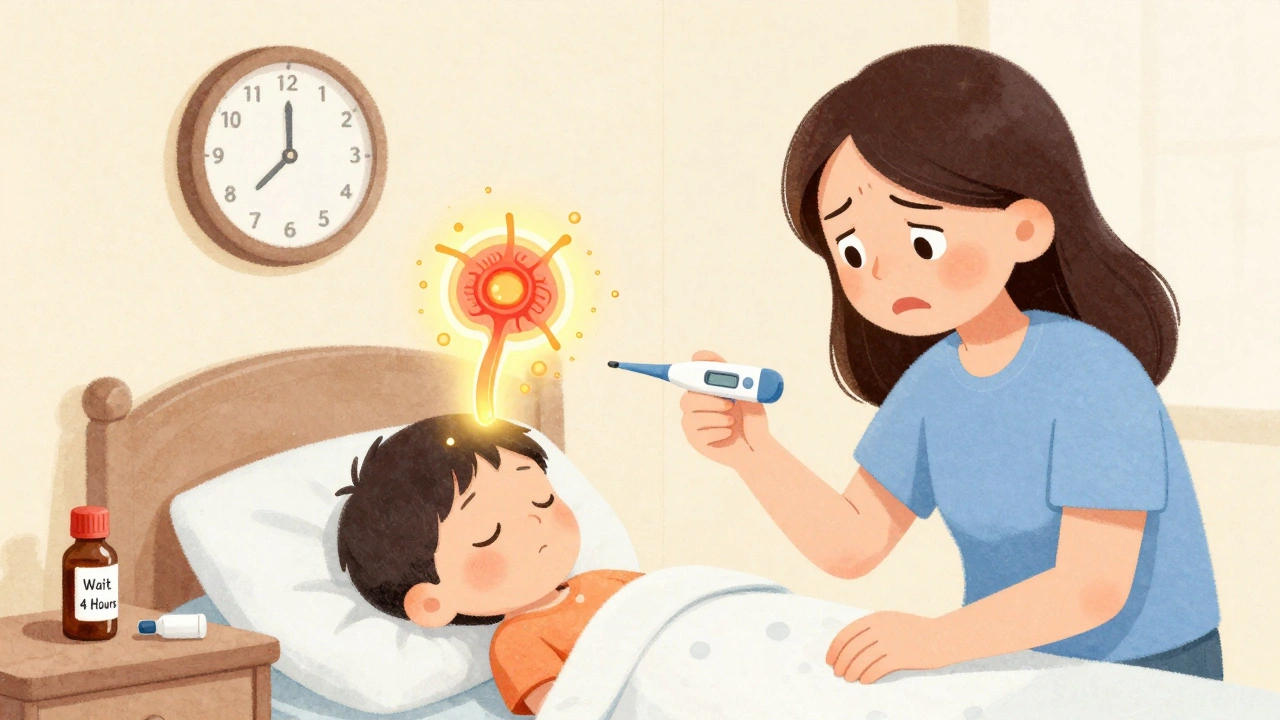
If your child starts running a fever after the shot, you can give medicine-but wait. Studies show that giving acetaminophen or ibuprofen more than 4 hours after the vaccine doesn’t interfere with antibody production. That’s the sweet spot: let the immune system kick in first, then help with symptoms if needed.
One study compared two groups: one that got fever medicine right after the shot (prophylactic), and another that waited until the child’s temperature hit 102°F. The group that waited had the same level of protection as kids who didn’t get any medicine. The group that got medicine too early? Their antibody levels dropped significantly.
So if your baby gets vaccinated at 10 a.m., hold off on Tylenol or Motrin until at least 2 p.m.-unless they’re clearly in distress. A low-grade fever (100-102°F) is normal and doesn’t need treatment. Your child’s body is building immunity. Let it happen.
When to Actually Give Fever Reducers
Not every fever needs medicine. You don’t need to rush to the medicine cabinet just because the thermometer reads 101°F. Here’s when to act:
- Give medicine if the temperature is above 102°F (39°C)-especially if your child is fussy, crying nonstop, or having trouble sleeping.
- Don’t give medicine for low-grade fevers (100-102°F). These are part of the immune response. Medication won’t make your child safer-it might just slow down their body’s natural defense.
- Watch for behavior, not just numbers. A child with a 101°F fever who’s playing and drinking fluids is doing fine. A child with a 100.5°F fever who’s lethargic or not eating needs attention.
Seattle Children’s Hospital and the NHS both stress: fever isn’t the enemy. It’s a signal. Your job isn’t to eliminate it-it’s to support your child while their body fights.
Which Medicine to Use and How Much
For children, only two fever reducers are safe: acetaminophen (Tylenol) and ibuprofen (Advil, Motrin). Never give aspirin-it’s linked to Reye syndrome, a rare but dangerous illness in kids.
Acetaminophen:
- Dose: Every 4 to 6 hours, no more than 4 doses in 24 hours
- Age limit: Not for infants under 12 weeks unless directed by a doctor
- Weight-based example (6-11 months, 18-23 lbs): 1.25 mL of infant drops
Ibuprofen:
- Dose: Every 6 to 8 hours, no more than 4 doses in 24 hours
- Age limit: Not for infants under 6 months (check with your doctor for younger babies)
- Weight-based example (6-11 months, 18-23 lbs): 2.5 mL of infant drops
Always use the measuring device that comes with the medicine. Kitchen spoons are not accurate. Overdosing can cause liver or kidney damage. If you’re unsure, call your pediatrician.
The Big Exception: MenB Vaccine
There’s one vaccine where guidelines differ: the MenB vaccine (meningococcal B). This one causes fever in up to 60% of babies, sometimes with high temperatures over 104°F. Because of this, the UK’s NHS recommends giving liquid paracetamol after the 8-week and 16-week MenB shots-not before, but right after.
This is the only major exception to the "wait 4 hours" rule. The NHS says the risk of a dangerous high fever outweighs the small chance of reduced immunity. In the U.S., this isn’t standard advice yet, but many pediatricians follow it for MenB. Ask your doctor if your child is getting this vaccine.
What About Other Symptoms?
Fever isn’t the only reaction. Redness, swelling, or soreness at the injection site? That’s normal. So is fussiness or sleepiness. You don’t need medicine for these. Try:
- Keeping your child lightly dressed-no extra blankets
- Offering extra fluids: breastmilk, formula, water, or electrolyte solution
- Letting them rest
- Using a cool (not cold) washcloth on the forehead if they seem uncomfortable
Don’t sponge them with alcohol or ice water. That can cause shivering, which raises body temperature further.

When to Call the Doctor
Most vaccine fevers go away in 1-2 days. But call your pediatrician if:
- Your baby is under 12 weeks old and has any fever (even 100.4°F)
- The fever lasts more than 48 hours
- Your child won’t drink, hasn’t urinated in 8 hours, or looks very pale or blue
- They’re having seizures, stiff neck, or difficulty breathing
- You’re unsure whether the fever is from the vaccine or something else
Remember: a fever after a vaccine is not the same as an infection. But in very young babies, any fever needs medical evaluation-because their immune systems are still learning.
What the Research Really Says
Some parents worry: "If the vaccine doesn’t work as well, does that mean my child is unprotected?" The answer is no. Even with reduced antibody levels, vaccinated children are still far better protected than unvaccinated ones. The immune system still remembers the pathogen-it just might not make as many antibodies right away.
Studies show that even with lower antibody counts, most kids still reach protective levels. The real risk isn’t total failure-it’s a slightly slower or weaker response. That’s why experts still strongly recommend vaccines. The benefit of protection against diseases like whooping cough, meningitis, and pneumonia far outweighs the small chance of reduced immunity from early fever medicine.
What’s still unknown? Whether certain vaccine combinations (like DTaP + PCV together) are more sensitive to interference. Whether higher doses of fever reducers cause bigger drops in antibodies. And whether these changes affect long-term protection.
For now, the safest, simplest rule is this: wait 4 hours. Only give medicine if your child is clearly uncomfortable or has a high fever.
Final Takeaway
Fevers after vaccines are common, normal, and usually harmless. Giving fever reducers too early can weaken the immune response. Waiting a few hours gives your child’s body the chance to build strong, lasting protection. Use medicine only when needed, stick to the right dose, and never give it before the shot.
Trust your instincts-but trust the science more. Your child’s immune system knows what to do. Your job is to support it, not interfere with it.

It’s wild how we’ve been conditioned to panic at the first sign of a fever-like it’s a villain instead of a bodyguard. The immune system doesn’t need a babysitter; it needs space to do its ancient, beautiful work. I’ve seen parents douse their kids in Tylenol like it’s holy water, terrified of a number on a thermometer. But fever isn’t the enemy-it’s the orchestra playing the symphony of immunity. Let the music play.
In India, we’ve always believed fever is the body’s way of burning out toxins-no medicine unless the child is truly suffering. This aligns perfectly with Ayurvedic principles: don’t suppress, support. The moment we intervene too early, we rob the body of its wisdom. I’ve watched children recover faster after vaccines when we let fever run its course-no meds, just cool cloths, hydration, and calm. Science finally caught up to tradition.
Bro, I just gave my kid Tylenol 20 minutes after his shots because he was screaming. I didn’t know any better. But now I’m reading this and realizing I might’ve messed up. 😅 Should I feel like a bad dad? Or is it chill if it’s just once?
Thank you for this clear, science-backed guide. Too many parents are misled by well-meaning but outdated advice. I’ve shared this with every new parent in my circle. Remember: fever is not a problem to be solved-it’s a process to be honored. Your child’s immune system is not broken. It’s building. Let it. And for heaven’s sake, stop using kitchen spoons. The CDC’s dosing charts exist for a reason.
YESSSSS 🙌👏🔥 I’ve been saying this for YEARS! Fever = good! Medicine = bad (unless above 102°F and they’re crying like the world’s ending). My twins got their 12-month shots last week-no meds until 5 hours later, and they were back to crawling and giggling by bedtime. 🤖💉👶 #TrustTheProcess
While the data on antibody suppression is statistically significant in controlled trials, the clinical relevance remains ambiguous. The effect size is modest, and longitudinal studies have yet to demonstrate diminished seroprotection rates in real-world populations. Moreover, the confounding variables-genetic variability, co-administered vaccines, microbiome composition-are rarely accounted for. One must question whether the precautionary principle is being overextended at the expense of parental autonomy and comfort.
Let me be perfectly clear: this article is dangerously naive. You are advocating for child suffering in the name of "science." Do you know what it’s like to watch your infant scream for hours because you followed some CDC pamphlet? I do. And I will never again risk my child’s comfort for a theoretical immune response. The medical establishment has been wrong before-remember thalidomide? Aspirin? Mercury in vaccines? This is just the next myth.
Wait-so you’re telling me the CDC, AAP, and Big Pharma are ALL in on this? They’re suppressing the truth that fever reducers DESTROY immunity? And they’re telling you to wait 4 HOURS? But what if they’re lying? What if the real reason they want you to wait is because they’re testing how long you’ll let your child suffer before you demand meds? I’ve read the original 2009 study-there’s a footnote on page 14 that says "funding provided by vaccine manufacturers." This isn’t science-it’s control. Don’t trust the system. Let your child’s body heal naturally-NO MEDS. EVER. 🕊️🩸