
 20
Jan,2026
20
Jan,2026
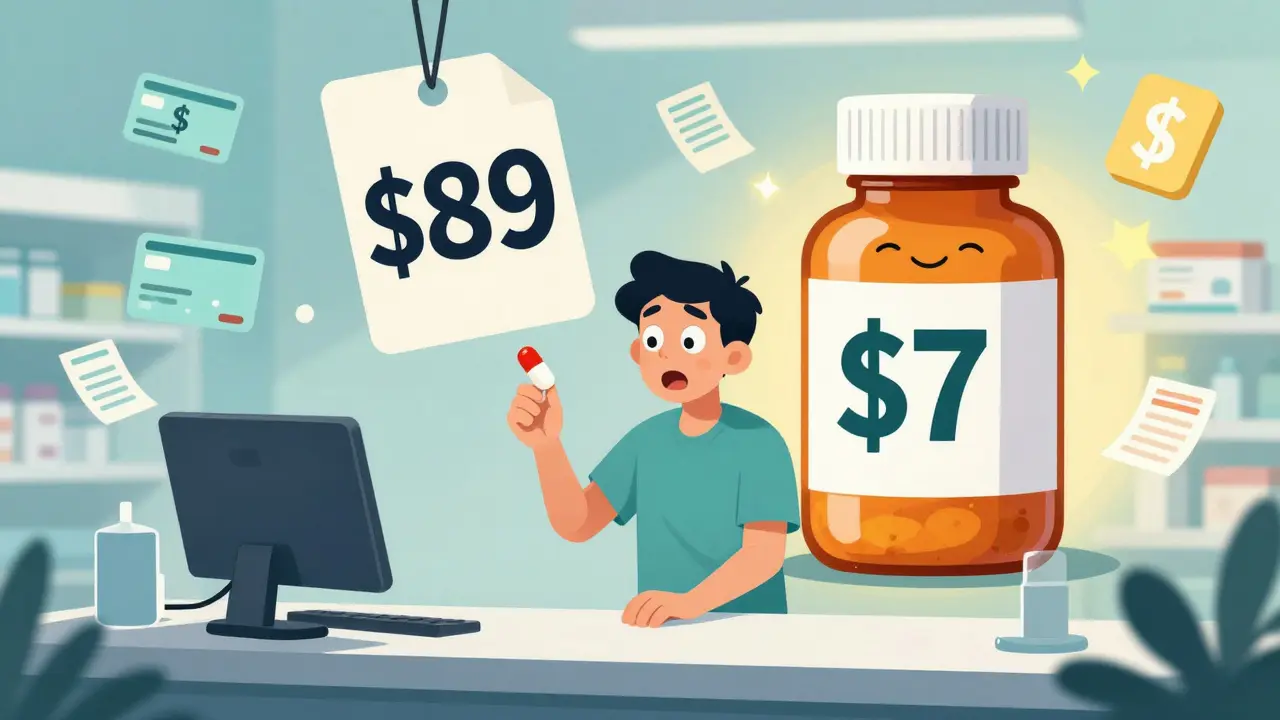
Imagine filling a prescription for a medication you’ve taken for years. You hand over your card, expecting the usual $10 copay. Instead, the pharmacist says it’s $89. You didn’t change your plan. The drug hasn’t changed. But the price did. That’s not a mistake. It’s the system.
Generics Are the Hidden Hero in Your Prescription
More than 9 out of 10 prescriptions filled in the U.S. are for generic drugs. That’s not a small detail-it’s the backbone of affordable care. These aren’t knockoffs or second-rate meds. They’re chemically identical to brand-name drugs, with the same active ingredients, same dosages, same safety profile. The only difference? Price.
In 2023, the average out-of-pocket cost for a generic prescription was $7.05. For the same drug under its brand name? $27.10. That’s nearly four times more. And that’s not an outlier. For drugs like Sildenafil Citrate (the generic for Viagra), the price dropped from $49.90 to $3.07 after generics entered the market. Emtricitabine/Tenofovir, used for HIV prevention, fell from $20.46 to $2.13. That’s a 90% drop. In one case, a three-drug HIV combo went from $1,000 a month to $65. That’s not a savings-it’s a lifeline.
And it’s not just a few drugs. In 2023, 93% of all generic prescriptions cost $20 or less. Over 82% were under $20. Nearly all-98.8%-were under $50. That’s the power of competition. When patents expire, multiple companies start making the same drug. Prices tumble. Patients win.
What Happens When Generics Disappear-Even Just in Name
Here’s the twist: even when generics are available, your insurance plan might not treat them like it should. Many plans still put generics on higher cost tiers. Why? Because pharmacy benefit managers (PBMs) and insurers sometimes make more money that way.
Between 2011 and 2019, researchers found that shifting generics to non-generic tiers increased patient spending by 135%, even as drug prices overall dropped by 38%. That means you’re paying more for the exact same pill, just because your plan labeled it differently. It’s not about the drug. It’s about the billing code.
And it gets worse. Medicare Part D, which is supposed to help seniors afford meds, spent $2.6 billion more in 2018 than it needed to. How? Because patients were being charged more than Costco’s cash price-yes, the warehouse club-for the same generic drugs. For 90-day fills, Medicare overpaid by nearly 30%. That’s not inefficiency. That’s a system designed to extract more from patients, even when cheaper options exist.
Why Your Pharmacy Charge Isn’t What It Seems
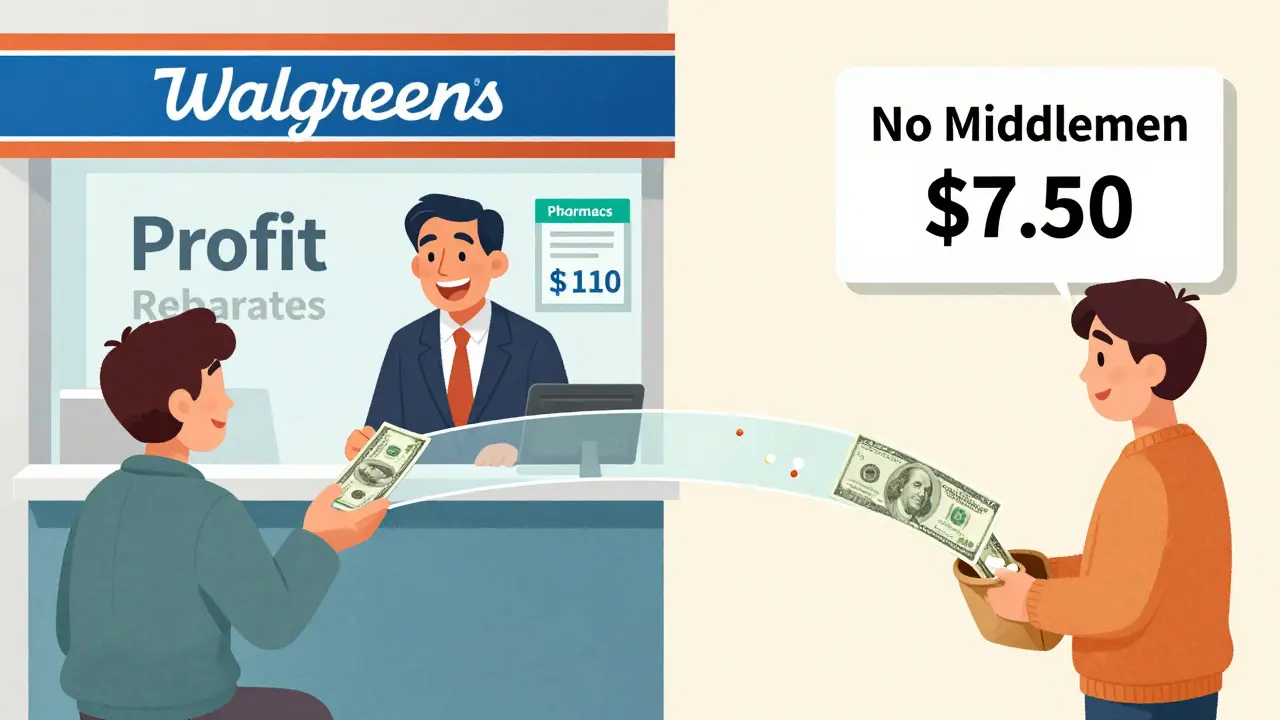
Let’s say you walk into Walgreens for Rosuvastatin, a common cholesterol drug. You’re told it’s $110. You’re shocked. But if you order it online from a direct-to-consumer pharmacy like Health Warehouse, it’s $7.50. Same pill. Same manufacturer. Same FDA approval. The only difference? Who’s handling the transaction.
NIH research from 2023 found that DTC pharmacies save patients 75-76% on generic drugs compared to traditional retail pharmacies. For Pantoprazole (a stomach acid reducer), Albertsons charged $44. MCCPDC charged $9.20. That’s 79% less. For patients on fixed incomes, that’s not a convenience-it’s survival.
These price gaps exist because of a broken supply chain. PBMs negotiate rebates with drugmakers, but those rebates rarely reach the patient. Instead, they inflate list prices, which insurers use to set copays. You pay based on the inflated price, not the real one. So even if your plan says you pay $10 for a generic, the real cost to the system might be $3. You’re paying the difference-and no one’s telling you.
Generics Are Saving Billions. But Who’s Getting the Savings?
Over the last decade, generic and biosimilar drugs saved the U.S. health system $445 billion. That’s more than the GDP of most countries. But here’s the problem: patients still pay more out of pocket for generics than for brand-name drugs in some cases.
AHRQ data from 2011-2016 showed that patients paid 41.8% of the cost of non-specialty generics, compared to just 32.1% for brand-name drugs. That’s backwards. Why? Because insurers often design plans so that generics have higher copays, assuming patients won’t shop around. They assume you won’t know the difference. They assume you’ll pay whatever they charge.
And it’s working. Even though generics make up 90% of prescriptions, they only account for 13.1% of total drug spending. That’s down from 26% in 2016. Why? Because while the volume of generics has exploded, the list prices of brand-name drugs have skyrocketed-and insurers are paying more for those, even when generics are cheaper. The system rewards high-cost drugs, not low-cost ones.
How to Pay Less-Even With Insurance
You don’t have to accept this. Here’s how to fight back:
- Ask for the cash price. Always. Even with insurance. Many pharmacies have lower cash prices than your copay. Costco, Walmart, and Sam’s Club often sell generics for under $5. You don’t need a membership at some locations.
- Use mail-order or direct-to-consumer pharmacies. Sites like HealthWarehouse, Blink Health, and GoodRx connect you directly to wholesalers. You skip the middlemen. You pay less. Same drug. Same delivery.
- Check your plan’s formulary tier. If your generic is on Tier 3 or 4, ask your doctor if there’s a lower-tier alternative. Sometimes, switching to a different generic version (same active ingredient, different brand) drops your cost dramatically.
- Use GoodRx or SingleCare. These apps show real-time prices at nearby pharmacies. They often beat your insurance copay. Print the coupon. Use it.
- Ask for a 90-day supply. Many generics cost less per pill when bought in bulk. But only if your plan allows it-and many don’t. Push for it.
One woman in Ohio, on Medicare, paid $112 for her generic Lisinopril at her local pharmacy. She used GoodRx and paid $6.50 at Walmart. She’s been doing that for three years. That’s $1,250 saved. Not because she’s rich. Because she knew to look.
The Bigger Picture: Why This Keeps Happening
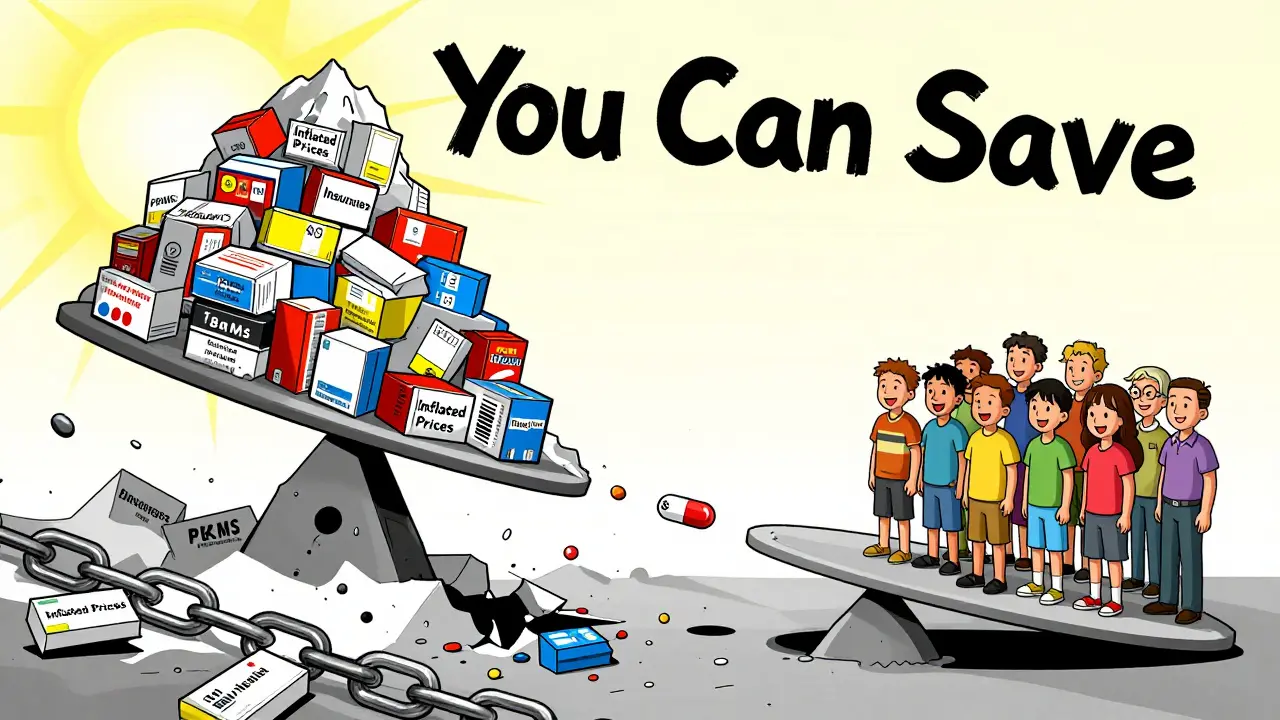
This isn’t an accident. It’s a business model. PBMs profit from the gap between list price and net price. Insurers profit from higher premiums tied to inflated drug costs. Pharmacies profit from patients who don’t question the price. And patients? They’re left wondering why their medication costs more than their groceries.
The U.S. spends nearly three times more on prescription drugs than other wealthy countries. Yet, 90% of prescriptions here are generics. That’s the paradox. We have the tools to make drugs cheap. But the system is built to keep them expensive.
Real reform means separating the price you pay from the middlemen’s rebates. It means requiring transparency so patients know what a drug actually costs. It means banning practices that put generics on higher tiers just to boost profits.
Until then, you’re the only one who can protect yourself. Don’t assume your insurance is working for you. Don’t assume the pharmacy is giving you the best price. Always ask. Always compare. Always look for the cash price. Because in this system, the cheapest option isn’t always the one your plan pushes-it’s the one you find on your own.
What’s Next? The Future of Drug Pricing
More blockbuster drugs are losing patents every year. Cancer treatments, diabetes meds, heart drugs-many will go generic in the next five years. That could save patients tens of billions more.
But without structural change, those savings will vanish into the same broken system. PBMs will keep hiding rebates. Insurers will keep misclassifying generics. Pharmacies will keep charging full price while sitting on cheap inventory.
The solution isn’t more regulation. It’s more awareness. Patients need to know that a $7 pill isn’t a gift from the government. It’s the result of competition, transparency, and a little bit of digging. And if you’re paying more than $20 for a generic, you’re almost certainly overpaying.
The next time you get a prescription, don’t just pay. Ask. Compare. Save. Because your wallet-and your health-depend on it.
Bro, I just paid $4 for my generic metformin at Walmart using GoodRx. Same pill my doctor prescribed. My insurance wanted $47. 😤 I told them to keep their deductible and take a hike. 🙌
Let me be perfectly clear: this isn't 'systemic failure'-it's predatory capitalism, meticulously engineered by PBMs, insurers, and pharmacy chains who view human health as a revenue stream. There is no moral ambiguity here. You are being exploited. And if you don't demand transparency, you are complicit. Period.
generic price drop = 90% but people still pay 10x? smh. pBM got rich. you got broke.
So you're telling me that the same exact chemical compound, manufactured under the same FDA standards, is priced at $110 at Walgreens but $7 at Costco? And we're supposed to be surprised? This isn't healthcare-it's a rigged casino where the house always wins. And you're the sucker.
You think this is bad? Try living in Canada. Their prices are lower because they negotiate. We don't. We whine. We're weak.
So the system is designed to make you pay more for the exact same pill... and you're still surprised? 😒 I guess the real drug here is denial. 🤡
This is not just about cost-it’s about dignity. Every person deserves access to life-sustaining medication without having to become a financial detective. The fact that we must scour apps, call pharmacies, and play pricing roulette to afford basic care is a national disgrace. Let’s demand better-not just for ourselves, but for every parent, elder, and child who can’t fight this battle alone.
I don't know why people are shocked. It's obvious. The system is broken. And if you're not rich, you're just... out of luck. Welcome to America.
so i used goodrx for my generic lisinopril and paid $5.50. my insurance said $98. i almost cried. not from sadness. from rage. why do we let them do this? 🤷♀️
These generics? They’re made overseas. China. India. We’re outsourcing our health to foreign labs. That’s not saving money-that’s surrendering sovereignty.
It is imperative to recognize that the structural inefficiencies within the pharmaceutical supply chain are not merely operational anomalies-they are systemic failures rooted in profit-driven incentive misalignment. Transparency and regulatory intervention are not optional; they are ethically non-negotiable.
I’ve seen people lose sleep over $20 prescriptions. I’ve seen folks skip doses because they can’t afford it. This isn’t just about economics-it’s about survival. And if we can’t fix this, then we’ve already lost the moral compass of what healthcare should be.
It is an undeniable fact that the United States government has abdicated its fiduciary responsibility to its citizens by permitting private entities to exploit pharmaceutical pricing mechanisms. This constitutes a violation of public trust on a scale that demands immediate congressional inquiry and punitive action.
Hey-I used to be one of those people who just paid whatever the pharmacy said. Then my mom got diagnosed with hypertension. She was paying $120 for lisinopril. I found the same pill for $6 at Walmart with GoodRx. She cried. Not because she was sick-but because she realized she’d been robbed for years. I’m telling you now: don’t wait until it’s someone you love. Ask. Always. It’s not rude-it’s righteous.
I just ordered my generic amoxicillin for $3.25 through a mail-order pharmacy. My local CVS wanted $44. I didn’t even need to call. Just clicked. Same pill. Same expiration. Just... cheaper. Maybe we’re not supposed to know this exists. But now we do.