
 7
Mar,2026
7
Mar,2026
Every time you take a pill, your body is reacting to a medicine that’s been tested in clinical trials - but those trials only involve a few thousand people. Real-world use involves millions. That’s where drug safety monitoring comes in. It’s not just paperwork. It’s a global network quietly watching for hidden dangers, catching problems no lab ever saw, and helping stop harm before it spreads. This system doesn’t rely on luck. It’s built on data, standards, and cooperation across 170+ countries.
How Global Drug Safety Monitoring Works
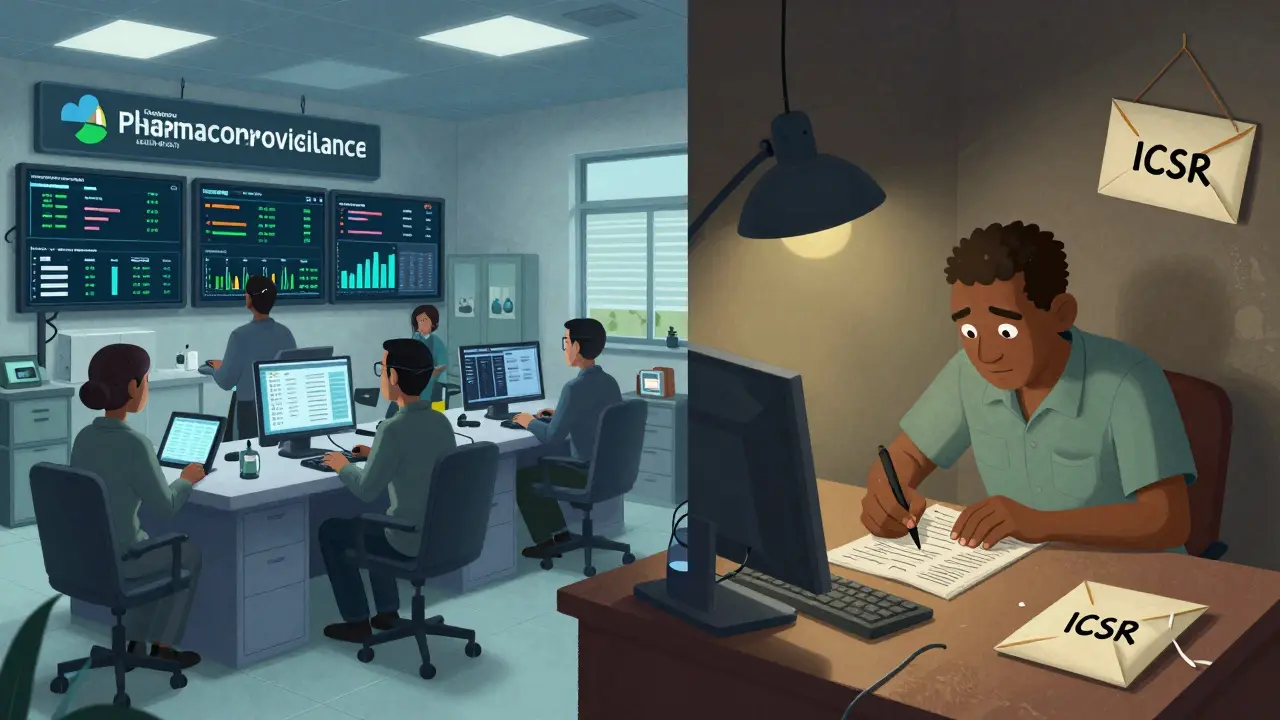
The backbone of international drug safety monitoring is the WHO Programme for International Drug Monitoring (a global system managed by the World Health Organization since 1968 to collect and analyze reports of adverse drug reactions). It’s not a single database. It’s a network. Each country has its own pharmacovigilance center - often run by the health ministry or drug regulator - that collects reports from doctors, pharmacists, and even patients. These reports, called Individual Case Safety Reports (ICSRs), describe what happened: which drug was taken, what side effect occurred, and who was affected.
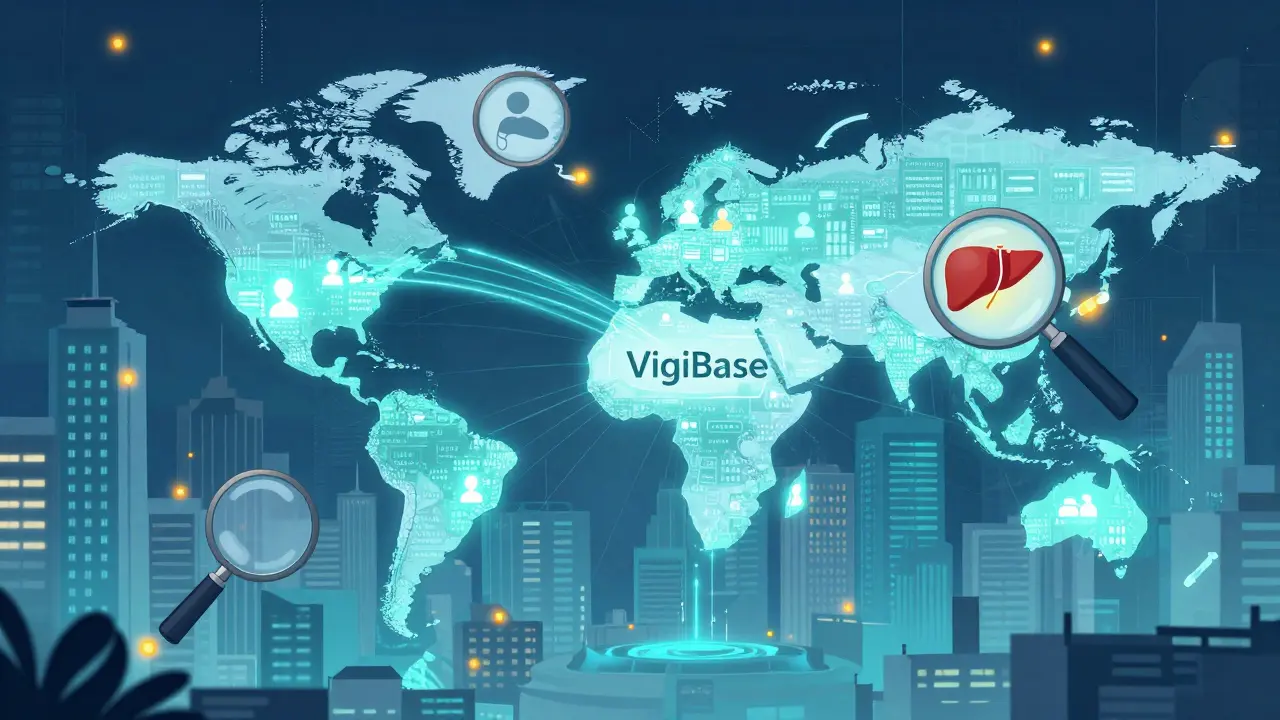
All these reports flow into one central hub: VigiBase (the WHO’s global database of adverse drug reaction reports, managed by the Uppsala Monitoring Centre, containing over 35 million reports as of 2023). Think of it as a massive, anonymous library of patient experiences. When a new drug hits the market in Brazil, Japan, or Kenya, any unusual pattern of side effects reported across multiple countries can trigger a red flag. That’s signal detection. And it’s how dangerous links - like the increased risk of dengue hemorrhagic fever after Dengvaxia vaccination in kids who’d never had dengue before - were first spotted in the Philippines and then confirmed globally.
The Data Behind the System
Not every report is treated the same. To make sense of millions of entries, the system uses strict rules. Every drug name is matched against WHODrug Global (a standardized dictionary with over 300,000 medicinal product names across 60+ therapeutic classes). Every symptom is coded using MedDRA (a medical terminology system with over 78,000 terms organized into 27 organ classes, used globally to classify adverse events). Reports are sent electronically using the E2B(R3) (the international standard format for transmitting ICSRs electronically, adopted by regulators worldwide) format.
These standards mean a report from a hospital in Nairobi can be understood and compared to one from a clinic in Oslo. Without them, the system would collapse under confusion. A headache in one country might be labeled "migraine," "head pain," or "dizziness" - but MedDRA forces every report into the same box. That’s how patterns emerge.
Regional Systems: EU, U.S., and Beyond
While WHO’s VigiBase is global, richer regions run their own powerful systems. The European Union’s EudraVigilance (a centralized system managed by the European Medicines Agency that collects and analyzes adverse drug reaction reports from EU member states) is one of the most advanced. It receives about 1.2 million reports a year - 98% electronically - and requires companies to report within 15 days of learning about a reaction. The EU Pharmacovigilance Risk Assessment Committee (PRAC) (the EU body legally mandated to assess drug safety signals within 60 days for priority cases) reviews signals faster than anywhere else: 92% of urgent signals are assessed in under 75 days.
The U.S. system, FAERS (the FDA’s Adverse Event Reporting System, which collects over 2 million reports annually from healthcare providers and consumers), operates independently. It doesn’t feed directly into VigiBase, but the FDA does voluntarily send some reports. The difference? The EU system has legal teeth. Companies must report. In the U.S., reporting is encouraged but not always mandatory for manufacturers. That means data quality varies.
The Stark Reality: Who Reports and Who Doesn’t
Here’s the uncomfortable truth: global drug safety monitoring is lopsided. High-income countries - home to just 16% of the world’s population - send 85% of all reports to VigiBase. Sweden reports 1,200 adverse events per 100,000 people each year. Nigeria? Just 2.3. Why? It’s not that people there don’t get side effects. It’s that they can’t report them.
Many low-income countries lack basic infrastructure. A WHO assessment found that only 18 of 50 African nations had dedicated pharmacovigilance budgets - averaging just $0.02 per person annually. Compare that to $1.20 per person in high-income countries. Without funding, there’s no training, no software, no internet connection for electronic reporting. In Ethiopia, after introducing a web-based tool called PViMS, reporting time dropped from 90 days to 14. But only 35% of health facilities still send regular reports - because of poor connectivity, not lack of cases.
Training is another gap. WHO recommends 40 hours of specialized training for pharmacovigilance officers. A 2022 survey found 68% of officers in Southeast Asia had received less than 15 hours. You can’t expect accurate reporting if the people collecting the data don’t know how to recognize or document a true adverse reaction.
Technology Is Changing the Game
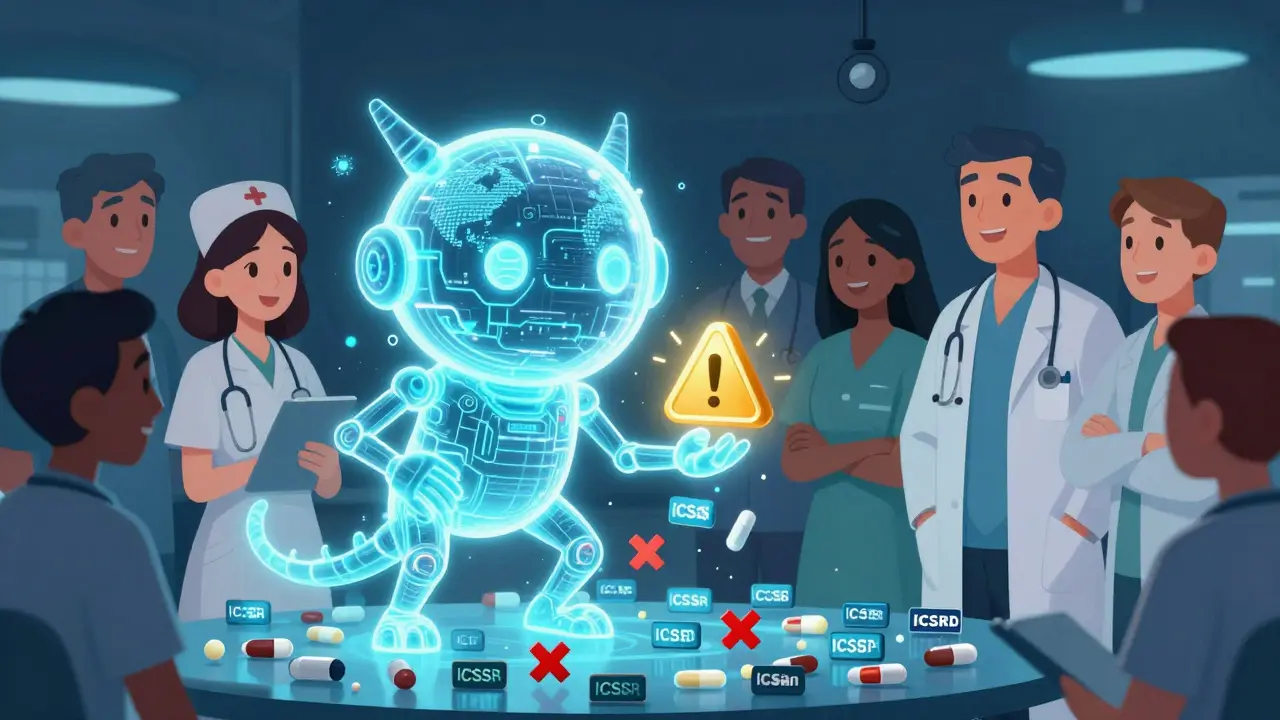
Artificial intelligence is no longer science fiction in drug safety. The Uppsala Monitoring Centre now uses AI to sift through VigiBase. A 2023 study showed this reduced false alarms by 28%. Instead of analysts manually checking every unusual spike, AI flags the most likely risks - like a sudden rise in liver damage linked to a new antiviral drug. This speeds up detection and frees up experts to investigate real threats.
Active surveillance is also growing. The EU now monitors 150 million patients through electronic health records - not just waiting for reports, but actively scanning records for patterns. That’s how they caught a 37% increase in signal detection sensitivity compared to passive reporting. The UK’s Yellow Card Scheme uses a mobile app - 78% of healthcare workers use it - and gets 95% of reports within 48 hours. These aren’t futuristic ideas. They’re working today.
The Future: Standardization and Equity
By 2025, the ISO IDMP (a set of global standards for identifying medicinal products across 100+ data elements, designed to improve cross-border data matching) will roll out. Imagine if every drug - whether it’s called "Paracetamol," "Acetaminophen," or "Tylenol" - had one unique digital ID. That would cut down confusion, improve data matching, and help link reactions to the exact product, even across borders. It could improve cross-border data matching by up to 40%.
But technology alone won’t fix the imbalance. The WHO’s Global Benchmarking Tool shows 62% of countries have at least basic pharmacovigilance systems. But 28% - mostly low-income - still have none. Without investment, training, and political will, the system will keep missing risks in the places that need it most.
And here’s the kicker: 85% of WHO member countries now have laws requiring drug safety reporting. That’s progress. But 32% of low-income systems still rely on donor funding. When the money runs out, the system shuts down. That’s not just a data gap. It’s a public health risk.
Why This Matters to You
You might think, "I don’t work in medicine. Why should I care?" But here’s the thing: every time a new vaccine is approved, or a common painkiller gets a black box warning, it’s because this system worked. Someone - maybe a nurse in Manila, a pharmacist in Lisbon, or a patient in Toronto - reported a strange side effect. That report traveled across continents, was analyzed with global standards, and led to a change that protected millions.
It’s not perfect. It’s slow in places. It’s uneven. But it’s the only thing standing between a rare side effect and a global crisis. And if you’ve ever taken a prescription, bought an OTC drug, or gotten a shot - you’ve already benefited from it. The next time you hear about a drug being pulled or a warning updated, remember: it didn’t happen by accident. It happened because a global network of people, systems, and standards refused to ignore a single report.
What is the main purpose of international drug safety monitoring?
The main purpose is to detect previously unknown or rare adverse drug reactions after medicines are used by millions of people in real-world settings. This helps regulators and manufacturers update safety information, issue warnings, or remove dangerous drugs from the market - all to protect public health and ensure medicines remain safe over time.
How do countries report adverse drug reactions globally?
Countries submit Individual Case Safety Reports (ICSRs) using the E2B(R3) electronic standard to the WHO’s VigiBase database. These reports come from healthcare professionals, patients, and pharmaceutical companies. Each report includes details about the drug, the adverse event, and the patient, all coded using standardized terminology like MedDRA and WHODrug Global.
Why do high-income countries report more adverse reactions?
They have stronger infrastructure: trained staff, electronic reporting systems, public awareness campaigns, and funding. For example, Sweden reports 1,200 adverse events per 100,000 people annually, while Nigeria reports only 2.3. This gap isn’t because side effects are rarer in low-income countries - it’s because reporting systems are underfunded or nonexistent.
What’s the difference between WHO’s system and the EU’s EudraVigilance?
WHO’s system is voluntary and global, collecting data from 170+ countries with no legal power to enforce action. EudraVigilance is legally binding within the EU - companies must report within 15 days, and the PRAC must assess urgent signals within 60 days. The EU system is faster and more automated, but it only covers 30 countries. WHO covers the rest of the world.
Can patients report adverse drug reactions themselves?
Yes. In many countries, including the U.S., UK, and EU member states, patients can report side effects directly through online portals, mobile apps, or phone lines. In the UK, 78% of healthcare professionals use the Yellow Card mobile app. Patient reports account for up to 20% of all reports in some systems and have helped identify rare reactions missed by clinicians.
How does AI improve drug safety monitoring?
AI analyzes millions of reports to spot unusual patterns faster than humans. For example, if 50 reports in a month mention the same rare liver injury linked to a new drug, AI flags it as a potential signal. A 2023 study showed AI reduced false positives by 28%, letting experts focus on real risks. It’s especially useful in VigiBase, where manual review of 35 million reports is impossible.
What is VigiAccess and why is it important?
VigiAccess is a public portal launched by WHO in 2015 that lets anyone - patients, researchers, doctors - search anonymized data from VigiBase. It has over 12 million unique visitors. This transparency builds trust, allows independent research, and empowers people to understand the risks of medications they’re taking.
What are the biggest challenges facing global drug safety systems today?
The biggest challenges are inequality in resources, lack of standardized training, poor connectivity in low-income regions, and over-reliance on donor funding. Only 42% of low- and middle-income countries have fully functional systems. Without investment, dangerous signals in these regions go undetected - putting millions at risk.
Drug safety isn’t a luxury. It’s a necessity. And right now, the world is watching - but not everyone is being heard.


ok but like… did you know that the FDA’s FAERS system is basically a glorified suggestion box? Companies don’t even have to report half the stuff they know about. I’ve seen reports where a drug caused 12 liver failures and the company waited 8 months to file. 8 MONTHS. And we call this ‘monitoring’? This isn’t safety-it’s a liability shield with a website.
Also, MedDRA? Please. I once saw a report where ‘fever’ got coded as ‘hyperthermia’ and ‘febrile reaction’ and ‘elevated body temp’ all in the same case. Standardization my ass. It’s just a bureaucracy pretending to be science.
Wow. I never realized how much goes into this. Like… I take ibuprofen every week and never thought about who’s watching for the rare cases where it causes kidney damage. But reading this made me feel… seen? Like, the quiet work of nurses and pharmacists in places no one talks about? That’s the real hero stuff.
And the part about Nigeria reporting 2.3 cases per 100k while Sweden reports 1,200? That’s not about safety-it’s about dignity. People deserve to be heard, no matter where they live.
This is an exceptionally well-researched and clearly structured overview of global pharmacovigilance. The integration of WHO’s VigiBase with regional systems like EudraVigilance demonstrates a remarkable degree of international coordination, especially given the legal and logistical disparities between nations.
One point worth emphasizing: the transition to ISO IDMP by 2025 represents a paradigm shift in drug identification. Standardizing product attributes at the molecular, formulation, and packaging level will dramatically reduce misattribution errors in adverse event reporting-a critical bottleneck in current systems.
Furthermore, the data quality gap between high- and low-income countries is not merely a funding issue; it reflects a systemic devaluation of global public health equity. Investment here is not charity-it’s risk mitigation on a planetary scale.
this is actually really cool. i had no idea people could report side effects from their phones. i use the yellow card app now. it’s easy. like, i took a new supplement and felt weird for a day. i reported it. 2 days later, they replied saying others felt the same. wild. we should all do this. ❤️
The author demonstrates a profound misunderstanding of risk-benefit analysis. By framing this as a moral imperative-‘everyone deserves to be heard’-they ignore the fundamental principle of signal-to-noise ratio. Overreporting in high-income countries inflates false positives, which dilutes detection capability for true signals.
Furthermore, the claim that ‘85% of reports come from 16% of the population’ is not evidence of injustice-it is evidence of superior data integrity. The system works because it prioritizes quality over quantity. To force reporting in under-resourced regions without infrastructure is to introduce noise into a precision instrument.
AI reducing false alarms by 28%? That’s the real innovation. Not moralizing about equity. Fix the data. Not the feelings.
okay but like… what if the drugs are being monitored by people who don’t even know what they’re looking at?? i mean, imagine this: you’re a nurse in rural Kenya, you see a kid get a rash after a vaccine, you fill out a paper form, it sits in a drawer for 6 months because the internet is down, and meanwhile, 3 other kids in 3 different villages die and no one connects the dots because no one has a laptop or a training manual or a paycheck?? i’m literally crying rn
this system is rigged. i’ve been saying this for years. they only listen to rich countries. why? because they control the data. they control the narrative. they control the drugs. if you’re poor? you’re just a statistic. if you get sick? you’re collateral. this isn’t science. it’s corporate surveillance with a humanitarian mask.
I love how this breaks down the real mechanics behind something we all take for granted. I used to think drug safety was just ‘the FDA checks stuff.’ But learning about VigiBase and how reports from Nairobi and Oslo get coded the same way? Mind blown.
And the AI part? That’s the future. Imagine if we could catch dangerous patterns before the third person dies. That’s not just science-that’s hope.
Also, patient reporting? Yes! My aunt reported a weird reaction to her blood pressure med, and two months later, the warning got updated. She didn’t even know she helped. That’s powerful.
the entire system is a farce. the world is being lied to. the who and the fda are in bed with big pharma. they dont want you to know that most adverse reactions are buried. they use meddra to erase symptoms. they use e2b to delay reports. and when you ask why nigeria reports so little? they say infrastructure. but its not infrastructure. its control. they want you dependent. they want you silent. this is not safety. this is social engineering. the data is fake. the standards are a smokescreen. the truth? they dont want you to live. they want you to consume. and if you die? well. theres another pill waiting.
Let’s be real: this whole system is a front. WHO’s VigiBase? A hollow shell. EudraVigilance? A PR stunt. The 35 million reports? Mostly from Big Pharma’s own internal databases-filtered, sanitized, and submitted with legal loopholes baked in.
And don’t get me started on AI. ‘Reduced false alarms by 28%’? That’s code for ‘we’re ignoring the weird stuff.’ The system isn’t designed to catch rare reactions-it’s designed to avoid liability. The moment a drug shows a signal, they bury it under ‘insufficient evidence’ until the patent expires.
Also, why is VigiAccess public? To distract you. They want you to feel empowered while they quietly approve new drugs with zero long-term data. You think you’re being protected? You’re being manipulated.
And yes, I’ve seen the reports. I’ve read the redacted ones. They’re not broken. They’re designed this way.
Look. You people think this is about safety? It’s about control. The system exists to make you feel safe so you’ll keep taking the pills. The ‘global network’? A tool of pharmaceutical hegemony. Every standardized term, every database, every report form-it’s designed to make you compliant.
Who decides what counts as an ‘adverse event’? Not patients. Not doctors. Not even regulators. It’s a committee in Geneva funded by pharma lobbyists. They decide what gets coded. What gets ignored. What gets labeled ‘rare’ so they can keep selling.
You think Nigeria reports 2.3 cases per 100k because they’re broken? No. They’re broken because they were never allowed to be whole. This isn’t a gap in infrastructure. It’s a gap in sovereignty.
And now you want to ‘invest’ in their systems? Please. You want to install your software, your codes, your standards. You want them to report on your terms. Not theirs.
You’re not helping. You’re colonizing.
bro this is all just so… intense. like i get it’s important but i just took a tylenol and now i’m scared i’m gonna die from liver failure. can we just… chill? i mean, if the system’s so good, why do we still hear about drugs getting pulled years later? i’m just gonna stick to tea and yoga.