
 9
Dec,2025
9
Dec,2025
Every year, thousands of children receive the wrong dose of medication-not because someone was careless, but because a simple number was wrong. A child’s weight, entered in pounds instead of kilograms. A calculation done on a napkin. A weight recorded three weeks ago that no one checked again. These aren’t rare mistakes. They’re preventable failures that happen in hospitals, clinics, and even community pharmacies. And they put kids at risk.
Why Weight-Based Checks Are Non-Negotiable in Pediatrics
Adults get pills. Kids get drops, syringes, and liquids measured by milliliters. Their bodies don’t handle medication the same way. A 10-pound infant needs a completely different dose than a 70-pound child-even if they’re both getting the same drug. That’s why pediatric dosing is always based on weight: milligrams per kilogram (mg/kg) or milligrams per square meter (mg/m²).
But here’s the problem: weight is often wrong. A 2021 review of 63 studies found that over 32% of pediatric dispensing errors involved incorrect weight-based calculations. And 8.4% of those errors caused real harm-vomiting, seizures, organ damage. The CDC found that 40% of liquid medication errors in kids under 4 came from mixing up pounds and kilograms. That’s not a typo. That’s a life-threatening mistake.
The World Health Organization says children are three times more likely to suffer medication errors than adults. Why? Because the math is harder. The stakes are higher. And too often, the system doesn’t catch it.
The Three-Point Verification System That Works
There’s no single fix. But experts agree on one thing: you need checks at three critical points-prescription, pharmacy, and bedside.
1. Prescription Entry
Every order must include the patient’s current weight in kilograms. No exceptions. No pounds. No estimates. If the weight isn’t in the system, the computer won’t let the prescriber submit the order. That’s not a suggestion. It’s a requirement from the American Society of Health-System Pharmacists (ASHP).
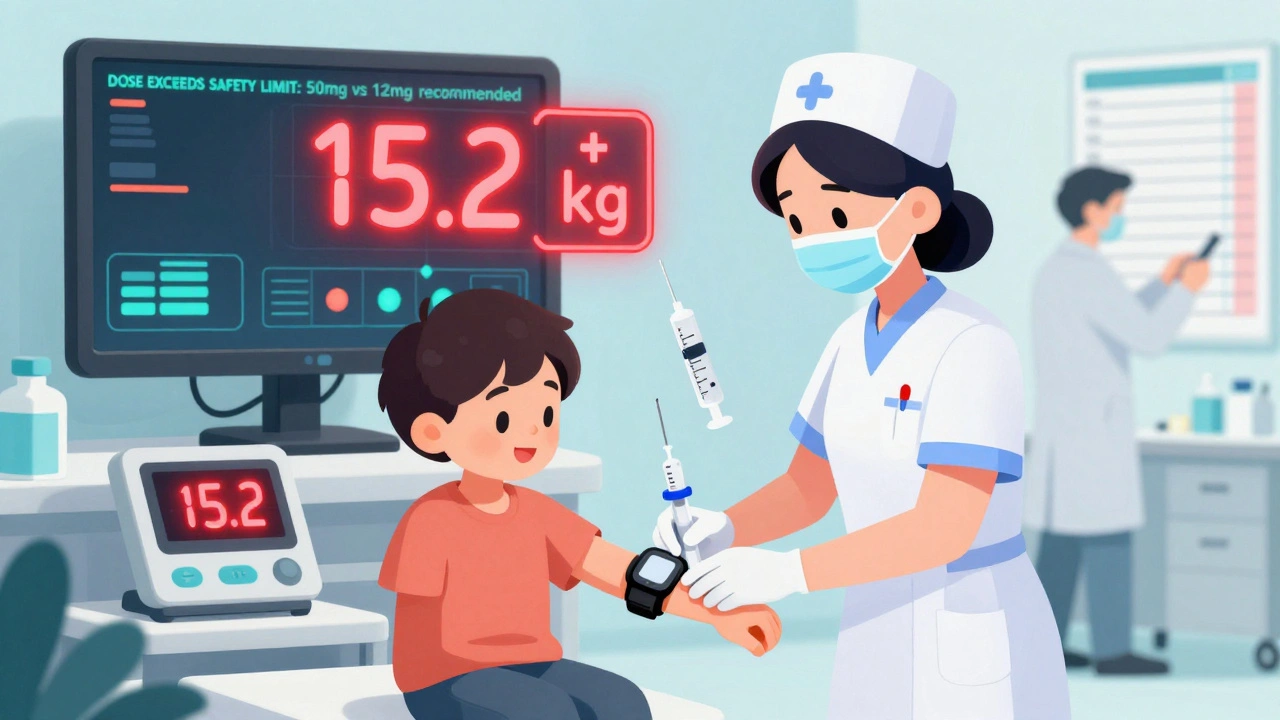
Electronic health record (EHR) systems should have built-in alerts. If a 15 kg child is ordered 50 mg of amoxicillin (which is way over the safe limit), the system should block it and say why. Studies show this cuts prescribing errors by 87%.
2. Pharmacy Verification
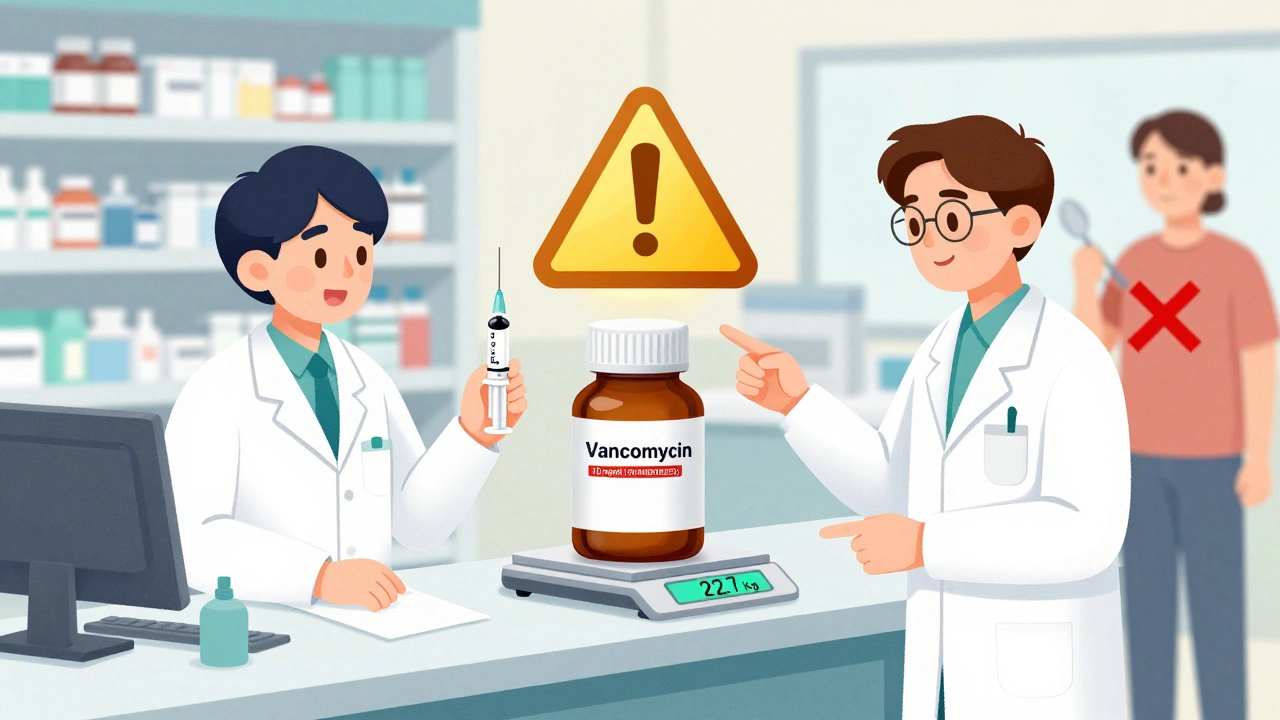
Pharmacists don’t just fill prescriptions. They verify them. Every time. That means checking the weight against the dose, checking the unit (milliliters, not teaspoons), and confirming the concentration (e.g., 25 mg/mL, not 125 mg/mL). Many hospitals now require two pharmacists to sign off on high-risk pediatric doses.
One hospital in Boston cut weight conversion errors from 14.3 per 10,000 doses to just 0.8 in 18 months-just by making kilogram-only entry mandatory and adding pharmacist verification.
3. Bedside Administration
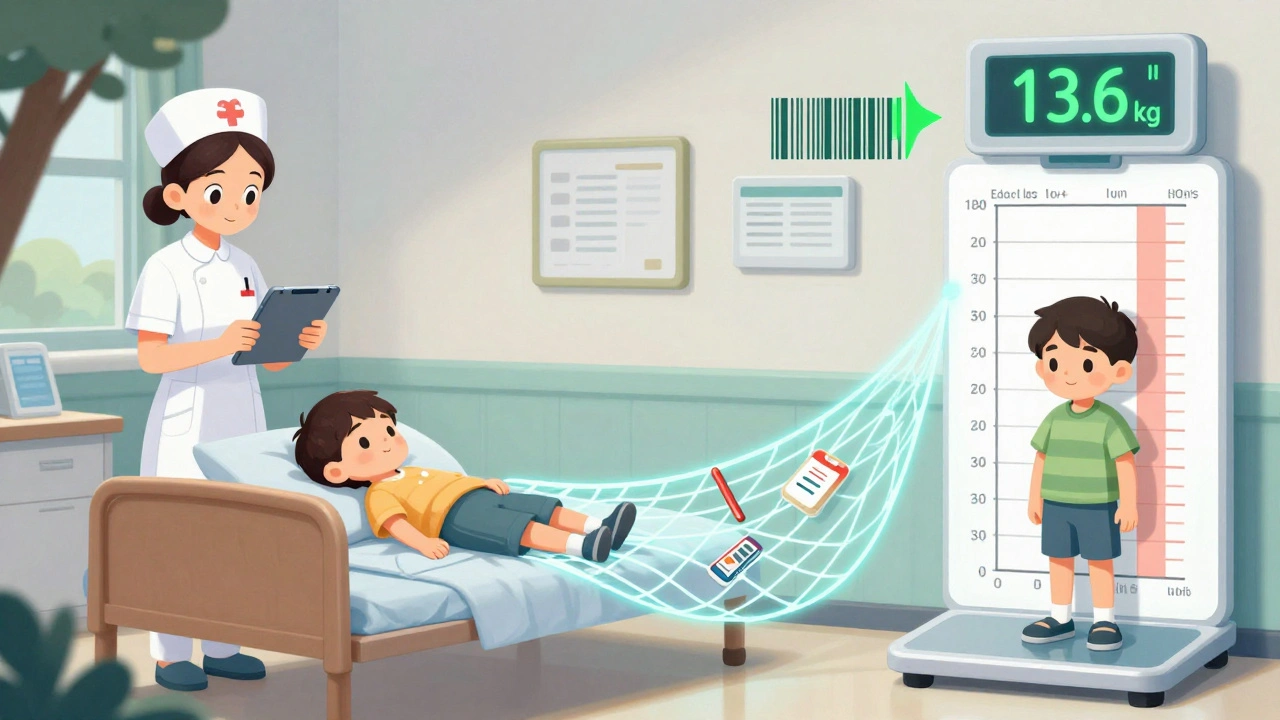
The final safety net is the nurse giving the dose. Barcode scanning systems that pull in the patient’s weight from the EHR can flag mismatches before the medication is given. A 2020 study showed this cut administration errors by 74%.
Dr. Matthew Grissinger from the Institute for Safe Medication Practices says this three-point check is the single most effective way to prevent errors. It’s not fancy. It’s just done every time.
What the Tech Can-and Can’t-Do
Technology helps, but it’s not magic. Computerized systems with weight-based alerts reduce errors by up to 87%. But here’s the catch: if the alert is wrong too often, people start ignoring it.
A 2021 study found that 41.7% of weight-based alerts were overridden by clinicians. And 18.3% of those overrides were actual errors that should’ve been caught. That’s alert fatigue. It happens when the system screams “wrong dose!” for a kid who’s just growing fast or when the weight is outdated.
Newer EHR systems like Epic’s Pediatric Safety Module 4.0 (released in January 2024) use growth charts to predict expected weight ranges. Instead of just comparing to a fixed number, it asks: “Is this dose reasonable for a child this age and height?” That cut inappropriate alerts by 63% in testing.
But tech fails when it’s disconnected. Community pharmacists without EHR access can’t verify weights. One survey found 28.4% of them had a near-miss every month because they didn’t know the child’s current weight. That’s why integrated systems matter. If the weight isn’t in the system, the safety net doesn’t exist.
Standardizing the Basics
One of the biggest sources of confusion? Units. Liquid medications are measured in milliliters. But many parents still think in teaspoons. And some prescriptions still say “give 1 tsp” instead of “5 mL.”
The American Academy of Pediatrics says: no more teaspoons. No more fluid ounces. All pediatric liquid meds must be labeled in milliliters. Period.
Another fix? Standardized concentrations. Instead of letting each drug come in different strengths (like vancomycin at 5 mg/mL, 10 mg/mL, 25 mg/mL), hospitals are switching to one standard concentration per drug. That cuts calculation errors by 72%. Fewer numbers to remember. Fewer chances to mess up.
And don’t forget the scale. Infants should be weighed on digital scales that show only kilograms, to the nearest 0.1 kg. Older kids? 0.5 kg precision. No pounds. No rounding. Just clean, exact numbers.
What Happens When You Don’t Do This
In 2022, a 3-year-old in a rural clinic got 10 times the intended dose of morphine. Why? The nurse entered 30 pounds instead of 30 kilograms. The system didn’t flag it. The pharmacist didn’t catch it. The child went into respiratory arrest. They survived. But only because a nurse noticed the dose looked wrong and double-checked.
That’s not an outlier. It’s a pattern. A 2022 survey of 1,247 pediatric nurses found that 63% had seen weight documentation errors in the past year. Over 40% said those errors caused delays in giving meds-meaning kids waited longer for pain relief or antibiotics.
And the gap is widening. While 94% of children’s hospitals have full weight verification systems, only 33% of rural community hospitals do. Kids in small towns, in underserved areas-they’re the ones most at risk.
How to Build a Real Safety System
Getting this right takes more than buying software. It takes culture. Training. And discipline.
Start with these steps:
- Make weight mandatory-no order without current weight in kilograms.
- Train everyone-doctors, nurses, pharmacists, even receptionists who enter weights. Teach them how to convert pounds to kilograms correctly (divide by 2.205, not 2.2).
- Standardize concentrations-limit how many strengths each drug comes in.
- Require dual verification-two people check high-risk doses.
- Update weights regularly-new weight within 24 hours for hospitalized kids, within 30 days for outpatients.
- Use barcode scanning at the bedside to match the drug, dose, and weight.
- Measure with digital scales-display only kilograms.
Successful programs hire 1.5 full-time pharmacists for every 50 pediatric beds just to verify doses. That sounds expensive. But one serious error costs far more-in money, trauma, and trust.
The Bigger Picture
Weight-based checks aren’t just about math. They’re about respect. Kids aren’t small adults. Their bodies are delicate. Their doses are precise. And every time we cut corners, we’re gambling with their lives.
Regulators are catching on. The Leapfrog Group now requires weight verification for hospitals to get an “A” safety rating. Medicare and Medicaid now demand it in billing rules. The FDA is pushing for EHRs to use growth charts to flag unsafe doses.
But the real change comes from people. From pharmacists who ask, “Did you weigh them today?” From nurses who pause before giving a dose that looks too high. From doctors who refuse to order until the weight is entered.
Technology helps. But the safety net is only as strong as the person holding it.




Weight-based dosing is one of those things that seems obvious until you realize how often it’s ignored. The data here is irrefutable: incorrect conversions lead to preventable harm. It’s not about blame-it’s about system design.
Let’s be brutally honest: if your EHR can’t enforce kilogram-only entry, you’re not a hospital-you’re a liability factory. The ASHP guidelines aren’t suggestions; they’re the baseline for moral competence in clinical practice. Anyone who still accepts pound entries should be mandated to retake pharmacology in 1998.
The fact that 41.7% of alerts are overridden isn’t ‘alert fatigue’-it’s systemic arrogance. Clinicians think they’re above algorithms because they’ve seen ‘a few cases.’ Spoiler: they haven’t seen enough. The 18.3% of overrides that were actual errors? Those are the ones that end up in medical malpractice journals.
And don’t get me started on ‘teaspoons.’ The AAP’s stance isn’t just wise-it’s a moral imperative. If you write ‘1 tsp’ on a pediatric script, you’re not being helpful. You’re a relic. A dangerous, outdated relic. Every time you do it, you’re contributing to the statistical noise that kills children.
Standardized concentrations? Of course. Why are we still letting vancomycin come in five different strengths? That’s not clinical flexibility-that’s institutional laziness. And digital scales? If your scale displays pounds, it should be smashed with a hammer. No exceptions. No ‘but we’ve always done it this way.’ That’s the kind of thinking that gets toddlers intubated.
The Boston hospital case study? That’s not a success story-it’s a baseline. If you’re not at 0.8 errors per 10,000 doses, you’re failing. Period. And the 33% of rural hospitals without verification systems? That’s not a gap. That’s a massacre waiting to happen.
Regulators are finally catching up. Leapfrog, Medicare, FDA-they’re all signaling the same thing: if you’re not doing this right, you don’t deserve to treat children. And if you think tech is the solution? It’s not. Tech is the enabler. The solution is discipline. Culture. And the courage to say ‘no’ when someone hands you a weight in pounds.
Oh please. You think this is about math? It’s about control. Who decided kilograms were the ‘right’ unit? Why not ounces? Why not stones? This is just Western medical imperialism dressed up as safety. In India, we’ve been dosing by pounds for generations-kids are fine. You’re pathologizing tradition to sell more software.
And don’t even get me started on ‘dual verification.’ Two pharmacists? That’s just job creation for overpaid white people. In real hospitals, one nurse does five jobs. You want safety? Train the nurses better. Don’t add bureaucracy. The system is already broken-not because of pounds, but because you’ve turned every step into a performance review.
Also, ‘growth charts’? So now we’re tracking kids’ weight like they’re cattle at a fair? What’s next? Mandatory BMI scores before giving Tylenol? This isn’t medicine-it’s surveillance capitalism with a stethoscope.
WAIT-so you’re telling me the system that’s supposed to protect kids is actually the one that’s KILLING THEM because of a decimal point? And nobody’s talking about the fact that Big Pharma profits from all these different concentrations? THIS IS A COVER-UP. The EHR companies are in bed with drug manufacturers to keep things confusing so they can sell more ‘safety modules.’
And why do you think the CDC only tracks ‘errors’? What about the kids who die quietly? No one reports those. No one wants to admit that 40% of pediatric deaths from meds are preventable. The system doesn’t want you to know this. That’s why they call it ‘alert fatigue’-to make you feel guilty for surviving.
I’ve seen the forms. They’re designed to fail. The weight fields are hidden under three menus. Nurses don’t have time. Doctors are rushed. And the ‘mandatory’ checks? They’re optional if you click ‘override’ fast enough. This isn’t safety. It’s a trap.
This is one of the most important things I’ve read in a long time. Thank you for laying it out so clearly. I work in a small clinic, and we’ve been struggling with weight entries-sometimes parents give us pounds, sometimes nurses guess. We’re starting with the scale upgrade this month. No more pounds. Ever.
It’s scary to change, but what’s scarier is doing nothing. I’ve seen kids wait too long for pain meds because the weight was wrong. That’s not okay. We’re training everyone-even the front desk staff. And we’re using the same concentration for all amoxicillin now. It’s small, but it matters.
You don’t need fancy tech to start. You just need to care enough to pause and ask, ‘Did we weigh them today?’ That one question saves lives.
Okay but like… why are we even using math in 2024? Can’t we just give kids a magic pill that adjusts itself? Or maybe a drone drops the right dose based on their sneeze?
Also, teaspoons are fine. My cousin’s kid took ‘1 tsp’ and lived to be 27. So chill.
I’ve worked in pediatric pharmacy for 17 years. I’ve seen the worst of this. I’ve held a mother while her child recovered from an overdose caused by a misplaced decimal. I’ve watched a nurse cry because she didn’t catch the weight error.
This isn’t about rules. It’s about respect. Children don’t get to say, ‘Wait, I meant 15 kg.’ They don’t get to argue. They don’t get a second chance. So we have to be their voice.
The three-point check isn’t bureaucracy-it’s love in action. It’s the pharmacist double-checking. The nurse scanning the barcode. The doctor insisting on a current weight. It’s not glamorous. But it’s everything.
And yes, it’s expensive to hire extra pharmacists. But the cost of one error? A lifetime of trauma. A broken family. A hospital lawsuit. A child who never walks again. That’s the real price tag.
If you’re reading this and you work in healthcare-don’t just follow the protocol. Live it. Ask the question. Pause. Verify. Because someone’s child is depending on you.
Love this. I’m a nurse mom and I’ve been pushing my clinic to switch to mL-only labels. Parents are confused, but once we show them the syringe with mL markings, they get it. One dad said, ‘I thought I was giving him medicine, but now I know I’m not killing him.’ That hit me hard.
Small changes. Big impact. Keep going.
It is of considerable importance to note that the integration of standardized weight measurement protocols into clinical workflows represents a paradigmatic shift in pediatric pharmacotherapy. The empirical evidence presented herein, particularly the 87% reduction in prescribing errors, is statistically significant and clinically meaningful. Further, the implementation of dual verification procedures constitutes a robust error-reduction strategy aligned with best-practice frameworks in high-reliability organizations.
It is recommended that institutions consider the adoption of ISO 13485-compliant weight documentation systems to ensure traceability and regulatory alignment. The continued use of non-standardized units, while historically entrenched, is no longer defensible under contemporary standards of care.
What if the real problem isn’t the weight… but the fact that we’re treating children like equations? We reduce them to kilograms and milliliters, but what about their pain? Their fear? Their parents’ panic?
Maybe the real ‘safety net’ isn’t the barcode scanner or the kilogram-only EHR-but the human who looks at the child, sees the trembling hands of the mother, and says, ‘Let me double-check this with you.’
Technology can prevent mistakes. But only presence can prevent trauma.
I wonder if we’ve confused precision with compassion. And if, in our quest for perfect numbers, we’ve forgotten to hold the kid’s hand while we calculate.
There’s a deeper layer here: we treat pediatric dosing like a math problem, but it’s actually a moral one. Every number on that screen is a living child. Every decimal point carries the weight of a parent’s sleepless night. Every override is a quiet surrender to the belief that ‘it’ll be fine.’
And yet-we don’t punish the system. We punish the nurse. We blame the pharmacist. We call it ‘human error.’ But the error isn’t in the person-it’s in the design. In the culture. In the refusal to make safety non-negotiable.
Maybe the real innovation isn’t a new EHR module. Maybe it’s a new way of seeing. Children aren’t small adults. They’re whole beings, fragile and bright. And we owe them more than a checklist. We owe them reverence.
So when you see that weight field, don’t just fill it. Honor it.
So… we’re making doctors do math now? What’s next? Asking them to tie their own shoes?
Just give kids the adult dose. They’ll be fine.
Western medicine thinks it owns the truth. In India, we use pounds, we use teaspoons, we use intuition-and we’ve been saving children for centuries. You think your ‘kilogram-only’ system is superior? You’re blind to our wisdom. Your ‘safety protocols’ are colonial relics dressed in EHRs. We don’t need your algorithms-we need respect.
And who gave you the right to say ‘no teaspoons’? Who are you to dictate how we care for our children? This isn’t science. It’s cultural imperialism.
Re: Raj, I hear you. But my cousin’s daughter in Mumbai got the wrong dose because the nurse mixed up pounds and kg. She was fine, but she could’ve been in ICU. We don’t have to choose between tradition and safety. We can honor both-by using the unit that prevents mistakes.
It’s not about ‘Western’ or ‘Indian.’ It’s about not killing kids.