
 30
Jan,2026
30
Jan,2026
What Is Thyroid Storm?
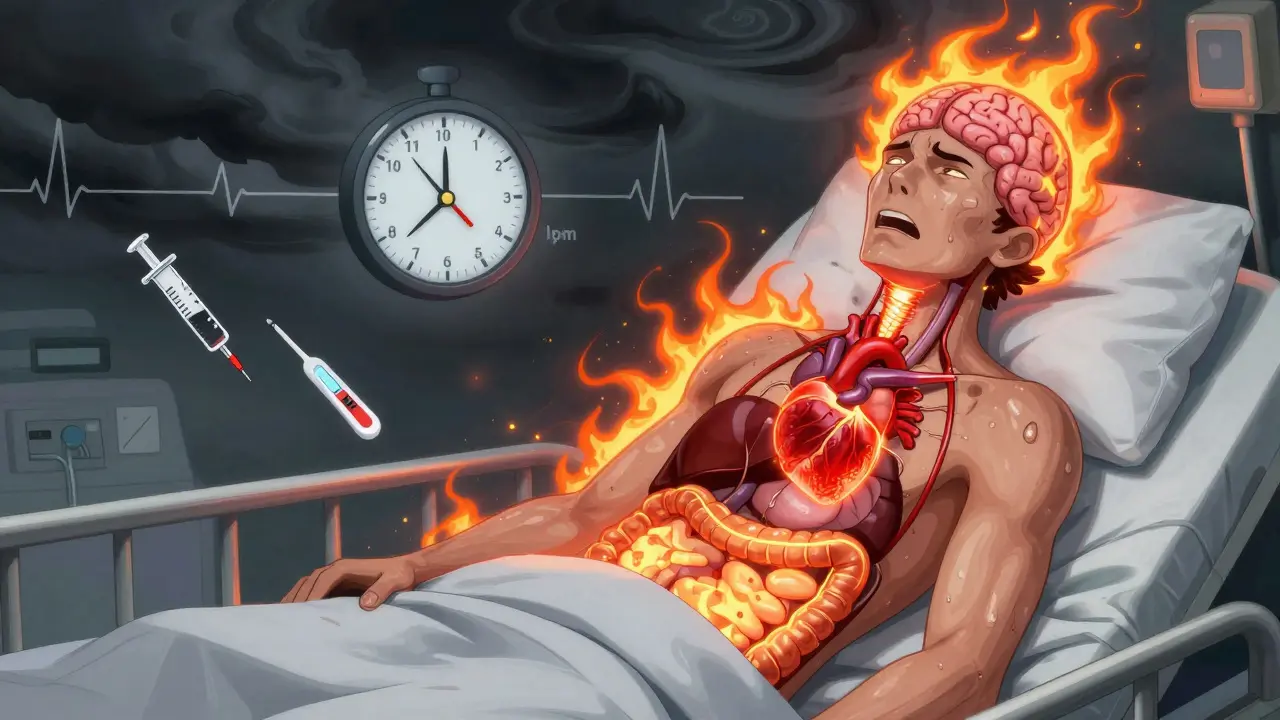
Thyroid storm is a rare, life-threatening explosion of hyperthyroidism that sends the body into a hypermetabolic crisis. It doesn’t happen in people with normal thyroid function-it strikes those with untreated or poorly controlled Graves’ disease or other forms of overactive thyroid. Think of it as hyperthyroidism on steroids: symptoms that normally develop over weeks suddenly crash over hours. This isn’t just feeling jittery or losing weight fast. This is fever over 104°F, heart rate above 140 beats per minute, confusion, vomiting, and sometimes coma. Without immediate treatment, death is likely.
Why It’s So Dangerous
Thyroid hormones control your body’s energy use. Too much? Every cell runs too fast. Your heart pounds so hard it can’t keep up. Your liver struggles to process toxins. Your brain goes haywire. Your gut churns nonstop. The result? Multi-organ failure. According to the National Institutes of Health, thyroid storm is the most severe form of thyrotoxicosis. The Japan Thyroid Association’s diagnostic criteria, adopted widely since 2012, require clear signs: fever, tachycardia, heart failure, mental changes, and GI symptoms-all happening together. One key detail: these aren’t vague feelings. They’re measurable. Free T4 levels often exceed 2.5 times the upper limit. Free T3 is triple normal. And in 90% of cases, the patient is confused, agitated, or worse.
What Triggers It?
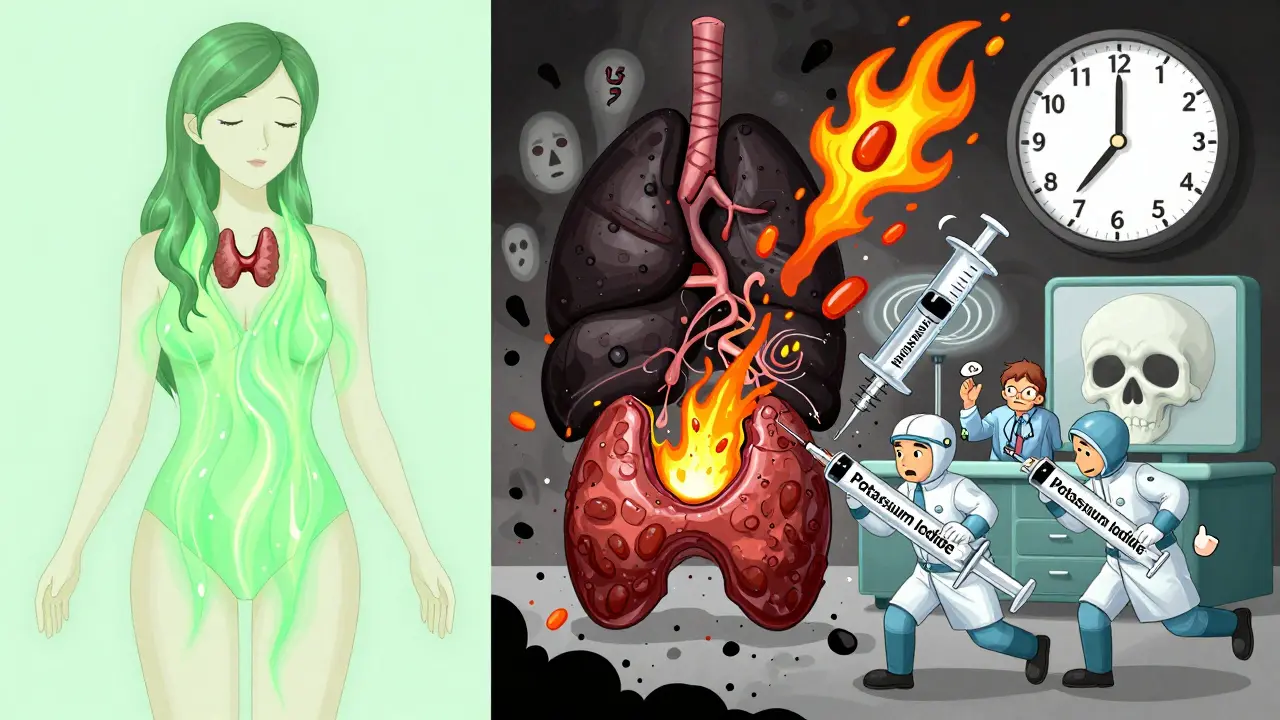
Thyroid storm doesn’t come out of nowhere. It’s triggered by stress on an already overworked system. The most common trigger? Poorly managed hyperthyroidism itself-about 60-70% of cases. But other events can push it over the edge. Infections, especially pneumonia or sepsis, are the second leading cause. Surgery, even something routine like a tooth extraction, can spark it if thyroid levels aren’t controlled. Trauma, including physical injury to the neck, has been documented. Emotional shock, stroke, diabetic ketoacidosis, and pulmonary embolism are also known triggers. Even pregnancy, particularly in the first few weeks after delivery, can trigger thyroid storm in women with undiagnosed Graves’ disease. And yes, radioactive iodine therapy, meant to treat hyperthyroidism, can sometimes cause it-usually a week or more after treatment.
Recognizing the Signs Before It’s Too Late
Time is everything. If you’re caring for someone with known hyperthyroidism and they suddenly get worse, act fast. Look for these red flags: a fever between 104°F and 106°F, drenching sweats, a pulse racing past 140 bpm, and a blood pressure spike with a wide gap between systolic and diastolic readings. Gastrointestinal symptoms like vomiting, diarrhea, or abdominal pain appear in half to two-thirds of cases. Mental status changes are nearly universal-restlessness, hallucinations, delirium, or coma. Jaundice? That’s liver stress. A total bilirubin over 3 mg/dL is a serious warning. The Burch-Wartofsky scoring system helps doctors quantify this: a score above 45 confirms thyroid storm. But you don’t need the score to know something’s wrong. If someone with hyperthyroidism looks like they’re dying, they probably are.
How ICU Teams Fight Thyroid Storm
Once thyroid storm is suspected, treatment begins within one to two hours. There’s no waiting for test results. The goal: stop hormone production, block hormone action, and calm the body’s chaos. First, high-dose antithyroid drugs. Methimazole-60 to 80 mg initially-is preferred. If it’s not available, propylthiouracil (PTU) is used at 600 to 1,000 mg. These drugs stop the thyroid from making more hormone. Within an hour, potassium iodide or sodium iodide is given to block the release of stored hormone. Beta-blockers like propranolol come next: 60-80 mg every 4-6 hours, or IV doses of 1-2 mg every 5 minutes if the heart rate won’t drop. This doesn’t fix the root cause, but it saves lives by slowing the heart and reducing tremors and anxiety. Fever is treated with acetaminophen, not ibuprofen-NSAIDs can worsen liver stress. Cooling blankets and fans help when temperatures hit 104°F or higher. Corticosteroids like hydrocortisone (100 mg IV every 8 hours) are given to protect the adrenal glands and stop T4 from turning into the more potent T3.
Supporting the Body While Fighting the Storm
ICU care isn’t just about drugs. It’s about holding the body together. Fluids are critical-patients are often dehydrated from sweating, vomiting, and diarrhea. Two to three liters of IV saline may be needed right away. Continuous heart monitoring is mandatory. Many need vasopressors to keep blood pressure up. If the patient is comatose or struggling to breathe, they’re intubated and put on a ventilator. Liver function is watched closely; jaundice means the liver is failing. Blood tests are repeated every few hours: T3, T4, electrolytes, liver enzymes, lactate, and blood gases. In severe cases, plasmapheresis-filtering the blood to remove excess hormones-is used when drugs aren’t enough. A 2021 study showed it worked in 78% of patients who didn’t respond to standard treatment. Emerging research is testing IL-6 inhibitors to calm the body’s inflammatory response, but that’s still experimental.
Survival Rates and What Affects Them
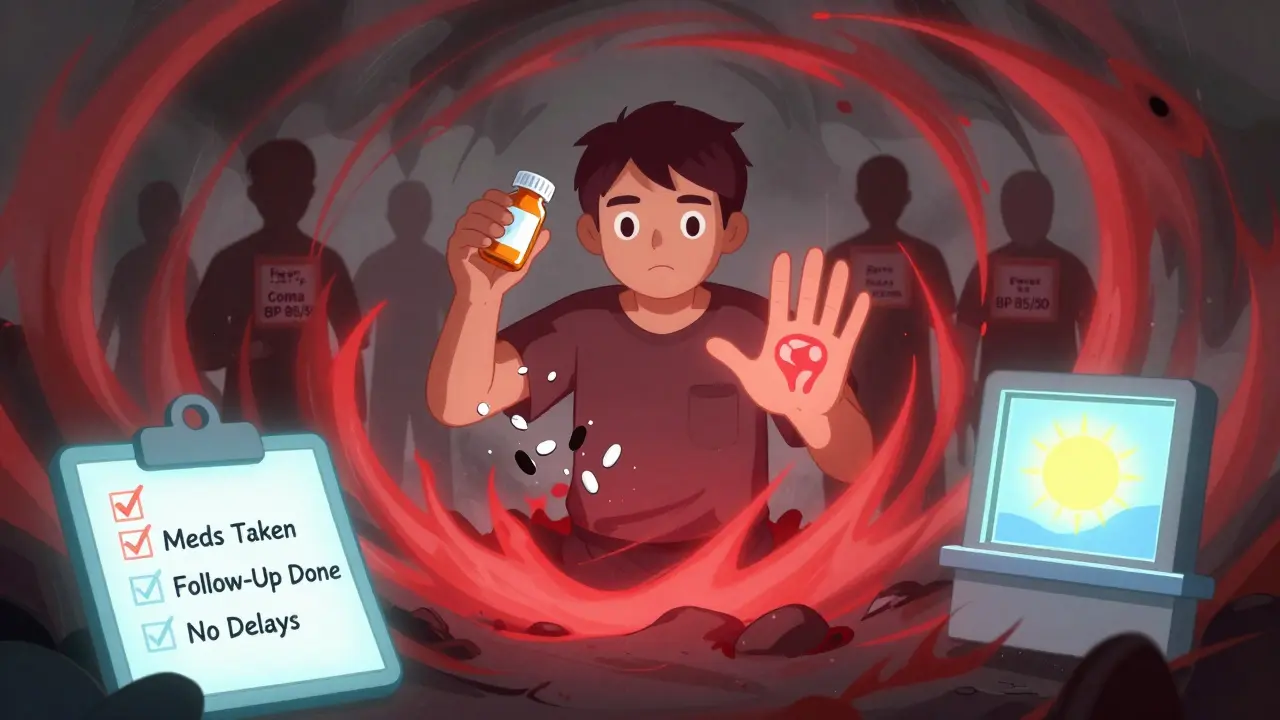
Even with modern care, thyroid storm kills 8-25% of patients. The odds get worse with delays. If treatment starts within 6 hours, survival jumps to 75-80%. Wait 24 hours? Survival drops to 20%. Age matters: elderly patients have higher death rates. Underlying heart disease doubles the risk of death. A systolic blood pressure below 90 mmHg means the heart is failing-50% mortality. A temperature above 105.8°F? That’s 40% mortality. Coma? 35% mortality. The Cleveland Clinic tracked 37 patients: 68% needed a breathing machine for an average of 5 days. 41% needed drugs to keep their blood pressure up. Average ICU stay? Nearly 8 days. Total hospital stay? Over two weeks.
What Happens After the Storm Passes
Survivors don’t go home with a clean slate. Most will need lifelong thyroid hormone replacement. Why? Because the only way to prevent another storm is to permanently disable the overactive thyroid-usually with radioactive iodine or surgery. About 85% of survivors end up hypothyroid after definitive treatment. Only 15% can stay on antithyroid meds long-term without relapse. Recovery isn’t instant. Mental confusion clears in 72 hours. Agitation fades in 24 to 48. Full cognitive recovery takes a week or two. But the real danger is recurrence. If patients skip follow-ups or stop their meds, recurrence rates jump from 2-3% to 25-30%. That’s why education matters. Programs like the American Association of Clinical Endocrinologists’ Thyroid Storm Awareness initiative have already cut delayed diagnoses by 18% since 2020.
Preventing the Next Crisis
The best treatment for thyroid storm is avoiding it. Anyone diagnosed with hyperthyroidism needs regular blood tests and strict medication adherence. If you’re on antithyroid drugs, never skip a dose. If you get sick, see your doctor immediately-don’t wait. Tell every healthcare provider you have thyroid disease before any surgery or procedure. Pregnant women with Graves’ disease need close monitoring, especially after delivery. And if you ever feel your hyperthyroid symptoms are suddenly worsening-racing heart, fever, confusion-go to the ER. Don’t wait. Don’t assume it’s just the flu. Thyroid storm doesn’t ask for permission. It strikes fast. And it kills fast. But it can be stopped-if you know the signs and act fast.


Man, this post hit different. I’ve seen a cousin go through something like this in Lagos - no one knew what was happening until he collapsed. We thought it was malaria. If this had been shared in our community earlier, maybe things would’ve been different. Thanks for laying it out so clear.
God bless the docs who catch this stuff in time.
Thank you for this meticulously researched and clinically accurate breakdown. As a nurse practitioner specializing in endocrine disorders, I’ve managed three thyroid storm cases in the last five years - each one a race against time. The emphasis on early intervention is critical: every minute counts. I particularly appreciate the inclusion of the Burch-Wartofsky scoring system and the note about avoiding NSAIDs. These are details that save lives in the ED.
Also, kudos for highlighting the post-storm management and lifelong monitoring. Too many patients are discharged without adequate education on recurrence risks.
LMAO 😂 so basically if you’re not a medical genius, you’re just gonna die? Cool. So let me get this straight - if your thyroid is acting up and you sneeze wrong, you’re toast? 🤡
Also, why is everyone so calm about radioactive iodine? That’s basically nuclear therapy for your neck. I’d rather just eat more kale.
Also also - who wrote this? It reads like a textbook that got drunk and started ranting at 3am.
bro this is wild. i had a friend with thyroid issues and he just got super tired and lost weight. thought he was doing a keto diet. turns out he was like… dying? 😳
why is this not on tiktok? everyone needs to know this. also why so many big words? i’m not a doctor lol
This is such a powerful reminder that health isn’t just about pills and appointments - it’s about awareness, community, and speaking up. I’ve seen so many women in India ignore symptoms because they’re ‘just tired’ or ‘stressed.’ This post could literally save lives if it reaches the right people.
Keep sharing this. Let’s turn knowledge into action. You’re doing amazing work ❤️
Real talk - I’ve been on methimazole for 4 years. I never knew thyroid storm could be triggered by something as simple as a tooth extraction. That’s wild. I’m gonna tell my dentist next time I go. Also, the part about beta-blockers being used before test results? That’s smart. Doctors in my city wait forever for labs. This changes how I talk to them now.
Thanks for the clarity. No fluff. Just facts.
damn. i thought hyperthyroidism was just being jumpy and losing weight. didn’t know it could turn into like… a full body meltdown. also why is everyone so chill about the iodine thing? that sounds like a horror movie plot.
anyways, thanks for not making it sound like a textbook. real talk > medical jargon.
My aunt had this. She was fine one day, then in the ICU the next. No one knew what was happening until the ER doc saw her T3 levels. We were lucky. But honestly? I didn’t even know thyroid storm was a thing until now. This should be mandatory reading for anyone with autoimmune issues.
Also - thank you for mentioning pregnancy. So many women get dismissed after birth because ‘it’s just hormones.’ It’s not.
OMG THIS IS THE MOST IMPORTANT THING I’VE READ THIS YEAR. IF YOU HAVE THYROID ISSUES AND YOU SKIP A DOSE YOU ARE A DEAD MAN WALKING. I’M NOT KIDDING. I SAW A GUY ON TV WHO DIED BECAUSE HE FORGOT HIS PILLS. THIS ISN’T A DRAMA. THIS IS REAL LIFE. SHARE THIS. NOW. BEFORE SOMEONE YOU LOVE DIES BECAUSE THEY THOUGHT IT WAS ‘JUST STRESS.’
Excellent summary. I’d add one thing: the role of thyroid antibody titers in predicting storm risk. In patients with Graves’ disease, rising TRAb levels over time correlate with increased storm vulnerability - even before TSH drops. Monitoring those can help preempt crises.
Also, the mention of IL-6 inhibitors is promising. I’ve seen case reports where tocilizumab stabilized patients when steroids failed. Worth a footnote for future research.
The clinical details are accurate, but the tone is unnecessarily alarmist. While thyroid storm is serious, the framing risks inducing unnecessary panic among patients with well-managed hyperthyroidism. A more measured approach would better serve public health communication.
Additionally, the statistic on recurrence rates without follow-up lacks citation. This undermines credibility.
Wow. So basically, if you’re not a doctor, you’re just supposed to Google ‘fever + heart rate + confusion’ and hope you’re not dying? 😅
On a real note - this is terrifying, but also kind of beautiful how medicine can flip a death sentence into survival if you catch it fast. I’ve got a buddy on methimazole. I’m sending him this. He’s gonna cry. And then he’s gonna take his meds.
USA RULES. WE FIX THIS SHIT. NOBODY DIES FROM THYROID STORM IN AMERICA. WE GOT THE BEST DOCTORS, THE BEST DRUGS, THE BEST HOSPITALS. IF YOU’RE FROM A COUNTRY WHERE PEOPLE DON’T KNOW THIS, THAT’S ON THEM. WE’RE THE ONES WHO MADE THIS MEDICINE. #AMERICA #MEDICALSUPREMACY 💪🇺🇸