
 4
Jan,2026
4
Jan,2026
When you or a loved one is taking a generic drug, knowing exactly what you’re taking matters. Generic medications save money-nearly 78% of all prescriptions filled in the U.S. are generics-but they’re not always simple to understand. Same active ingredient? Maybe. Same effect? Usually. But sometimes, small differences in how the body absorbs the drug can make a real difference, especially with drugs like levothyroxine or warfarin. That’s why having trustworthy, up-to-date information isn’t just helpful-it’s essential.
What Makes a Drug Resource Reliable?
Not all websites giving drug info are created equal. Some are run by pharmacies, some by companies trying to sell you something, and some by people with no medical training. Reliable sources come from places that answer to the law, not profit. The best ones are backed by the U.S. government, academic institutions, or professional medical groups that update their data daily and cite official sources.Look for these signs:
- Updated within days of FDA changes
- Uses official FDA-approved labeling
- Clear about what’s proven vs. what’s anecdotal
- No ads pushing specific brands
- Free to use without signing up
These aren’t just nice-to-haves-they’re the bare minimum for safety.
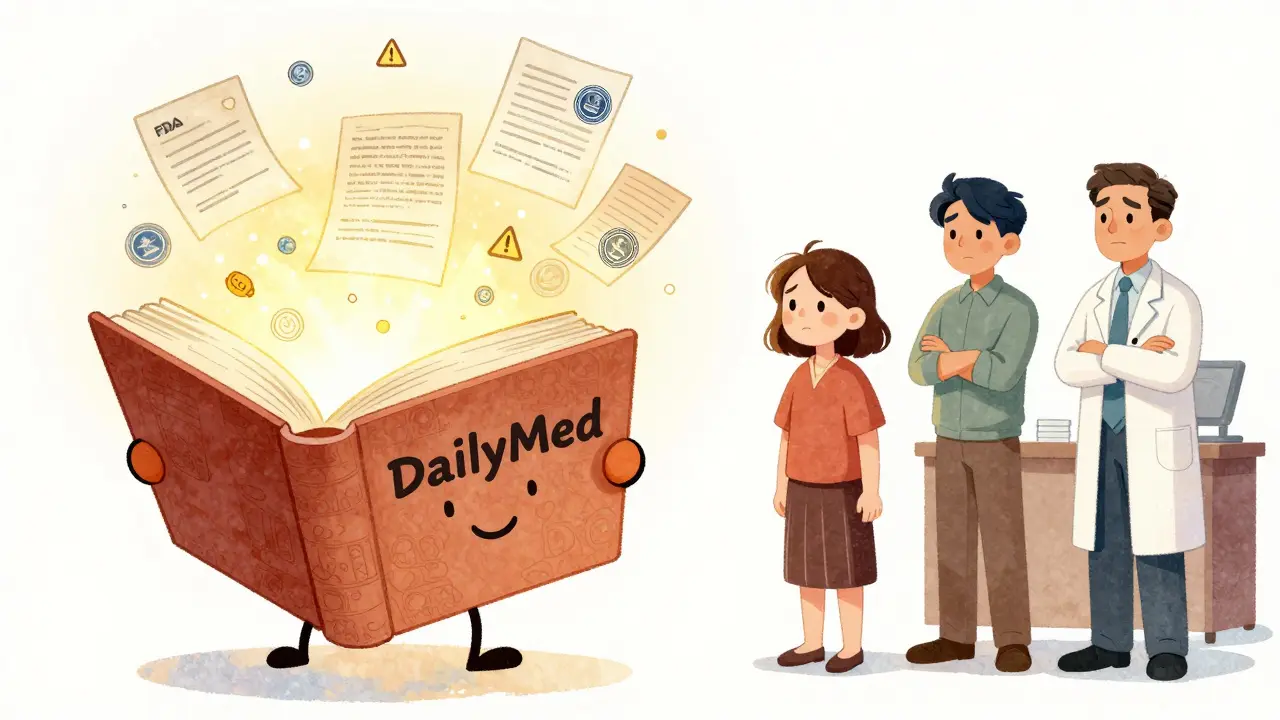
DailyMed: The Official FDA Drug Labeling Source
If you need the exact wording the FDA approved for a drug-down to the warnings, dosing instructions, and storage requirements-DailyMed is your only source. Run by the National Library of Medicine (NLM), it’s the official database for all prescription and over-the-counter drug labels in the U.S.As of October 2023, DailyMed had over 92,000 drug entries, including every generic version approved by the FDA. It’s updated within 72 hours of any label change, and 98.7% of updates are posted in that window. That’s faster than most hospitals can update their internal systems.
Here’s why pharmacists and doctors rely on it: if there’s a safety alert-say, a new warning about kidney risks with a common generic blood pressure pill-DailyMed will have it first. It’s the only place that carries the full, legally binding label. No summaries. No interpretations. Just the raw, official text.
But here’s the catch: it’s not built for patients. The language is dense, full of medical terms like “bioavailability” and “pharmacokinetics.” If you’re just trying to figure out if you can take your generic metformin with coffee, DailyMed will overwhelm you. But if you’re a caregiver, pharmacist, or someone who needs to verify a change in their prescription, it’s the gold standard.
MedlinePlus: The Patient-Friendly Guide
If DailyMed is the legal document, MedlinePlus is the friendly neighbor who explains it in plain English. Also run by the National Library of Medicine, MedlinePlus turns complex drug info into something a 6th or 7th grader can understand. It covers over 17,500 drugs, herbs, and supplements.Each monograph includes:
- What the drug is used for
- Common side effects (in simple terms)
- What to avoid while taking it
- How to store it safely
- What to do if you miss a dose
It’s available in both English and Spanish, and updates 15-20 times a day. Over 450,000 healthcare providers use it monthly to explain meds to patients. And according to a 2023 NIH usability study, 94% of patients found what they needed without help.
It doesn’t have every obscure generic-some specialty drugs are missing-but for common meds like insulin, statins, or antibiotics, it’s the best place to start. Patients give it a 4.7 out of 5 stars on Google reviews, mostly because it answers the questions they actually care about.
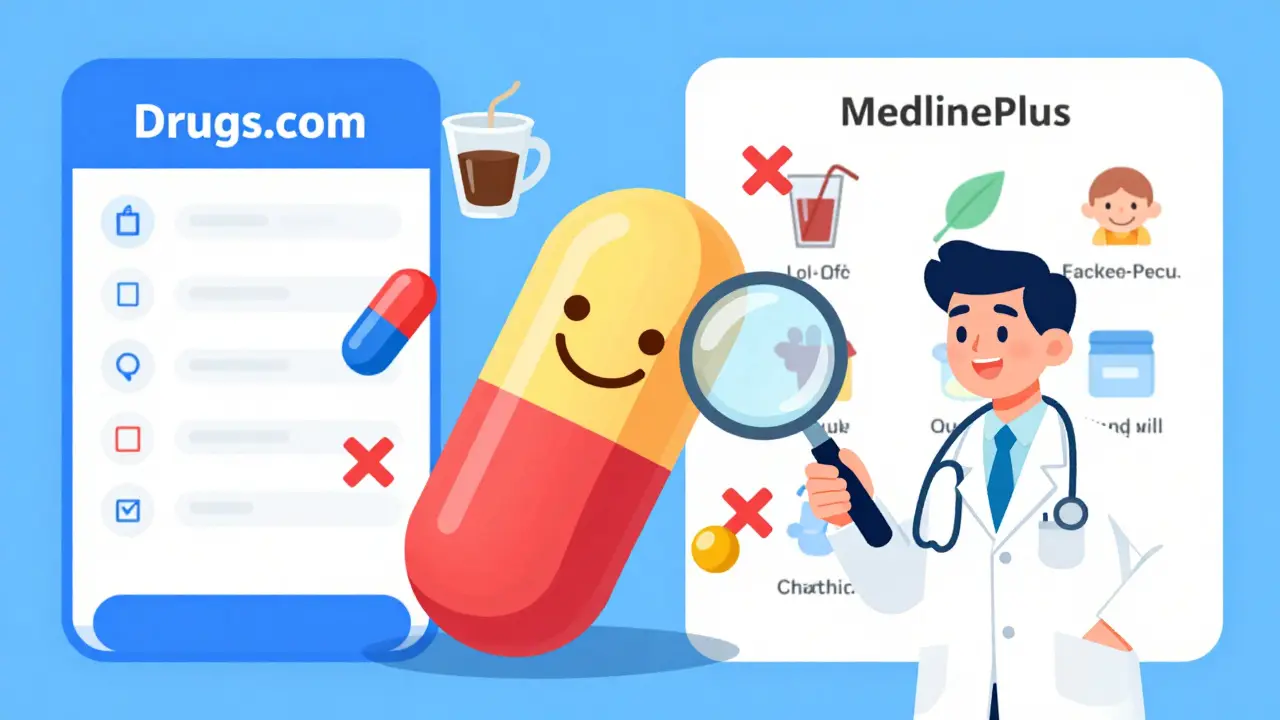
Drugs.com: The Quick-Check Tool for Everyday Use
Drugs.com is the app you open when you’re in a hurry. Founded by a pharmacist in 1999, it’s now one of the most visited drug info sites in the world, handling 12 million searches a day.What makes it useful:
- Its pill identifier tool can match a pill by color, shape, or imprint-9 out of 10 times, it gets it right.
- The drug interaction checker caught 92.4% of serious interactions in a Johns Hopkins study.
- It shows both brand and generic names side by side.
- The mobile app works offline and has a one-tap lookup.
It pulls data from FDA labels, AHFS Drug Information, and Micromedex, so it’s accurate. But it’s also ad-supported. You’ll see ads for supplements, pharmacies, or even weight loss products. Some users say it feels cluttered. Still, for a quick check-“Can I take this with my blood thinner?”-it’s hard to beat.
Healthcare professionals rate it 4.3 out of 5. Nurses and pharmacy techs use it daily. It’s not for legal compliance, but it’s perfect for real-time decisions.
The Orange Book: Therapeutic Equivalence Made Clear
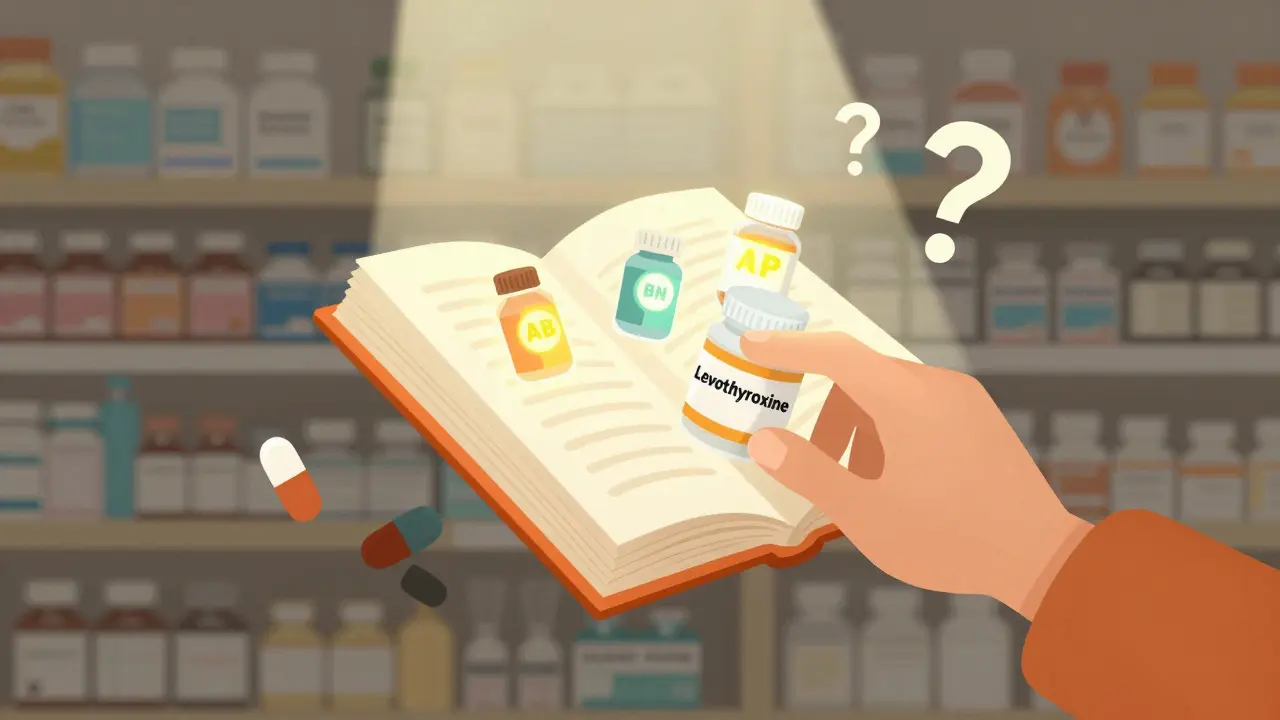
This one’s less known but critical if you’re switching between generic brands. The Orange Book, officially called “Approved Drug Products with Therapeutic Equivalence Evaluations,” tells you which generics are interchangeable with the brand name.It uses ratings like:
- AB = Therapeutically equivalent (safe to swap)
- BN = Not rated (not enough data)
- AP = Approved but not rated for substitution
As of November 2023, it listed over 20,000 generic products. For drugs with a narrow therapeutic index-like thyroid meds, seizure drugs, or blood thinners-this matters a lot. A change in how the body absorbs even 5% more of the drug can cause serious side effects.
The Orange Book doesn’t explain why a drug is rated a certain way. But it tells you whether your pharmacy can legally substitute one generic for another. If you’re told your new prescription is “the same” but you’re feeling off, check the Orange Book. You might be getting a different version than before.
How Professionals Use These Tools Together
No one uses just one. In hospitals, pharmacists use DailyMed to verify labeling, MedlinePlus to explain things to patients, Drugs.com for quick checks, and Lexicomp (a paid tool) for complex cases.Community pharmacists-who fill most prescriptions-rely more on free tools. A 2022 survey found:
- 84% use DailyMed
- 61% use MedlinePlus
- 57% use Drugs.com
Doctors use Epocrates or Lexicomp for fast answers during rounds, but they still check DailyMed when something seems off. And patients? They’re using MedlinePlus and Drugs.com more than ever.
The key? Use the right tool for the job:
- Need to know the legal label? → DailyMed
- Need to explain it to a child or elderly parent? → MedlinePlus
- Need to check if your meds clash? → Drugs.com
- Worried your generic isn’t working like before? → Orange Book
What to Avoid
Stay away from:- Random blogs or forums (like Reddit or Quora) as your main source
- Pharmacy websites pushing their own brand
- Any site asking for payment to see basic drug info
- Apps that don’t say where their data comes from
Some sites look official but are just repackaging ads. If you can’t find a clear link to the FDA, NIH, or a major medical school, walk away.
What’s Changing in 2026
The government is making these tools better. In late 2024, MedlinePlus will roll out multilingual safety alerts in 15 languages. DailyMed’s API is now connected to most electronic health records, so your doctor’s system might automatically pull the latest label.But here’s the big takeaway: free, reliable tools are more important than ever. With over 3.8 billion generic prescriptions filled each year, mistakes cost lives. And the people who can’t afford paid apps or hospital databases? They’re counting on these free resources to keep them safe.
Don’t wait for a bad reaction to learn where to look. Bookmark these now. Print out the MedlinePlus page for your main meds. Show your family how to use the pill identifier. Knowledge isn’t just power-it’s protection.
Are all generic drugs the same as the brand name?
Most are. The FDA requires generics to have the same active ingredient, strength, and route of administration as the brand. But they can differ in inactive ingredients like fillers or dyes, which rarely affect how the drug works. For drugs with a narrow therapeutic index-like levothyroxine, warfarin, or seizure meds-even small differences in absorption can matter. Always check the Orange Book to see if your generic is rated AB (therapeutically equivalent).
Can I trust Drugs.com for serious drug interactions?
Yes, for most cases. Drugs.com’s interaction checker is backed by AHFS DI and FDA data, and a Johns Hopkins study found it caught 92.4% of serious interactions. It’s not perfect-some rare or complex interactions may be missed-but it’s one of the best free tools available. For high-risk patients or complex regimens, always cross-check with a pharmacist or use DailyMed for the official label.
Why does my pharmacy give me a different generic each time?
Pharmacies often switch generics to save money. As long as the drug is rated AB in the Orange Book, it’s considered interchangeable. But if you notice side effects or changes in how you feel after a switch, it could be due to different inactive ingredients. Ask your pharmacist which manufacturer made your last refill and keep a record. You can also ask to stick with one brand if you’re sensitive to changes.
Is MedlinePlus only for U.S. residents?
No. MedlinePlus is free and available to anyone worldwide. Its content is based on U.S. FDA standards, but the explanations are clear enough for international users. If you’re outside the U.S., check your country’s health authority site for local guidelines, but MedlinePlus remains one of the most accurate and easy-to-understand sources globally.
Do I need to pay for better drug info?
Not for basic, reliable info. DailyMed, MedlinePlus, and the Orange Book are all free and government-run. Paid services like Lexicomp or Clinical Pharmacology offer advanced features like real-time alerts, pharmacogenomics, and integration with hospital systems-but these are mainly for clinicians in hospitals or large clinics. For patients and caregivers, the free tools are more than enough if used correctly.
Next Steps: What to Do Today
1. Find your most important generic drug-maybe your blood pressure pill, thyroid med, or diabetes drug. 2. Go to MedlinePlus and search for it. Read the “Side Effects” and “What to Avoid” sections out loud to someone you live with. 3. Check the Orange Book (search “FDA Orange Book”) and look up your drug. Note its rating-AB means you can swap safely. 4. Save the link to MedlinePlus and DailyMed on your phone or computer. Add them to your browser bookmarks. 5. Teach one person-a parent, sibling, or friend-how to use these tools. One extra person who knows where to look could prevent a mistake.Medications are powerful. Knowing where to find the truth about them is one of the smartest things you can do for your health-and the health of everyone you care about.

Just bookmarked MedlinePlus. Been using Drugs.com for years but never knew about DailyMed. This is the kind of info I wish my pharmacist had handed me when I switched to generic levothyroxine and felt like a zombie for three weeks.
Wow, so the Orange Book is basically the FDA’s Yelp for generics? I always thought ‘AB rating’ was just corporate jargon. Turns out it’s the only thing standing between me and a thyroid meltdown. Thanks for not making this sound like a pharmaceutical ad.
I’ve been telling my mom to stop trusting WebMD for years. She’d read some blog about ‘natural alternatives’ to her blood thinner and panic. Now I just send her the MedlinePlus link. She actually reads it. Shocking, I know.
This is the kind of post that makes me believe the internet isn’t entirely doomed. Someone actually took the time to explain how to navigate the minefield of generic meds without selling snake oil or pretending they’re a doctor. The Orange Book breakdown? Chef’s kiss. I’m printing this out and taping it to my medicine cabinet.
I live in Nigeria and my sister takes warfarin. We don’t have access to these resources here, but I printed the MedlinePlus page and sent it to her. She doesn’t speak English well, but the pictures and simple language helped. Thank you for making this global.
Of course the government’s free tools are the best. Meanwhile, people pay $30/month for apps that just repackage DailyMed with pop-ups and a fancy UI. I swear, capitalism turns everything into a subscription model-even life-saving information. The fact that we need to be this vigilant just to not die from a pill change is a national disgrace.
Y’all don’t get it. This isn’t about drug info. This is about control. Who gets to decide what ‘safe’ means? The FDA? The pharmacists? The CEOs of Big Pharma who profit off the confusion? I’ve seen people switch generics and have seizures. And nobody talks about it. Because if we admit that generics aren’t all equal, we admit the whole system is a lie. 😔
Let’s step back from the clinical details for a moment and examine the epistemological framework here. We’re told to trust ‘official’ sources-DailyMed, MedlinePlus, the Orange Book-as if authority alone confers truth. But what if the FDA’s definition of ‘therapeutic equivalence’ is itself a social construct? What if ‘bioavailability’ is measured in lab conditions that bear no resemblance to human life-stress, diet, gut microbiome, sleep deprivation? We treat these databases as gospel, yet we ignore the fact that a 5% absorption difference might mean the difference between stability and crisis… and that difference is invisible to the algorithm. We’re not just managing medication-we’re negotiating with a system that reduces human biology to a spreadsheet. And yet, paradoxically, these are the only tools we have. So we use them. Not because they’re perfect, but because the alternative is surrendering to ignorance. And that, my friends, is the real tragedy.
Just checked my levothyroxine on Drugs.com. AB rating. Phew. 😌 But also… why does the pill look different every time? Is that normal? Or am I just paranoid? 🤔
They say ‘free reliable tools’-but what if those tools are funded by the same agencies that approve the drugs? It’s like trusting the fox to guard the henhouse. Who audits the auditors? Who checks if DailyMed’s updates are truly timely, or just… delayed enough to avoid lawsuits? I’ve seen cases where safety alerts took 14 days to appear. And nobody talks about that.
Let me guess-this post was written by a pharmaceutical rep with a PR degree. DailyMed? MedlinePlus? The Orange Book? All government-run. And what do we know about government-run systems? Slow, bloated, and full of hidden agendas. Meanwhile, the real answer is: don’t take generics at all. Pay for the brand. Or better yet, don’t take pills. Eat turmeric. Walk barefoot. Your body knows better than the FDA.
OMG I JUST REALIZED I’VE BEEN GETTING DIFFERENT GENERIC WARBIN FOR 3 YEARS AND I THOUGHT I WAS JUST GETTING SICKER 😭 I’M GOING TO CALL MY PHARMACY RIGHT NOW AND ASK FOR THE ORANGE BOOK RATING. THANK YOU FOR THIS POST I FEEL LIKE I’M GONNA LIVE A LITTLE LONGER 💖
i am student from india and i was searching for info on generic metformin. medlineplus helped me a lot. but why no hindi version? i know many people who cant read english but need this info. plz make it multilingual!
It is with the utmost respect for public health infrastructure that I acknowledge the extraordinary diligence exhibited by the National Library of Medicine in maintaining these vital repositories of pharmacological truth. The commitment to transparency, accuracy, and accessibility in an era of rampant misinformation constitutes not merely a service, but a moral imperative. I commend the authors of this piece for elevating the discourse and empowering the populace with knowledge that is, quite frankly, non-negotiable for human dignity.
Thank you for this. My grandmother takes four different generics. I used to have to call the pharmacy every time she switched brands. Now I check the Orange Book before she even leaves the pharmacy. She doesn’t know it, but I’ve probably saved her from a fall-or worse. This isn’t just info. It’s a lifeline.